
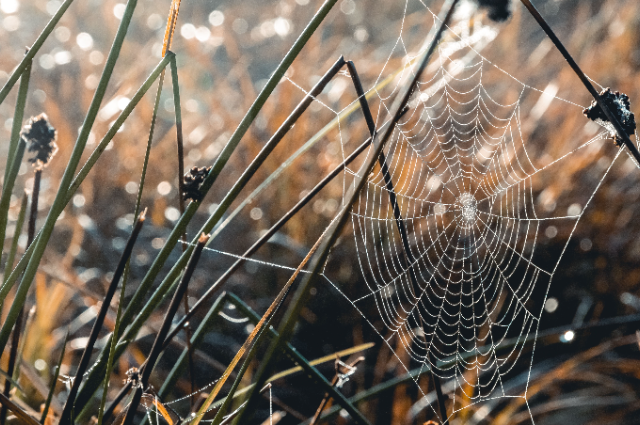
There is a spider in your house right now. You may not know where it is. It may be behind the curtain, under the bed, in the corner of the ceiling you stopped looking at after the last time. It is small. It is still. And it is, in all likelihood, quietly keeping your world in order.
We have never given spiders a fair trial. We sentence them on sight, a shriek, a shoe, a rolled-up newspaper and move on with our lives. But the data tells a different story. A rather humbling one.
A new study arrived at a stunning estimate of how much spiders eat every year: between 400 and 800 million tons of insects and other invertebrates. For comparison, all of humanity combined consumes about 400 million tons of meat and fish annually.  Read that again. The creatures you are trying to kill are, collectively, out-eating the entire human race.
A single spider eats approximately 2,000 insects per year. Multiply that across the at least 45,000 known spider species, with a total global biomass of around 25 million tons, and you have the most efficient, most distributed, most under-appreciated pest control operation on the planet, and it costs us nothing.
The targets of this operation are not random. Mosquitoes, flies, aphids, locusts, the insects that carry malaria, dengue, and typhoid, the ones that devastate harvests and spread disease- these are what fill a spider’s web. Most of what spiders eat are pests, emphasising the important role they play in keeping insects that transmit diseases or parasites in check.
Arachnophobia is one of the most common fears on earth. Some estimates suggest it affects up to one in three women and one in four men. We have screamed at creatures smaller than a coin. We have fumigated homes, bought sprays, called professionals. All to eliminate something that was, in its quiet eight-legged way, protecting us.
There is hardly any terrestrial area on earth where spiders are absent. They have been found in the Arctic, in the hottest deserts, at the highest altitudes of any living organism, in bogs, dunes, and almost every other habitat imaginable. They will go wherever there is food. And there is always food, because there are always insects.
Remove the spiders, and the insects stay. Without natural predators keeping populations down, crop destruction and disease transmission would climb. Pesticide use would need to scale dramatically to compensate — at enormous financial and environmental cost. The spider in your kitchen ceiling is doing a job. It just never thought to send an invoice.
The same venom that makes spiders frightening to us is now being studied as a source of medicines that do not yet exist. Researchers at the University of Queensland discovered a molecule called Hi1a in the venom of the K’gari funnel-web spider, the same species known for one of the most medically significant bites in Australia. Hi1a has shown the ability to reduce damage to the heart and brain during heart attacks and strokes by preventing cell death caused by lack of oxygen. The significance of this is difficult to overstate. Cardiovascular disease is the leading cause of death globally, yet there are currently no drugs on the market that prevent the damage caused by heart attacks.  Hi1a, if it clears human trials, could be the first.
Infensa Bioscience, a company co-founded by the researchers, raised $23 million in 2022 to develop Hi1a for commercial purposes. The funnel-web spider, long cast as a villain, may yet become the source of one of medicine’s most significant breakthroughs. And that is just one compound, from one species. Spider venom is being explored for chronic pain relief, stroke protection, blood clot prevention, and even cancer-targeting treatments, with several venom-based drugs now in or approaching clinical trials. Scientists believe they have barely scratched the surface of what spider venom chemistry contains.
There is a version of the natural world without spiders. In it, insect populations run unchecked. Harvests fail. Disease vectors multiply. Farmers spray chemicals on an accelerating treadmill. And the medicines that might have come from venom, the heart drugs, the painkillers, the stroke compounds, remain undiscovered, locked away in creatures we never gave the chance to help us. That world is not hypothetical. It is what we are inching toward every time we treat spiders as enemies rather than allies.
The spider has been on this earth for over 300 million years. It predates the dinosaurs. It survived every extinction that wiped out animals far larger and more fearsome than itself. It spread to every continent except Antarctica. It wove silk that engineers are still trying to replicate. It filled its webs with the insects that would otherwise fill our hospitals. And yet here we are, the most technologically advanced species in the planet’s history, still reaching for the shoe. Perhaps it is time to put it down.
Sources:
- Nyffeler & Birkhofer, The Science of Nature (2017) — global spider prey consumption statistics (400–800 million tons annually), sourced via Live Science, ZME Science, CNN, ScienceDaily, HowStuffWorks, and Smithsonian Magazine
- University of Queensland / Infensa Bioscience (2024) — Hi1a funnel-web spider venom research for heart attack and stroke treatment, sourced via Interesting Engineering, New Atlas, and ScienceDaily
- Science Times (2026) — venom-based drugs in clinical trials including pain relief, stroke protection, and cancer targeting
- Entomologist.net — per-spider annual insect consumption figure (approximately 2,000 insects per year)