
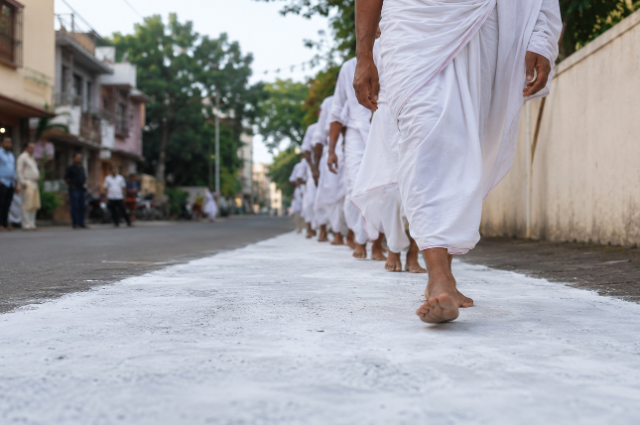
Sometime last week, a YouTuber in Mumbai looked at a white strip painted on his housing society’s ground and decided to call it “Jain Jihad.” The strip existed because Jain monks were visiting. The white chemical coating is traditionally applied ahead of Chaturmas, a four-month holy period, because Jain monks travel barefoot and adhere to Ahimsa, or non-violence. It protects their feet from hot asphalt, prevents injuries from monsoon algae, and ensures small organisms aren’t trampled underfoot. None of that made it into the video. The YouTuber posted it anyway; it went viral. Police showed up at his door, threats came in from the other direction, and the society eventually repainted the strip after resident discussions. The whole thing blew over in under a week. What remains worth examining isn’t the incident; it’s the pattern it fits into.
Jains represent just 0.37% of India’s total population, roughly 4.5 million people, making them the country’s smallest religious community, concentrated mostly in Maharashtra, Rajasthan, and Gujarat. And yet, in the past year alone, Jain monks have been at the centre of at least two nationally viral controversies. Before the Mumbai incident, a man in Uttarakhand filmed himself harassing two Digambar Jain monks, pestering them about why they walked without clothes, not knowing, or not caring, that for Digambar monks, renouncing clothing is central to their faith and has been for centuries. Police formed a Special Task Force and booked him under the IPC and the IT Act. A five-second search would have answered his question. He chose a camera instead. Both men were chasing the same thing: the performance of righteous confusion, aimed at a community too peaceful and too small to mount a coordinated counter-attack.
The phrase “Jain Jihad” isn’t a slip of the tongue. It’s a template. In Indian social media discourse, “jihad” has been detached from its meaning and turned into a suffix applied to anything a minority group does that someone finds inconvenient: Love Jihad, Land Jihad, Housing Jihad. The formula is simple: take an ordinary
action, append the word, and let the algorithm handle the rest. What makes Jains a particularly easy target within this formula is that their response to provocation is, almost by religious obligation, silence. A community built on non-violence, non-attachment, and non-interference doesn’t riot. It doesn’t trend in enough constituencies to make the controversy politically expensive. Its anger doesn’t translate into votes at scale. Online outrage merchants know this, even if only instinctively.
The infrastructure that makes this possible is worth naming. Hate speech incidents targeting religious minorities in India surged 74.4% between 2023 and 2024, with over 995 of those incidents first appearing on social media platforms before spreading. The platforms aren’t passive infrastructure; they reward exactly this kind of content: emotionally charged, visually simple, and designed to make the viewer feel like they’ve stumbled onto something being hidden from them. A strip of white paint becomes evidence of creeping influence. An elderly monk walking barefoot becomes a provocation. The smaller and quieter the community, the easier it is to make their ordinary existence seem sinister.
What actually happened in Mumbai is almost embarrassingly simple. An ancient religious tradition asked for a small accommodation. A housing society provided it. A man with a camera decided that was a story, reached for the most inflammatory framing available, and posted it. The society repainted the strip. The monks passed through. The controversy dissolved the moment people stopped performing outrage about it because there was never anything there to begin with. A question asked in good faith would have taken thirty seconds to answer. A viral video took a week to forget.
Sources:
- Free Press Journal
- LatestLY
- Republic World
- Deccan Herald
- One India News
- India Hate Lab / Centre for the Study of Organised Hate o Census of India 2011 / Ministry of Minority Affairs o Wikipedia — Jainism in India