
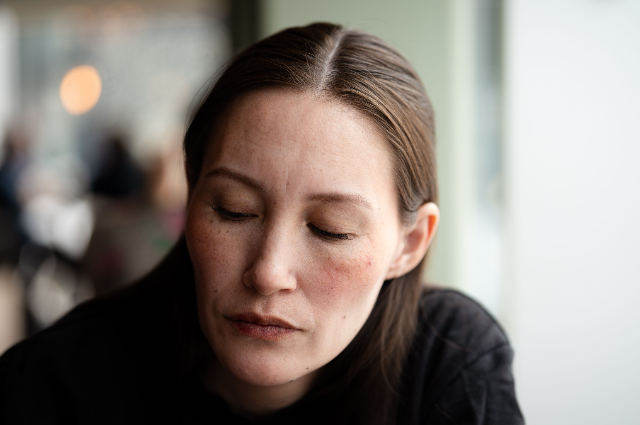
Déjà vu is basically a French word that means ‘already seen’, so the term déjà vu refers to the strange feeling that you have already experienced a moment that is actually happening for the first time. It usually lasts only a few seconds, but you can feel, surprisingly, that this moment has already happened.
There are different perspectives to interpret it: Science says it's a temporary mismatch in how the brain processes familiarity and memory. Philosophy says it's a reminder that our sense of reality and self is constructed by the mind that can occasionally "glitch”. Religion/Spirituality
says that it can be viewed as a soul memory, a past-life recollection or a spiritual sign. Psychology says that it involves the evidence that memory is not a perfect recording system but an active reconstruction of experience.
The statement "reality feels constructed" reflects a genuine scientific idea that your brain continuously builds your experience of the world from sensory information, memories, and expectations. However, déjà vu itself does not prove time travel, past lives, or simulated reality. But here is a catch.
Some misinterpretations people believe in and consider it Déjà vu -
In today's world, there are different types of people, and there are some people who believe in superstitions that sometimes even ignore science, but these superstitions are sometimes considered true as well, like :
Some people believed that 2025 was the worst year because history was repeating itself, or it was déjà vu because it had the same calendar as 1941, the bloodiest and the most tragic year, so people believed 2025 was exactly like that.
Some people also said that they felt they knew about COVID since the start because it was a déjà vu to them from the cartoons they saw when they were kids.
Some historical details about Déjà vu -
The Naming of Déjà Vu, 1876, was done by a French philosopher and psychologist, Émile Boirac, who introduced the term "déjà vu" ("already seen") after studying reports of the phenomenon.
Déjà vu is linked to Epilepsy because doctors discovered that some patients with Temporal Lobe Epilepsy experience intense déjà vu immediately before seizures. This was one of the first clues that the phenomenon of Déjà vu originates in memory-related brain systems.
Scientists Artificially Triggered Déjà Vu, like the Neurosurgeons performing brain stimulation during epilepsy treatment, found that stimulating parts of the temporal lobe could produce powerful déjà vu sensations. Patients reported feeling that the current moment had happened before even though they knew it hadn't.
The Brown University Experiment also stated that psychologists created situations where participants encountered scenes that subconsciously resembled earlier scenes. Many reported a strong sense of familiarity despite being unable to identify why, supporting the theory that forgotten memories can trigger déjà vu.
Military and Aviation Reports say that pilots and soldiers have occasionally reported intense déjà vu during high-stress situations. Researchers believe stress and rapid information processing may sometimes contribute to the sensation.
Fascinating Historical Accounts
Carl Jung and the "Already Lived" Experience - Jung described moments that felt uncannily familiar and interpreted them as meaningful psychological events rather than simple memory errors.
Sigmund Freud's View - Freud suggested that déjà vu could emerge from unconscious memories and desires that become briefly accessible to awareness.
What Scientists Think Today - The leading theory today is called the dual-processing explanation: A new event occurs, the brain's "familiarity" system accidentally activates, and the memory-retrieval system finds no actual memory. This mismatch creates the sensation of "I've lived this before."
In other words, déjà vu may be one of the few moments when you become aware of the brain's normally invisible process of constructing reality from perception and memory. That's why it feels so realistic for a second or two that when you notice the machinery of consciousness, the experience can seem almost supernatural even though it likely originates within the brain.
References:
- Britannica
- Encyclopaedia
- A few shorts and videos on Instagram and YouTube