
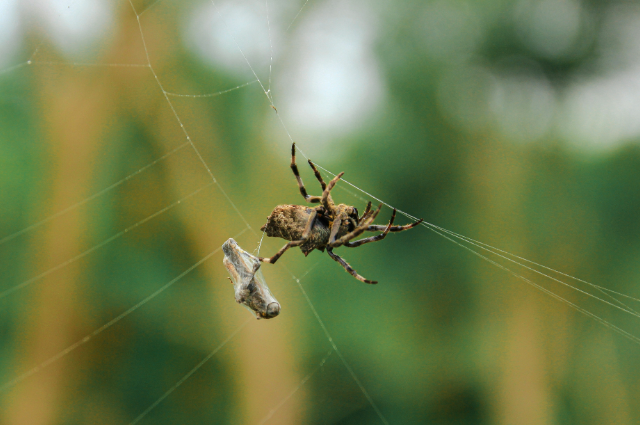
When Peter Parker gained spider powers, he became a hero and was widely known as Spiderman, but when an actual spider appears on your wall, you might scream. But the spiders crawling in your house every day are quietly doing everything in their power to save your life without you knowing about it. They feed on harmful insects, help maintain the environment and could eventually be used to make medicine that saves your life, but you will kill a spider without any hesitation. That is the irony: what we fear is what we absolutely need.
Remove spiders from an ecosystem, and it will collapse. Without them controlling insect populations, herbivorous insects will explode. Grasshoppers and beetles overwhelm plants. Crops will fail. Wild vegetation will wither. Food chains dependent on plants will starve. Spiders are invisible regulators maintaining the ecological balance. They are the reason why gardens don't overrun with plant lice, greenflies, blackflies, and ant cows. But spiders aren't just pest controllers; they are also food for other animals of the food chain. Birds, reptiles and small mammals rely on them. Some parasitic wasps lay eggs in spiders. Remove them, and you don't just lose pest control, you lose a crucial protein source for predators throughout the ecosystem. Nearly every ecosystem on Earth depends on spiders as a foundational species.
Spiders might as well save your life through medicine. Spider venom represents millions of years of evolutionary refinement, with the chemical compounds that precisely target nerve and muscle cells. Researchers are now beginning to realise the actual potential of spider venom. Some of the uses are pain management, stroke recovery, Heart disease, etc.
These discoveries are quite minor in the field of medicine because every undiscovered species represents lost medical knowledge that we will never be able to gain.
But Arachnophobia, that is, intense fear of spiders, affects 3 to 15 per cent of people, making it one of the most common specific phobias. But the reality is that spiders do not actually affect people because they are harmless. Maybe some regions have very dangerous species of spiders, but the percentage of those is quite low, and you cannot possibly be severely harmed by spiders.
Most spiders are shy. They avoid humans and bite only if trapped or threatened. Even medically significant bites from the most dangerous spiders, the Sydney funnel- Web or Brazilian wandering spiders, are treatable with modern medicine. Deaths are very rare.
Meanwhile, the spider in your kitchen has probably killed a dozen mosquitoes in a week alone. We have built a cultural narrative around spiders as threats in movies and stories we tell to children. This narrative doesn't actually match the reality. The reality is that spiders are one of the most beneficial creatures in your home. They eat pests silently, ask for nothing, damage nothing, and show no interest in you. They simply work in the food chain. They are also potential sources of medical breakthroughs because every studied species only adds to the tools of human medicine. And the fact is that nearly every ecosystem depends on spiders.
So, the next time you see a spider, you have options. You can kill it, feeding cultural narratives about spider danger. Or you can let it live, allowing it to hunt pests 24/7 for free in your homes. If you're uncomfortable indoors, just catch it gently in a cup and release it outside. It will be equally helpful in your garden. Either way, you're making a conscious choice to coexist with something that is far more beneficial than dangerous.
Spiderman is a fictional character considered a hero, and to be precise, this fictional character has been made into a significant hero of daily life, known as Spiderman. They are the silent heroes who protect the whole world when we are not even paying attention, so let's not make these tiny creatures the villains and not take away their lives because every life on this planet is precious.
References -
- Wikipedia
- Britannica
- National Geographic