
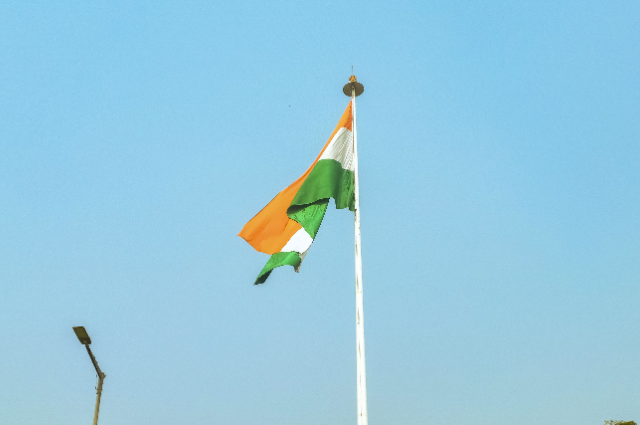
India's national anthem, Jana Gana Mana, is more than a patriotic song. It incorporates various regions of India and gives a sneak peek into the historical imagination of the country. Composed by Rabindranath Tagore and first sung at the Calcutta session of the Indian National Congress on December 27, 1911, this song describes various regions such as Punjab, Sindhu, Gujarat, Maratha, Dravida, Utkala and Banga and also includes the Vindhya and Himalaya ranges and the rivers Yamuna and Ganga. There are a lot of regions which are recognisable on today’s political map of India that are missing in the song. These include Rajasthan, Kashmir and the Northeast. One of the prime reasons for omitting the names of these regions could be the conditions during which the song was composed. The other reason could be the difference in geographical identity and political boundaries.
A song written before modern India took shape
When Tagore wrote Jana Gana Mana in 1911, the Indian subcontinent was under British colonial rule but was not politically unified. British India was made up of directly governed provinces and some princely states, where British paramountcy was held by a local ruler. Thus, the political situation was dramatically different from what it is today.
The regions mentioned in the anthem are more cultural and geographical than political. Today’s Punjab, Gujarat and Bengal were easily identifiable cultural regions. Dravida encompasses the southern region of the subcontinent, and Utkala alludes to the region of present-day Odisha, while Maratha is a cultural region of the subcontinent encompassing people of the Marathi language. Thus, the verse should not be seen as an account of the provinces of India in 1911. Also, just because a particular region is not mentioned in the anthem doesn’t mean that Tagore did not see that region as part of India.
Why is Rajasthan absent from the anthem?
Why the regions of the subcontinent are not listed in the anthem can best be illustrated by looking at Rajasthan. Before independence, the region was known as Rajputana. Amongst other princely states, it comprised the states of Jaipur, Jodhpur, Bikaner and Udaipur. Unlike the British-administered provinces, the states of Rajputana were under the rule of local rulers under British paramountcy.
As outlined by the Rajasthan Legislative Assembly, the unification of Rajputana after independence happened in stages. The formation of Greater Rajasthan happened on 30 March 1949, and the current state of Rajasthan was formed on 1 November 1956. Therefore, the state of Rajasthan existed at the time that Tagore wrote the anthem, but as a unified administrative entity, it was formed decades later. Absence can be understood historically. Tagore wrote the anthem at a time when the regions that make up Rajasthan were not unified as a state. The same broad principle applies to other regions. The anthem should not be assessed to see whether the regional references are in accordance with the newly formed states of India after independence.
What about Kashmir and the Northeast?
Not mentioning Kashmir and the communities of the Northeast in the opening stanza does not prove that Tagore excluded them from his concept of India. Although they are not mentioned in the opening stanza, exclusion cannot be proved just with their absence.
The verse makes judicious use of geography and culture. It refers to mountain ranges, rivers, and coastlines and to broad cultural and historical regions, and so is able to suggest a landscape that sprawls over much of the subcontinent while not needing to name every single region. The Himalayas, for example, represent a large geographical region without the need to enumerate all of the northern regions. The Dravida reference alludes to a broad cultural and geographical region of the south without the need to mention all of the south’s states.
Historical context, however, should not be used to dismiss contemporary concerns of representation. National symbols may be imbued with different meanings, including by different communities, from those intended by their creators. There is nothing wrong with asking how one’s identity has been represented in the national symbols of the country. The issue is to recognise such concerns as legitimate, and not to look for proof in the lack of a name. The historical record would support the former, and not the latter.
What about Sindh: why is a region in Pakistan mentioned in our national anthem?
The case Sanjeev Bhatnagar v. Union of India, 2005, reached the Supreme Court of India based on the petitioner’s request to delete the word Sindh from the National Anthem, because Sindh has no territorial association with the country of India. The Union of India responded to the petition stating that since the territory of India has changed from time to time, any amendments to the National Anthem will lead to the distortion of a literary work and may cause unwarranted controversies.
The Court dismissed the petition, stating that a National Anthem is an expression of patriotism and does not require the depiction of an up-to-date geographical description of the country. The Court also noted the term ‘Sindh’ holds more meaning than a description of a geographical region, including the Sindhi community, their cultural heritage, and the Indus River and Indus Valley Civilisation.
Controversy continued, and in 2011 retired professor Shreekanth Malushte approached the Bombay High Court to change “Sindh” to “Sindhu” in the national song. He stated that the Government of India changed the text of the anthem in 1950, and the text being sung now is wrong. There was another controversy in Maharashtra in 2013 when textbooks published “Sindhu” in the anthem, which resulted in further legal action. In 2014, the Maharashtra Government in the Bombay High Court stated that a 1953 circular of the Central Government used “Sindhu.” The entire controversy is not just about the status of Sindh, but about the official wordings and pronunciations as well.
However, it is essential to distinguish between the issues. The 2005 verdict of the Supreme Court is about the demand to remove “Sindh” from the National Anthem. The later Bombay High Court cases are about the use of “Sindhu” in textbooks and the question of officially prescribed wordings, and should not be seen as one and the same.
Sindh and Belonging after Partition
Beyond the legal arguments, referring to Sindh has a cultural significance for members of the Sindhi community. With Partition, thousands of Sindhis were forcibly displaced, and a large number of them migrated to independent India, thereby leaving their ancestral homeland. Unlike other communities, Sindhis in India lost their main homeland as a consequence of the new international border.
Keeping Sindh in the National Anthem shows that the government recognizes the identity of a community that transcends political boundaries and that it understands the community’s attachment to their historical and cultural land. This, however, does not mean that all Sindhis share the same opinion on the issue.
The presence of Sindh in the National Anthem is comparable to the presence of Rajasthan. The absence of Rajasthan is because its constituent states had not been unified at the time. Sindh’s presence is because of the cultural and historical context of a composition that precedes Partition. Like the anthem, both the composition and Partition demonstrate the reasons why the borders of present-day India are not the only boundaries that can be described by the Indian National Anthem.
Why the original composition remains unchanged
Jana Gana Mana was officially adopted as India’s national anthem on January 24, 1950, when Constituent Assembly President Dr Rajendra Prasad announced the decision. The first stanza of Tagore’s longer five-stanza composition became the full version of the national anthem.
The decision not to change the original composition reflects the view that national symbols, to an extent, retain their meaning with their historical continuity. If the anthem is changed every time a state is created, renamed, or reorganised, the wording of the anthem would be historically tied to the successive changes in administrative arrangements.
It doesn’t mean that symbols of the nation shouldn’t be able to generate critique. The legal cases involving the word Sindh and Sindhu demonstrate that the question of history, language and identity continues to influence the interpretation of the national anthem. Nevertheless, in 2005 the Supreme Court ruled that altering the text of the national anthem is not required by adjusting its boundaries. The official account continues to state it in the same way.
In the end, the omission of Rajasthan, Kashmir and the Northeast and the continuous mention of Sindh reflects the difference between a National Anthem and a Political Map. When Tagore composed the national anthem, he did it in a particular historical period, but it was adopted by an independent India which extended beyond the colonial boundaries and the political situation of 1911. The question it leaves behind is not about which territories it names, but rather how a historical composition continues to be the representation of a nation which is completely different from the time it was written.
References:
- The New Indian Express- https://www.newindianexpress.com
- The Indian Express - https://indianexpress.com
- Times of India- https://timesofindia.indiatimes.com
- Indian Kanoon- https://indiankanoon.org/doc/724972/?