
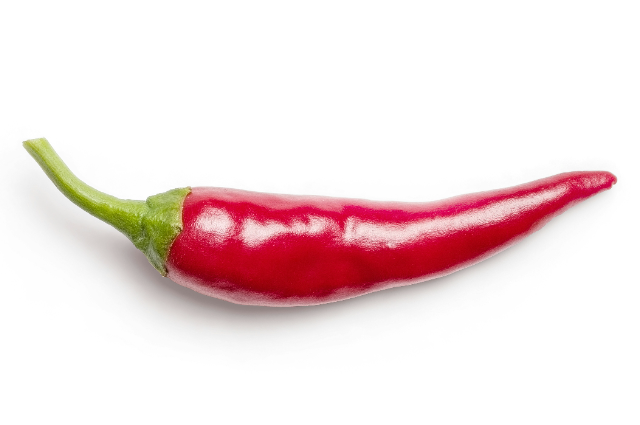
Crunch up a hot chilli. Your tongue is burning. Your eyes are tearing. You have a runny nose. Your brain rings a bell. But somehow, millions of people around the world answer, “This is delicious.”
Why? And the answer is a strange biological paradox: spicy food is not really a taste. There are five tastes: sweet, bitter, salty, sour, and umami. Spice is a whole other thing. It hurts.
The culprit is capsaicin, the chemical compound in chillies. Capsaicin doesn’t stimulate taste buds, but rather binds to TRPV1 receptors, the receptors that sense dangerous heat. A mouthful of chilli is not food for your nervous system. That is a bad sign. A biological emergency of sorts.
Your brain can't tell the difference between a chili pepper and a hot stove. Both give the same message: Something's burning. But eating chilli always feels good, unlike touching a stove. This contradiction has intrigued scientists, psychologists, and food lovers for decades. There is a biochemical explanation. In response to pain, the brain produces natural chemicals, endorphins and dopamine, that reduce pain and produce feelings of pleasure and reward.
Basically, your body rewards you for surviving a perceived threat. And so a curious cycle is born, of pain and then relief, discomfort and then satisfaction. To some critics, this sounds all too familiar. Think of coffee. Bitterness developed in nature as a deterrent. Alcohol can burn. Soda is irritating. Yet all these sensations have been turned by man into the pleasures of the table.
The history of food is full of examples of people learning to enjoy experiences that were never biologically designed to be pleasurable. Spice might just be another case of cultural adaptation. If chilli consumption were just a search for a chemical high, then why do cuisines across the world use spice so differently?
In Mexico, chilli gives depth and complexity; in Thailand, it balances sweetness and acidity. In India, it mingles with dozens of other spices to create complex flavour profiles, while Korean heat is more about warmth and richness than about being overwhelming. Most people who love spicy food are not chasing pain. They are tasting a language of the kitchen that has been forged over centuries.
Anthropologists have another interesting view. Humans are one of the few species to actively seek out danger in a controlled way. We ride roller coasters, watch horror movies, skydive from aeroplanes, and swim with sharks behind reinforced cages. Psychologist Paul Rozin has called this phenomenon "benign masochism", the enjoyment of experiences that seem threatening but are, in fact, safe. Spicy food is in this category.
The burn is exciting but not dangerous. It allows people to flirt with danger from the safety of their dinner tables. In this sense, eating chilli may reveal something uniquely human: our ability to transform fear into entertainment. Yet there is also a social dimension. Watch a group of friends attempt an extremely spicy challenge.
The experience quickly becomes collective. People laugh, compete, boast, and suffer together. Heat becomes a social ritual. Enduring spice can signal courage, toughness, cultural identity, or even belonging. The chilli, then, is no longer just chemistry. It becomes communication. There is also a historical irony to consider.
The chilli pepper originated in the Americas but spread across the globe after the Columbian Exchange. Within a few centuries, entire national cuisines became inseparable from an ingredient that had never existed there before.
Today, it is difficult to imagine Indian curries, Korean kimchi, or Thai street food without chilli. What began as a foreign plant became an essential part of cultural identity. Pain, remarkably, became tradition; still, the biological reality remains. Every fiery bite activates systems originally designed to protect us. Every burning sensation is technically a warning. Every bead of sweat represents your body's attempt to respond to a perceived threat.
The chilli pepper is, in a sense, hacking human biology. But perhaps that is precisely why it fascinates us. Spice exists at the intersection of nature and culture. Biology says "stop." Curiosity says, "continue." Pain says "avoid." Pleasure says, "One more bite." The result is a sensory experience unlike any other.
So is spicy food a flavour? Scientifically, no. Is it pain? Technically, yes. Is it an addiction? Some argue it shares features with reward-seeking behaviour, though most researchers would not classify ordinary spice consumption as a true addiction.
But perhaps the most interesting answer is that spice is a conversation, a negotiation between the body and the mind. The body screams, "This hurts." The mind smiles and replies, "I know. Pass the hot sauce." And humanity has been having that argument for centuries.
References:
- Cambridge University Press & Assessment https://www.cambridge.org
- National Library of Medicine https://pmc.ncbi.nlm.nih.gov
. . .