
"When injustice becomes law, resistance becomes duty."— Attributed to Thomas Jefferson
The Spark of a Student Revolution
What happens when an official authority dismisses millions of angry, unemployed youth as mere pests? In contemporary India, the answer is that it gave birth to the biggest youth-led political movement India has ever seen in recent times. CJP did not come from the backrooms of conventional politics. It came straight out of sheer frustration with a judge who used a derogatory statement to refer to students as cockroaches. Instead of being demoralised, an entire generation accepted it as a challenge and transformed it into a proud symbol of its identity.
The root cause of this unparalleled mass movement lies in a very human problem. For many years, millions of hopeful young people wasted their entire youth preparing themselves for highly competitive national tests like NEET, just to have their futures destroyed suddenly through paper leaks and administrative corruption.
Escalation: The Sansad Chalo Movement and the Monday Raids
This marked the point at which police officials dragged the weak Sonam Wangchuk out of the protest area in the early morning hours, admitting him into the Safdarjung Hospital. Video clips of the raid, witnessed by people all over the country, were seen as an effort to kill off the spirit of the movement. Instead, it served as a great catalyst.
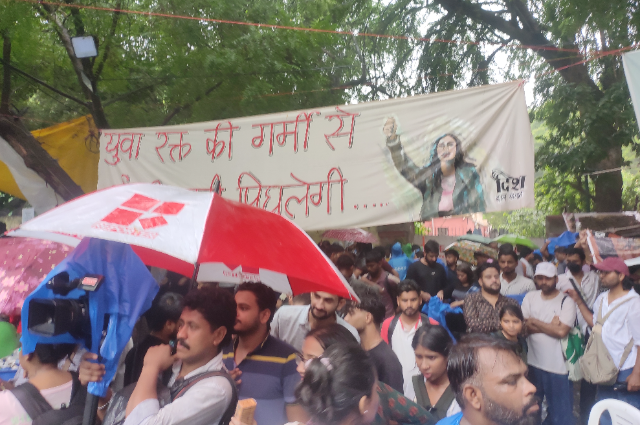
More than 10,000 young protesters came together in the capital city for the “Sansad Chalo” march towards the Parliament on Monday. Armed with placards, copies of the Constitution, and the National Flag, the crowd surged ahead, seeking to be heard by their elected representatives. Immediate lockdowns were imposed in central Delhi, mobile internet services were cut down, roadblocks were created using steel barriers, and strong security forces were posted at every major intersection.
As the sea of students reached the security barriers, the mood of violence prevailed. At a point when sections of the crowd tried to cross the barriers, security forces reacted by using strong physical violence on them, using tear gas several times and baton charges systematically. The chaos resulted in injuries to many young demonstrators and security officers, and made the roads around Parliament appear like a battleground.
“Professional Handling” or “Direct Approach?”
While thousands marched in the streets, the security system acted promptly to obstruct the movement towards the parliamentary area. Barricades were erected, mobile internet facilities were suspended in selected regions of Central Delhi, and police forces formed strong cordons around selected zones.
When the authorities termed this handling of the mass procession that was not approved by them as “professional handling,” what the situation on the ground showed was the use of strong defensive power. As some sections of the crowd tried to overcome the barricades, the security forces used tear gas shells and baton charges against the crowds.
Detention and Retaliation
In response to this stalemate, the police went about conducting rigorous containment processes. Some of the main organisers and leaders of the CJP, who included the party’s founder, were arrested. The justification given by the police for such actions was that it was necessary to keep civil unrest at bay and maintain public order.
The difference between the government’s security briefings claiming “necessary minimum force” and footage of youngsters receiving batons and tear gas sparked heated discussions regarding the state’s reaction to civil protests.
Dialogue Offers and Tactical Standoff
With the pressure mounting inside the country as well as outside from the media attention, government officials finally agreed to begin a dialogue process. Top ministers proposed to have discussions with some of the chosen members of the Cockroach Janta Party at government facilities in New Delhi. Such a way was offered as a peaceful solution to resolve students' problems without causing more commotion in the streets.
Nevertheless, while agreeing to open the lines of communication, the government officials did not agree to give up on the main demand of the movement – the resignation of the Education Minister Dharmendra Pradhan. Though government officials claimed that investigation agencies were investigating the paper leak, the organisers of the protest said that there would be no trust without concrete actions. The organizers of CJP said that any discussion without concessions such as the release of protesters would be only a tactical move.
The Unstoppable Resonance of Youth Dissent
The appearance of the Cockroach Janta Party signals a turning point in modern Indian politics. It has revealed the existence of a deep divide between an aging political system and a technologically savvy, politically conscious generation of citizens who would no longer submit to the bureaucratic indifference as their inevitable fate. Through their attempts at ignoring the importance of young people, the authorities have unwittingly given them an identity representing the essence of survival, omnipresence, and institutional resilience.
Regardless of what might happen in terms of political consequences or administrative bargaining in the short term, this movement will forever change the relationship between the state and its youth. Barricades, tear gas, and arrests during nighttime can disperse the place of demonstration; however, this will not stop the realization that millions of youth have reached about their own strength. When the government perceives the justified despair of its students as an issue of law and order, it is not crushing the movement but ensuring its further resonance and growth.
References:
- Britannica- https://www.britannica.com
- The Guardian- https://www.theguardian.com
- The Hindu- https://www.thehindu.com
- News Laundry- https://www.newslaundr