
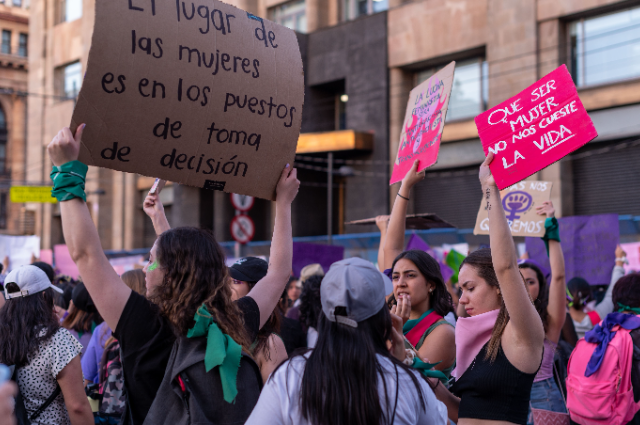
4B refers to the South Korean feminist movement based on the refusal to marry, date, engage in sexual intercourse with a man, and give birth, called respectively bihon, biyeonae, biseksu, and bichulsan. The 4B movement did not exist as an officially organised political organisation but emerged out of feminist online communities in South Korea in the mid-to-late 2010s. This happened at the time of growing feminist mobilisation connected with sexual harassment, hidden-camera crimes, reproduction, and overall gender equality issues. Consequently, researchers do not see 4B as a typical membership-based organisation but as a digitally networked and individualised type of resistance.
The movement needs to be understood within South Korea's particular gender and social context. Feminist activism expanded considerably during the 2010s, including protests against illegal filming and other forms of digital sexual abuse. The 2016 murder of a young woman near Gangnam Station also became an important moment in public discussions about violence against women. Later, the #MeToo movement and the "Escape the Corset" movement further challenged expectations surrounding women's bodies, appearance, relationships and sexuality. In this environment, rejecting marriage, dating, sex, and childbirth became, for some women, a way of refusing social expectations that they believed placed disproportionate responsibilities on women.
The Demographic Paradox
4B has been an interesting phenomenon to watch, particularly in view of South Korea's incredible demographic paradox. Statistics Korea reported that South Korea's total fertility rate was 0.75 in 2024, which was slightly higher than 0.72 in 2023. South Korea had about 238,300 births in 2024, but there were about 120,000 more deaths than births.
Yet, to suggest that South Korea's low fertility rate is due solely to 4B would be erroneous. The movement is s quite small in relation to the entire population, and the decline in marriage and childbirths is a result of many other economic and social reasons. The cost of living, job instability, financial pressures of having children, work-life balance, and a different attitude to marriage can all play a role in demographic changes. Scholars thus distinguish between 4B as a form of feminist protest and the larger phenomenon of young South Koreans postponing and forgoing marriage and parenthood.
Why It Became Global in 2024
The phenomenon of 4B remained largely confined to South Korea for several years until its global rise following the 2024 US presidential election. Following Trump's victory, the number of internet searches and conversations about 4B skyrocketed, with American women introducing the th4B movement in connection with reproductive rights, gender equality, and misogyny issues. With the help of social media platforms, such as TikTok, the obscure idea of Korean feminists was turned into an international and easy-to-recognise hashtag and lifestyle movement.
In addition, the international rise of 4B shows how political ideas spread differently in the age of digital media. Instead of reproducing the Korean movement, American internet users adapted its main principles to the local political context. This point is crucial. While the Korean movement was formed within a certain political context of gender relations and
feminist activism, the discussions about 4B in the US had much to do with the 2024 elections and reproductive issues. Thus, the global 4B is not identical to the South Korean movement.
At the same time, the post-election popularity of 4B should not be interpreted as evidence that American women as a whole adopted the movement. Much of the reported growth occurred through social media, and researchers have described participation as relatively small and difficult to measure. The visibility of a hashtag therefore does not necessarily correspond to the size of an organised movement.
Beyond the U.S.: China and Transnational Feminism
Circulation of the movement did not confine itself to only the United States. Another phenomenon similar to the previously mentioned 4B came into existence as 6B4T in China somewhere around 2020. This idea extended the original values of 4B by including collective help between women and boycotting specific products, beauty standards, and cultural norms. The study of transnational dissemination of the movement suggests that all these conversations soon became censored on Chinese digital media platforms.
This is why the idea of 4B is now increasingly being referred to as a transnational feminist movement rather than a movement restricted only to South Korea. In this way, digital media allows feminist theories to be spread beyond borders but simultaneously distorts them at the same time.
The Debate on Whether Withdrawal Can Amount to Resistance
The primary question concerning 4B is whether withdrawal by an individual can lead to structural changes. The supporters believe that the act of refusing constitutes resistance: if marriage, heterosexuality, and motherhood are social norms for women, then their rejection will constitute resistance to the assumption that their lives are meant to revolve around these things.
However, critics ask if withdrawing is enough to counteract institutions that perpetuate gender inequality. Not dating or getting married gives individuals freedom but does not transform workplaces, criminal justice systems, technology firms, or laws that sustain these inequalities. This criticism brings up the more significant question regarding feminist politics: can individual behavioural change be seen as political resistance if the structures behind the inequalities do not undergo change?
This is relevant because South Korean gender issues go far beyond individual relations between people. Digital sexual violence, such as the sharing of sexual material without consent and artificial intelligence-based deepfakes, has emerged as an issue. South Korea has been increasing its response to digitally created sexual violence cases, while UN Women views technology-enabled sexual violence as an emerging form of gender-based violence.
The Question of Inclusion
A related controversy has to do with the connection between 4B and trans-inclusive feminism. Some varieties of South Korean online feminism have been found to be trans-exclusive, using definitions of womanhood that rely primarily on biological sex. According to one 2026 academic article, popular feminism in South Korea at times merged an anti-violence stance with trans-exclusionary views, but did not represent all of South Korean feminism.
This controversy is significant because the global dissemination of 4B removes it from the context of the debate that it originated from in South Korea. Those learning about 4B through TikTok or elsewhere may view it solely as "women rejecting men" without engaging with the deeper debates surrounding 4B.
A Movement Larger Than the Number of Members
As a result, the interest in 4B reflects not only the state of the movement, but also new attitudes towards gender relations. It is obvious that the movement’s visibility on a global scale testifies to the increased readiness of young women to discuss the question of whether marriage and motherhood should be considered universal stages of adulthood and a necessity. However, the limitations inherent in this movement show the inability to convert personal refusal into a collective effort aimed at structural change.
In essence, the importance of 4B is not in the number of participants and members, but in the questions it raises in society. Why should women be married and give birth to children? What happens if the economic and social system makes this choice increasingly hard for a woman? Is it possible to make refusal a political act? And can the feminist movements fight for gender equality, including all the varieties of womanhood? This path of the movement from South Korea to the whole world shows how fast these questions can travel, but it also shows how fast the meanings and political context of feminism can travel as well.
References:
- Taylor & Francis-https://www.tandfonline.com
- Taylor & Francis- https://www.tandfonline.com
- The Guardian- https://www.theguardian.com
- Yale Journal of International Affairs- https://www.yalejournal.org
- ABC News- https://www.abc.net.au