
You probably used a Hindi word before breakfast. Maybe you lathered up with shampoo, pulled on your pyjamas, or complained that someone else’s job looked rather cushy. None of these words feels foreign now, yet each one made a long journey, carried home from India by soldiers, traders and civil servants who stayed long enough to pick up the local speech.
How the words travelled
The English presence in India stretches back to the early 1600s, when the East India Company set up trading posts along the coast, and it deepened through the centuries of Company rule and the Raj that followed. People lived there for years, ran households, fought campaigns and filed paperwork. The language they used in daily life slowly filled with local terms, and many came home with them in their luggage.
So many of these words were in circulation that in 1886 two British officials, Henry Yule and A. C. Burnell, compiled a whole glossary of them. They gave it a title borrowed from a phrase of the day, Hobson-Jobson, itself an English mangling of the cry heard at Muharram processions. It remains the classic guide to the subject.
Shampoo and loot
Shampoo comes from the Hindi champo, an instruction to press, knead or massage. For most of its life in English, the word meant just that, a massage, and the idea of washing hair with a bottled liquid came much later.
The man who put the word on the English map was Sake Dean Mahomed, an entrepreneur from Bengal who had served with the Company’s army before settling in Britain. After working at a fashionable vapour bath in London, he opened his own establishment in Brighton in 1814, offering steam baths and “shampooing” to a seaside crowd that could not get enough of it. He eventually styled himself the Shampooing Surgeon and was appointed to the royal households of George IV and William IV.
Loot has a darker origin. It comes from the Hindi lut, meaning plunder, and soldiers in India were using it well before it reached a wider public. It spread through newspaper reports of the 1857 Rebellion, when accounts of looting and reprisal filled the British press. From there it settled into English as the word for stolen goods and, eventually, for any big haul.
Trousers, houses and a god’s chariot
Pyjamas began as everyday wear. The word goes back to the Persian and Urdu pae-jama, literally “leg garment,” for the loose trousers worn across much of South Asia. British residents found them comfortable for sleeping in, and the habit, and the word, followed them home.
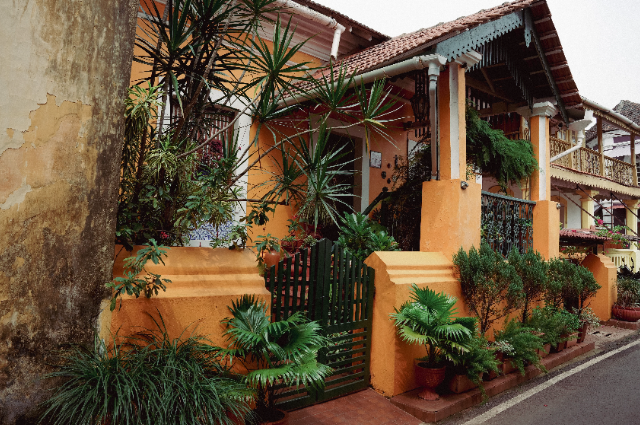
Bungalow is my favourite of the lot, because the word is practically a map. It comes from the Hindi bangla, meaning “of Bengal,” and describes the low, verandah-fringed houses built in the Bengali style. Europeans took to the design, and by the late 1800s builders in Britain were putting up bungalows of their own, far from any delta.
Jungle is another surprise. It comes from the Hindi jangal, which traces back to a Sanskrit word for dry, uncultivated ground. The dense green tangle we picture today is the English reinterpretation.
Juggernaut comes from Jagannath, “lord of the universe,” the deity worshipped at Puri in Odisha. Every year the Rath Yatra carries his image through the streets on enormous chariots. European travellers wrote lurid, probably exaggerated, accounts of devotees crushed beneath the wheels, and by the nineteenth century the name had become a general term for any vast force that rolls over everything in its path.
Crime, comfort and creatures
Thug is from the Hindi thag, a swindler or cheat. In the 1830s the British launched a campaign against groups of professional robbers and stranglers they called Thugs, and the sensational coverage turned a regional word into a general insult. Dacoit, from the Hindi dakait, meaning a member of a robber gang, never travelled quite as far, but it remains in use in the subcontinent and in older English writing.
Many humbler words came too. A cot is from khat, a bedstead. A dinghy is from dingi, a small boat. Chutney comes from chatni, linked to the verb for licking, and the cheetah takes its name from the Hindi cheeta, meaning spotted.
Slang from the barracks
Some of the best borrowings are slang. Cushy, meaning easy and comfortable, comes from the Hindi khush, “pleasant.” Dekko, as in “have a dekko at this,” is just dekho, “look.” And Blighty, the soldiers’ affectionate name for home, comes from vilayati, meaning foreign or European. First World War troops embraced it so eagerly that a wound serious enough to send a man back to Britain became a “Blighty one.”
A note on where the words really come from
Calling all of these Hindi words is a handy shortcut, but linguists prefer a more careful description. Many arrived in Hindi from Persian, the court language of the Mughal era, or from Sanskrit, or even Arabic, before English picked them up. Pyjamas and cushy lean on Persian, jungle and cheetah on Sanskrit, and Blighty on Arabic. The British usually met the words in Hindustani, the everyday speech of northern India, which is why it is more accurate to say they came through Hindustani than from Hindi alone.
The exchange continues
The borrowing did not stop when the Raj ended. The Oxford English Dictionary now identifies around 900 words as distinctive to Indian English, and it keeps adding more. In its September 2017 update, it welcomed seventy at once, among them jugaad, a clever, makeshift fix, and dadagiri, bullying behaviour by a local strongman. Oxford’s editors said Indian speakers have a highly specific vocabulary with no direct English equivalents.
The history of jugaad is telling. When it first turned up in English in 1995, it meant a makeshift vehicle built from cheap parts. Today it describes a whole philosophy of resourceful improvisation. The old trade of words between India and Britain is still running, only now the traffic flows freely in both directions.
References:
- Yule, Henry, and A. C. Burnell. Hobson-Jobson: A Glossary of Colloquial Anglo-Indian Words and Phrases. London: John Murray, 1886.
- Oxford English Dictionary (OED Online). Entries for bungalow, shampoo, loot, juggernaut, thug, dacoit, jungle, cushy, dekko, Blighty and jugaad. Oxford University Press.
- Harper, Douglas. Online Etymology Dictionary. etymonline.com.
- Fisher, Michael H. The Travels of Dean Mahomet: An Eighteenth-Century Journey Through India. Berkeley: University of California Press, 1997.
- “Shampoo Empire.” History Today. https://historytoday.com/node/54394
- “How an Indian took shampooing to England.” Scroll. in. https://scroll.in
- “Anna, vada, dadagiri among 70 new Indian words in Oxford English Dictionary’s latest update.” Scroll. in. https://scroll.in/latest/855622/scroll_in
- “Dadagiri now part of the Oxford dictionary.” Deccan Chronicle, 29 October 2017. https://www.deccanchronicle.com
- “Achcha, Didi, Abba in Oxford Dictionary: How desi-words went global.” NewsBytes, 26 October 2017. https://www.newsbytesapp.com