
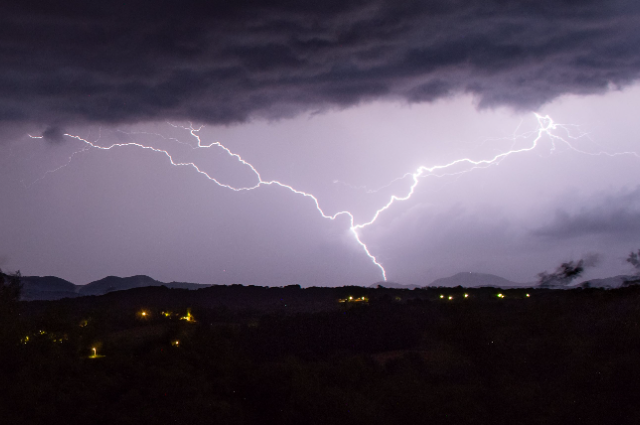
Every thunderstorm that rolls overhead isn't just noise and light; it's a chemistry lab in the clouds quietly manufacturing plant food and dropping it straight into the soil. Nitrogen is an important nutrient for plant growth, and it's everywhere; nitrogen gas makes up roughly 78% of Earth's atmosphere. But there's a catch: plants can't use it in that form. The two nitrogen atoms in an N2 molecule are locked together by a strong triple bond, and nothing in a plant's root system can pry it apart. That's where lightning comes in.
A single lightning bolt can heat the surrounding air to 30,000°Chot enough to tear that stubborn triple bond apart. Once the nitrogen atoms are free,d they react with oxygen to form nitrogen oxides, which then react with water vapour to produce nitrous and nitric acid. When those acids seep into the soil, they convert into nitrate, the exact form of nitrogen plants can actually absorb.
Rain does the delivery work. These soluble nitrogen compounds dissolve in precipitation and get carried down to the soil surface, where they're converted into ammonium and nitrate ions ready for plant roots to take up. Scientists call this pathway "wet deposition," and researchers have even noticed it hits hardest during the first big storms after a dry spell, often called the "first-flush effect."
The scale is genuinely enormous. Estimates put lightning-driven nitrogen fixation at somewhere between 3 and 10 teragrams of nitrogen per year; for scale, one source compares that to the weight of over half a million elephants falling from the sky as fertiliser, every single year. This isn't some fringe theory; it's the same basic chemistry humans have tried to industrialise. People first used electricity to manufacture nitrogen fertiliser in 1903, mimicking lightning's own chemistry before the more cost-efficient Haber-Bosch process took over and became the backbone of modern agriculture. That trade-off matters. Haber-Bosch is responsible for as much as 3% of global emissions, largely because field-applied ammonia fertiliser releases nitrous oxide, a greenhouse gas even more potent than CO2. Lightning's version comes with no smokestack and no runoff bill, though it's worth noting that today's global food supply couldn't survive on lightning alone. Feeding 8 billion people requires more nitrogen than natural processes can provide, which is exactly why synthetic fertiliser exists in the first place.
Some researchers are now trying to close that gap by bottling the lightning effect using electrical discharge in the lab to fix nitrogen directly into soil, essentially replicating a lightning strike on demand as a lower-emission alternative to chemical fertiliser.
It's worth keeping this in perspective. Lightning does measurably add nitrogen to soil through rainfall. Soil microorganisms still handle the vast majority of nitrogen fixation on any given piece of land. Lightning's real advantage is reach; while soil bacteria can fix nitrogen too, lightning spreads it widely, reaching places those microbes may never live. So the next storm that rattles your windows isn't weather passing through. It's the atmosphere doing a bit of farming one bolt, one raindrop, one nitrate molecule at a time.
References:
- GardenerBible. How Does Lightning Put Nitrogen In The Soil?. Https://gardenerbible.com
- 13News: How lightning fertilises soil with atmospheric nitrogen fixation. Https://www.13newsnow.com
- Science and Stuff. The Science Behind Lightning and Its Role in Nitrogen Fixation. Https://jaysciencetech.com
- ScienceDirect. Electrical discharge assisted nitrogen fixation: An alternative to chemical fertilisers. Https://www.sciencedirect.com
- Varshik, Medium. Thunderstorms and Fertile Soil: How Lightning Fixes Nitrogen in India's Farms. Https://medium.com
- Sierra Club. Lightning-on-Demand Could Create the Green Fertiliser We've Been Waiting For. Https://www.sierraclub.org
- Wikipedia. Nitrogen fixation. Https://en.wikipedia.org/wiki/Nitrogen_fixation
- Walking Mountains Science Centre. From Flash, to Fertiliser: How Lightning Feeds Plants. Https://www.walkingmountains.org
- The Weather Guys, UW-Madison. Does lightning add nitrogen to the soil?. Https://wxguys.ssec.wisc.edu