
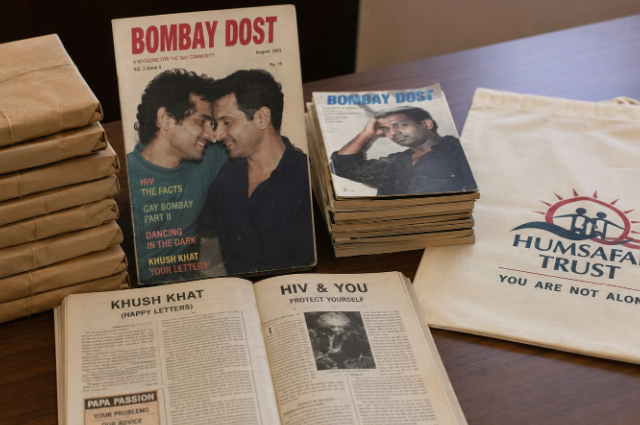
In 1990, a 16-page newsletter began circulating quietly through a handful of shops in Bombay, wrapped in plain brown paper so no one on the street could tell what they were carrying. It cost fifteen rupees more than most glossy mainstream magazines of the time, and it could not be displayed on a shelf, named in a phone call, or read on a train. It was called Bombay Dost, and it was India's first registered magazine for the LGBTQ community, born at a moment when homosexuality was still a criminal offence under Section 377 of the Indian Penal Code.
Bombay Dost was founded by journalist and activist Ashok Row Kavi, along with Suhail Abbasi and Sridhar Rangayan. Kavi, who had already spent years writing for the mainstream press and covering the HIV/AIDS crisis, became the first man in India to speak openly about his own homosexuality. With Section 377 still in force and the AIDS epidemic deepening, he felt there was no space — legal, social, or medical — built for gay Indians to simply exist safely. Bombay Dost was his answer: a "charter" publication that promised to be a refuge for people of alternate sexualities regardless of caste, class, or creed, and to function as a counselling service and information centre as much as a magazine.
The first issue read less like a glossy and more like a survival manual, practical advice on staying safe, building confidence, and navigating a hostile legal and social climate. Kavi described the magazine's underlying philosophy as walking activism: modest, practical help like assisting readers in setting up a private P.O. box for correspondence rather than grand political theatre.
The secrecy built into Bombay Dost's distribution was the whole point. Copies were tucked into the backs of small shops, never displayed, bought in a hurry and read in private. Yet that quiet network turned into something far bigger than its print run suggested. Its “Khush Khat" (Happy Letters) column, where readers could write in and arrange to meet one another, became wildly popular — at its peak, the magazine's editors were said to be receiving as many as 3,000 letters a week. Correspondence arrived not just from across India but from well beyond its borders, including Pakistan, Afghanistan, Tajikistan, Iran, and the Gulf, proving that an underground publication out of Bombay had become a reference point for queer readers across the wider region.
Alongside the letters column, the magazine carried frank material on HIV/AIDS prevention, legal explainers on Section 377, an agony-aunt-style advice section called "Papa Passion," and a gossip column nicknamed "Poison Pudi" that tracked Bollywood's open secrets. As the years went on, Bombay Dost leaned further into film and celebrity culture to stay relevant —
featuring stars such as Akshay Kumar in the 1990s, and later Manoj Bajpayee, Imraan Khan, and Kalki Koechlin on its covers.
That mix of Bollywood commentary and queer politics occasionally collided head-on with the industry it covered. In 1995, Bombay Dost ran a review describing actor Saif Ali Khan's film as effectively a love story between its two male leads, sidelining the heroines as superfluous to the central relationship. Around the same time, Kavi had also made remarks about Khan's mother, actress Sharmila Tagore, during a television appearance. The combination reportedly enraged the young actor, who showed up at Kavi's home in Santacruz and assaulted him; Kavi has said his mother was struck as well when she tried to intervene. Kavi filed a police complaint, and the case eventually reached a Mumbai court, where Khan issued a public apology years later. The episode became one of the more notorious flashpoints in the magazine's history, a reminder of how personally charged its coverage could get, even when wrapped in humour.
In 1994, Kavi, Abbasi, and Rangayan co-founded **the Humsafar Trust**, a Mumbai-based NGO that grew directly out of the *Bombay Dost* network and soon took over publishing responsibilities for the magazine itself. Humsafar would go on to become one of India's most significant LGBTQ and HIV/AIDS-focused organisations — the institutional offspring of what had started as a discreetly wrapped newsletter.
Financial strain eventually caught up with the magazine. Bombay Dost shut down in 2002, a casualty of funding troubles rather than any loss of relevance. It returned in 2009, the same year a Delhi High Court ruling briefly decriminalised consensual homosexual acts, giving the relaunched magazine a noticeably freer legal climate to publish in, even as that ruling itself
would later be challenged and ultimately reversed by the Supreme Court, before Section 377 was finally struck down for good in 2018.
Bombay Dost never achieved mass circulation, but its influence was never about numbers. It gave a name and a network to a community that had neither, decades before queer visibility became mainstream conversation in India. Its letters column connected strangers across borders; its Humsafar Trust offshoot built lasting public-health and advocacy infrastructure; and its decades of survival through bans, beatings, and bankruptcy turned a brown-paper-wrapped newsletter into one of the founding sparks of India's modern queer rights movement.
Sources and references-
- Bombay Dost — official history, *bombay-dost.com*
- "India's First Gay Magazine, Bombay Dost," *NewsGram*
- How Bombay Dost Mobilised India's Gay Movement," *Homegrown India*
- "The Rise, Fall, and Resurrection of India's Oldest Surviving LGBT Magazine," *Pacific Standard*
- India's first and oldest gay rights activist is also on the extreme right of RSS," *ThePrint* - 'Saif hit my mother and metoo'," interview with Ashok Row Kavi
- Top Scandals from Saif Ali Khan's life," *Yahoo/Finance*
- Ashok Row Kavi — biography, *LGBT History Month*
- Gay Bombay revisited: Ashok Row Kavi," Chitra-Lekha Sarkar
- Wikipedia: *Bombay Dost*; *Ashok Row Kavi*