
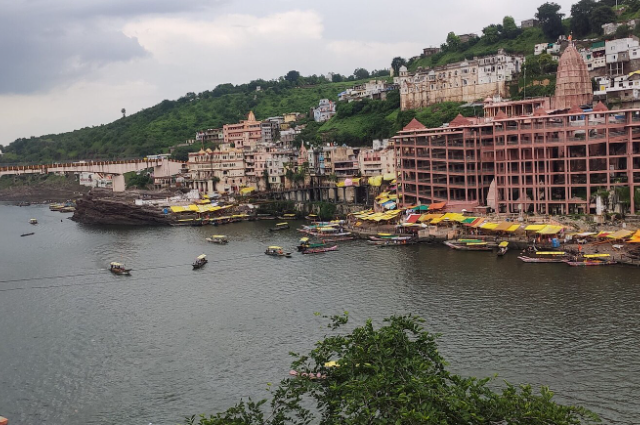
At the Omkareshwar Jyotirlinga in Madhya Pradesh, the fastest way to reach the deity no longer runs through a donation box; it runs through a blood bank. For generations, "VIP darshan" at India's great temples has meant one thing: paying a premium to skip the line. The Khandwa district administration decided to rewrite that equation entirely. Under a scheme launched on February 24 this year, pilgrims who give blood, a process that takes roughly twenty minutes, are exempted from the standard three-to-four-hour queue and granted direct, priority entry to the sanctum, for themselves and their families.
A five-bed blood collection facility now operates near the temple complex, staffed to handle the steady flow of devotee-donors. Any healthy pilgrim between 18 and 60 years old, weighing at least 45 kilograms, is eligible to donate. The process itself is simple and dignified: donors are given refreshments afterwards, along with a certificate, prasad from the temple, and a keepsake image of Lord Omkareshwar. That certificate is the golden ticket; it lets the donor and their accompanying family bypass the general queue entirely.
The idea was championed by Khandwa Collector Rishabh Gupta, and it arrived at a fortunate moment: the holy month of Adhik Maas, when pilgrim footfall at the temple swells considerably.
What began as a modest pilot has turned into one of the more remarkable public-health success stories to come out of a temple town. In February, when the scheme started, the camp collected 168 units of blood. By June 14, that figure had climbed to nearly 500 units. Earlier reports from the district hospital noted that daily collections jumped from a routine 15–20 units to as high as 200 units a day soon after the pilot began.
The timing could not have been better. Khandwa's blood requirement has grown sharply with the opening of a new medical college in the region, pushing monthly demand to an estimated 1,200 units. The temple camp's donations have helped meet that demand and even build a reserve for emergencies. Authorities are now working on something more permanent: a dedicated, standalone blood bank attached to the medical college, born directly out of this temple-side initiative.
The success in Khandwa has not gone unnoticed in Bhopal. Officials at the National Health Mission have flagged the Omkareshwar project as an effective model for promoting voluntary blood donation, and the state government is now exploring whether the same blood-for-darshan format could be extended to other major temples across Madhya Pradesh.
It is, in many ways, a quiet reinvention of what "VIP" means in a religious context, trading a transaction of money for a transaction of compassion. Not everyone is uncritical: some commentators have raised questions about tying privileged access at a place of worship to an incentive scheme, even a well-intentioned one. But for now, the data speaks for itself: a temple queue has become, almost by accident, one of the more efficient blood drives in the state.
As officials continue to track collection numbers in the coming months, Omkareshwar's experiment may end up doing something rare: turning a darshan queue into a small, steady stream of saved lives.
References:
- India.com — Is Omkareshwar Temple providing 'VIP darshan' in exchange for blood donation? Here's what we know, Tahir Qureshi.
- Inshorts — Devotees can donate blood for VIP darshan at Omkareshwar Temple.
- Pune Pulse — Can Devotees Get 'VIP Darshan' at Omkareshwar Temple by Donating Blood? Here's What We Know, June 16, 2026.
- Deccan Chronicle — MP Mulls Offering VIP Darshan to Devotees for Voluntary Blood Donation, Rabindra Nath Choudhury.
- Youth Ki Awaaz — Omkareshwar Temple VIP Darshan: Replacing Money With Blood Donation, V Rohaan Thyagaraju.