
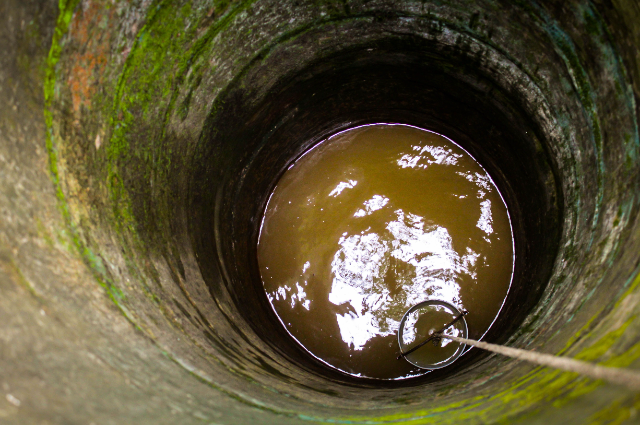
In Virparda village, tucked into Gujarat's Morbi district, farmer Pranjivanbhai Sadariya has an 18-foot well that refuses to sit still. Since early August, its water has been rolling in continuous ripples, movement that began after heavy monsoon rainfall filled the well, after which the water reportedly turned muddy before developing persistent, wave-like oscillations that have continued even in calm weather. Locals say the motion sometimes intensifies enough that water spills over the well's edge, while nearby wells in the same area have stayed eerily still.
Naturally, the internet noticed. Videos of the rippling well drew crowds from nearby villages, and motorists on the adjoining highway began pulling over just to watch it. Social media did what social media does: some users blamed strong winds, others floated theories about underground water movement, pressure differences, or vibrations from passing traffic. A more colourful local theory took hold too — given that Morbi sits relatively close to Gujarat's coastline, several villagers came to believe the well's behaviour was tied to the Arabian Sea's tides, with underground channels supposedly linking the well to coastal aquifers. It's a lovely piece of folklore, but it remains just that — a public belief that officials and scientists have not confirmed. Others, watching the water churn unpredictably, worried it might be an omen: the waves briefly calmed one day only to start the next evening again, and the on-and-off pattern fed rumours that it could signal an impending earthquake.
Officials moved quickly to head off panic. Morbi District Collector Swapnil Khare directed officials to investigate, and geologists carried out a preliminary inspection of the site while experts from the Gujarat Groundwater Research Institute were asked to conduct a fuller study and submit a report. Speaking to the press, Khare said the initial assessment pointed to trapped air beneath the water's surface as the likely cause. The mechanism, as district officials described it: as trapped air shifts underground, it creates movement on the water's surface.
That trapped-air explanation connects to a broader, very ordinary process — one your own well or borewell goes through every monsoon, just usually without the theatrics. When rain soaks into the ground, water percolates down through soil and porous rock, gradually recharging the aquifer below. As it does, it often has to push past air that was sitting in the tiny pore spaces and fractures of the rock. Normally, that air escapes quietly. But given the right combination of a shallow water table, saturated soil, and a well positioned right where an air pocket or fracture network happens to vent, the escaping air can literally bubble and churn the water above it, setting off rhythmic ripples that look, for all the world, like ocean waves in a bucket.
Geologists have a specific name for a related phenomenon: a "well seiche." As one commentator explained it online, the term describes standing-wave oscillations in a well that can be triggered by distant seismic activity or by pressure changes, and with groundwater levels rising rapidly because of excessive rain, the resulting water movement can look just like what's happening in Virparda. Importantly, officials have ruled out any link to actual earthquakes or fault activity in the area; the seiche-like sloshing here appears to be a hydrogeological quirk of this particular well's geometry and its connection to the surrounding aquifer, not a tremor underfoot.
Why would one well dance while its neighbours stay flat calm? That's the detail that makes this case genuinely interesting to hydrogeologists, and it's exactly what the Gandhinagar-based scientific team has been sent to figure out. The leading explanation is that Sadariya's well happens to sit atop a specific fracture or void in the bedrock, a kind of underground plumbing quirk, that channels trapped air upward through that well and not through the others nearby, even though they're drawing from the same general aquifer. In the meantime, the quiet farm has turned into a full-blown tourist attraction, with hundreds of people gathering to watch the water churn like miniature sea waves, while the administration has barricaded the site and appealed to visitors not to spread rumours while the investigation continues.
There's a useful lesson buried in all the viral excitement: groundwater recharge isn't some invisible, abstract process happening quietly underground; it's a physical, mechanical event, with water displacing air, pressure shifting through rock, and occasionally, a farmer's well putting on a show. Whether Virparda's well settles back into stillness or keeps rippling through the rest of the monsoon season, it's become an accidental, very visible reminder of what's happening beneath the ground every rainy season, everywhere, just usually out of sight.
References:
- Gulf News — "Gujarat's Viral 'Wave Well': Rippling Water Phenomenon Puzzles Locals, Geologists Launch Probe." https://gulfnews.com
- Free Press Journal — "Gujarat's Oscillating Mystery Well In Morbi Leaves Internet Scratching Heads; Viral Videos Have Netizens Saying 'It's Haunted'." https://www.freepressjournal.in
- Business Today — "Gujarat's Morbi 'waving well' mystery: Experts explain why water moved for days like ocean waves." https://www.businesstoday.in
- Daily Jagran — "Gujarat: Mysterious Waves In THIS Village Well Leave Locals Stunned; Here's What Experts Reveal | Viral Video." https://www.thedailyjagran.com
- YouTube — "'Dancing Well' In Gujarat's Morbi Goes Viral; What Is Behind The Mysterious Waves?" https://www.youtube.com/watch?v=K8c3bwi9E9I