
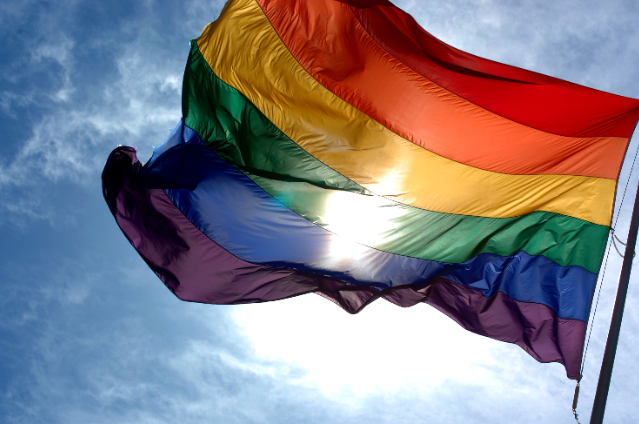
Every June, the flags go up. Corporate logos swap to rainbow. City blocks fill with glitter and music, and a billion social media posts declare, in unison, that love wins. It's a celebration, and it should be. But underneath the spectacle, there's a history that most people marching in those parades don't know — and a few inconvenient truths that the brands sponsoring the floats would rather you didn't think about too hard.
Let's start with the flag itself. The six-stripe rainbow you recognise, red, orange, yellow, green, blue, violet, is not the original. The first Pride flag had eight colours, designed by San Francisco artist and activist Gilbert Baker in 1978. Hot pink represented sex. Turquoise stood for art. Both were stripped out for reasons that had nothing to do with meaning and everything to do with logistics. The flag you wave is edited. Its story is a metaphor for Pride itself: something radical, made practical, then packaged for mass consumption.
It started with a riot, not a parade.
The story of modern LGBTQ+ rights begins not with a march, but with a confrontation. On June 28, 1969, police raided the Stonewall Inn, a mafia-owned bar in Greenwich Village, New York. The raid was routine, the kind of harassment LGBTQ+ people had come to expect. A criminal statute at the time required individuals to wear at least three items of "gender-appropriate" clothing. Officers could and regularly did arrest patrons simply for existing as themselves in public.
That night, they fought back. The uprising that followed lasted six days. It was messy, angry, and led largely by people who are often footnoted out of the polished version of the story: trans women of color+, drag queens, sex workers. The comfortable narrative has smoothed over the edges. But the fire that started the modern movement was not a candlelight vigil. It was broken glass and thrown coins, and people who had nothing left to lose, deciding they were done losing it quietly.
"The riots were not the start of a celebration — they were the end of a silence."
The woman history keeps forgetting.
Ask most people who invented Pride Month, and they'll gesture vaguely at Stonewall, 1969. They're not wrong, exactly. But they're missing a name: Brenda Howard. Howard, a bisexual activist from New York, organised the first Christopher Street Liberation Day March on the first anniversary of the Stonewall uprising. More than that, she originated the idea of stretching the commemoration into a week-long series of events — the direct ancestor of the month-long celebrations now held worldwide. For this, she earned a title: the Mother of Pride. She worked alongside Robert A. Martin and L. Craig Schoonmaker to popularise the very word "Pride" as the framing for these gatherings. Before them, the movement used terms like "liberation" and "freedom." The shift to Pride was deliberate — a reclamation of dignity for people who had been told for decades they should feel shame. Howard herself was pointedly out as bisexual at a time when bisexuality was frequently dismissed even within LGBTQ+ spaces. Her erasure from mainstream Pride history is not incidental.
Gilbert Baker sewed the first rainbow flag by hand with a team of volunteers in 1978. Each of the eight colours carried a meaning he had assigned deliberately:
The original 8-stripe flag (1978)-
- Hot pink-sex (removed)
- Red-Life
- Orange-healing
- Yellow-Sunlight
- Green-nature
- Turquoise-art (removed)
- Indigo-harmony
- Violet-spirit
The removals came in sequence, and both were mundane in origin. Hot pink was the first to go: after Harvey Milk's assassination in 1978 triggered a surge in demand for the flag, manufacturers simply couldn't source hot-pink fabric at scale. A symbol of sexuality was excised for supply-chain reasons. Then, when organisers wanted to display the flag along both sides of a parade route, an even number of stripes was needed; the seven-stripe version couldn't be split symmetrically. Turquoise, representing art, was cut to make the math work.
What remained was the six-stripe flag the world now recognises. No committee voted to remove sex and art from the Pride flag. The market and logistics did it instead.
The rainbow wasn't the community's first symbol. For years before Baker's flag, many LGBTQ+ activists deliberately adopted the pink triangle from the badge that Nazi Germany had forced gay prisoners to wear in concentration camps. The act of reclaiming it was radical: taking a mark of persecution and wearing it as defiance.
The AIDS crisis of the 1980s reinvigorated the pink triangle, particularly through the Silence = Death campaign, which placed it now pointing upward, inverted from its Nazi configuration against a black background. It became an emblem of both mourning and fury. But as the movement grew, there was a desire for something that looked forward rather than backward, something that could hold grief and also contain joy. Baker's rainbow flag became that thing.
Pride parades have been running annually since 1970. The community had built a tradition without waiting for permission. But formal recognition from the US government took three more decades.
It was President Bill Clinton who first designated June as Gay and Lesbian Pride Month in 1999 and 2000, and notably, he did not seek a second term in which to follow through. The proclamation lapsed. President Barack Obama revived and expanded it in 2009, reframing it as Lesbian, Gay, Bisexual, and Transgender Pride Month. The name change mattered: trans people had been present since Stonewall, but official recognition had long lagged. Thirty years of parades before a president put his name on it. That's not an endorsement timeline. That's a political weather vane.
Here is the argument that is very much alive within LGBTQ+ communities, and that tends to get left out of the confetti-and-capitalism version of Pride: some of the corporations sponsoring those floats also donate to politicians who vote against LGBTQ+ rights. The rainbow logo in June and the campaign contribution in October are not contradictions to these companies; they are parallel strategies, each aimed at a different audience.
Several of the original organisers and activists from the Stonewall era have said publicly that the parades have drifted so far toward entertainment and corporate spectacle that their protest function has been hollowed out. They aren't wrong that something has shifted. The first marches were explicitly political events: demands for decriminalization, for safety, for an end to state-sanctioned violence. The question of whether a celebration can also remain a confrontation is not settled, and different parts of the community answer it differently.
This is not an argument that Pride should be cancelled or that joy is a betrayal. It is, rather, an acknowledgement that the people who started all of this were not marching for the right to buy a rainbow-branded credit card. Holding both things, the genuine jubilation and the genuine critique, is closer to the spirit of the original than either sentiment alone.
Sources and references-
- The Stonewall Uprising
- Brenda Howard and the Naming of Pride
- The Rainbow Flag
- The Pink Triangle
- Official Recognition and Corporate Pride, and protest debate