
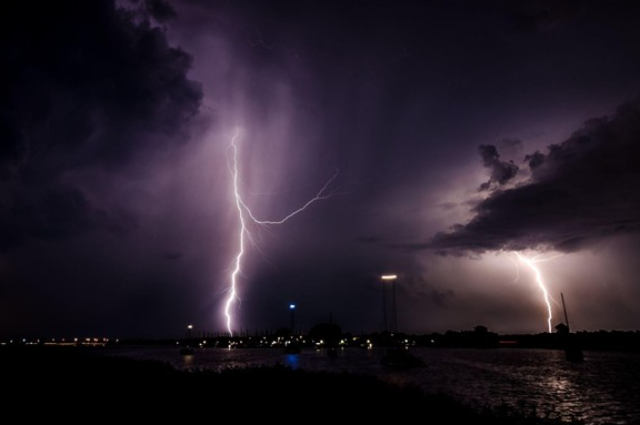
Lightning storms. We all know them; we all either hate or love them, depending on how pleased you are to hear the sound of pouring rain and flashes of lightning scouring the air like blades in the sky,y followed by rumbling thunder.
If you’ve been anywhere in the world, you have experienced at least one lightning storm in your lifetime.
Apart from the fact that they are known to be loud, deafening and very dangerous when you're out at night, did you know that these storms actually help fertilise the soil of our Earth?
It’s madness, but it’s true, and we shall look more into that below.
The nature of lightning storms
The air in the sky acts like one big insulator that lets different things pass through it back and forth. Whether it be us or even something as visceral as lightning.
Lightning, as we know, happens due to the positive and negative charges meeting in such a manner that it causes an extreme electrical reaction that tears open the sky with a streak of light.
A single lightning strike can be very hot and can burn bright enough to light up a pitch-black sky. The thunder that follows soon after is just to let you know of the power of how loud the lightning strike even was, a type of aftermath of a natural phenomenon, as the light itself is way too fast for the sound to even travel at the same speed.
Civilisations of ancient history had no idea how to even fathom such a phenomenon in the sky, which they had assumed was the sheer power of deities and the gods from above, since the lightning storms would also provide them with rain for their crops.
As much as lightning is something we usually stay far away from and don’t engage with due to it literally being pure natural electricity, there is a benefit to these sparks in the sky that you may not have known of.
The secret fertiliser from the sky
So while the lightning zooms through the air, what exactly happens while it’s zooming in?
When lightning breaks through the atmosphere, it also breaks something else during it: a little molecule known as nitrogen. The colourless gas that fills the air and doesn’t do much, except when it breaks apart.
When the nitrogen molecules break apart, this allows the nearby oxygen to combine with them and,d in turn, form nitrogen oxides.
Floating in the sky with no care, it then gets dissolved into nitrates by the rain of the storm, and travels down to the earth and straight into the soil.
Nitrates are extremely useful to plants and their growth, and are widely used as beneficial fertilisers. They are usually preferred over other such fertilisers due to their positive impact on the health and productivity of the soil and plants.
This process is also known as nitrogen fixation, and has been a process that has been going on for years. The stats also state that around 3–10 teragrams (roughly the weight of half a million elephants) of nitrogen reach the soil every year.
So not only is the rain providing water to our soil that replenishes the crops and plants of the earth, but it also feeds the soil a very valuable type of beneficial fertiliser due to lightning.
A bringer of life and death?
As we’ve discussed, we can admit that lightning is both extremely beautiful to gaze at in the sky, and it also provides a beautiful resource for our crops and plants, and in turn helps them grow.
On that matter, we shouldn’t ignore the double-sided nature that has to do with lightning on its own.
Because as much as it is a beautiful phenomenon that helps plants grow and brings the rain the earth needs to stay healthy, it also destroys.
Forest fires, infrastructure failures, deaths caused by lightning strikes, and even frying power outages when it gets the chance.
So how does something beneficial to the earth also end up destroying it in the same way?
Forest fires especially show a back and forth when it comes to the positive and negative aspects of lightning. Entire forests are burnt up, with animals in danger, their homes destroyed and buried for the rain to sweep away. It’s a cruel act of nature that shows its ugly face in the form of two sides.
It replenishes and destroys, and has been doing that for many, many years, way before we even existed. It’s jarring to think about, but that’s the truth.
Nature is never always pure and peaceful. It’s ruthless, violent, something you can never predict until it’s already too late.
In the end, however, it will always be like that. As much as we appreciate the good things in one thing, the same can have its fair share of bad things in the same way. In those cases, sometimes acceptance is the best way to tackle it.
The grand circle of life has us as a part of it, with the draw of the wrathful sky coming forth to march on our grounds. We can all just accept the good and bad all the same.
As we close off, the next time you see lightning in the distance during a stormy night, we can kindly appreciate the way it replenishes the earth. It has been doing that for millions of years.
But note that there is a reason why people urge us to stay inside during such storms, or to stay away from high places.
Maybe historical civilisations were right to assume there were gods above us, just in the form of the flashes and downpour of our great skies.
References:
- https://www.walkingmountains.org
- https://www.actionnews5.com
- https://pmc.ncbi.nlm.nih.gov/articles/PMC10389047/
- https://zandz.com
- https://www.yara.us