
Our viewpoints and the way we understand and handle things can be vastly different from each other, whether it be based on communities, groups, and large-scale cliques that make you truly wonder how we go about things.
It's also interesting to note that no matter how much it’s argued about half the population’s autonomy, consent, and a need to be recognised as human, the majority of the world is still on a bend on whether it should be considered.
But not for these two Adivasi communities, who have been practising equality long before the modern age could, giving the women of the tribe a status and the right to be human.
Here we are indeed talking about the two tribes, the Khasi and Muria Tribes.
Difference in perspective?
Most of the world can agree that each person or community has a different understanding of gender and what it entails.
But when you separate an entire half of the population into a category where they are never listened to, assumed as an object, and are worthless in the eyes of society, are we really doing the right thing?
The dowry system is an example of that, as not only is the system disrespectful to families, but most notable are the women who have to handle that kind of shame and entitlement due to their status.
So really, is it a different way of thinking? Or is it ignorance?
We shall see the two tribes and their activities and practices and how the women are respected and given autonomy just like the men are.
The Muria Tribe
The Muria Tribe of Chhattisgarh are alive with many different traditions and ways of life, some of them being extremely unique in the way they handle their special practices.
For example, parents teach children as young as 10 years old the freedom to explore their own friendships, romantic relationships, and sexuality as they grow up. Something foreign to us in most areas of the world.
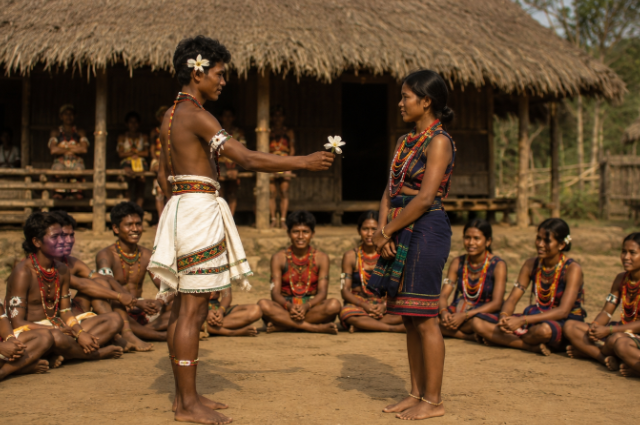
There is also a special community dormitory known as the Ghotul, which is a place where young boys (known as Chelik) and girls (known as Motiari) learn about concepts of cleanliness, cooking, discipline and many other essential skills for a growing human. There are usually two leaders, a male ‘Sirdar’ and a female ‘Belosa’, who teach the children these skills during the evening hours.
As the music, dancing and eating fill the air in the dormitory, the night soon comes, and the young boys and girls usually pair up for the night to move inside the dormitory, with both parties consenting, to either spend the night talking or engaging in sexual activity.
Once partners are chosen, marriage can happen with the practice of a Chelik offering a white flower, and it’s Moriarty’s choice to either accept the flower or reject it.
If accepted, the Chelik puts the white flower in the hair of Moriarty to symbolise the partnership and band of commitment to each other.
All in all, it’s a very unique and beautiful way of exploring humanity and how connection is valued based on the mutual commitment of both parties.
The Khasi Tribe
The Khasi of Meghalaya, of over 1 million members, have a special way of going about the systems in our world, which leans more towards a matrilineal tradition.
Here, instead of the women moving into the man’s home, the children take the father’s surname. Here, the men live in their mother-in-law’s home, with the children taking the mother’s surname. Here, the Khasi men will always join the women’s households in marriage.
The youngest daughter (known as khatduh) is also entrusted with the full custody of the land, the clan’s property, and the responsibility of taking care of aged parents when they get older.
This does not mean that women are fully in power, since the men of the tribe still make decisions and are in positions of power within the community, but it still shows how women have some sense of responsibility and power when it comes to their status, hence the term matrilineal.
David Roy Phanwar, who was a classical writer known to be an intellectual when it comes to writing about the Khasi Tribe, stated the following when writing about them,
“A man is the defender of the woman, but the woman is the keeper of his trust.”
Which is very poetic, and it also reflects beautifully on the culture of this community.
Final thoughts
What we have seen here are two completely different tribes from different areas, with different traditions. But they all work on the same important principle, which is the autonomy of women.
When we observe each tribe and think about how different it really is compared to modern-day society, are we really in the right here?
From the lessons taught on freedom and a way to explore your own self and understanding through the form of the traditions of the Muria Tribe, consent and judgment-free being a key factor to the cause, to a sense of responsibility and status that comes pertaining to your gender that is seen through the Khasi Tribe.
It also notes another aspect, which is that it gives the freedom of choice to women who don’t feel the need to justify their existence as humans, and can just be. Their consent and freedom matter; their voice and status matter. They are not treated as mere objects that are looked down upon, but as equal individuals with so much life.
That is something that needs to be considered in a good community. Whether it be different groups and cliques, a sense of equality and equal treatment based on the needs of each one are extremely important when it comes to the future.
The more we hold back on the freedoms and voices of many, the more society stunts and falls back so much that it can never truly get up again.
And so, when we see these tribes and their practices of equality and giving women the autonomy they deserve, we can acknowledge that some ways of life have already figured everything out way before we ever could.
References
- https://artsandculture.google.com
- https://eastkhasihills.gov.in
- https://www.drishtiias.com
- https://thefolktales.com