
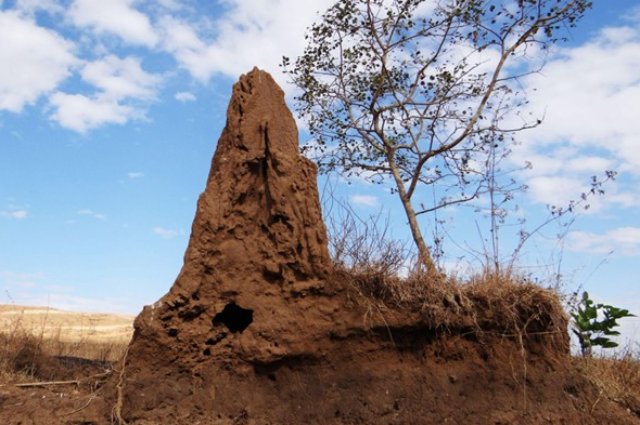
There are many things we can take away from insects. Due to being one of the smallest living beings on Earth, they have indeed found many clever and intelligent ways of sustaining themselves and surviving.
It’s not always, however, that we ourselves end up learning something from these small creatures that ends up being extremely beneficial to us. What is something we can all learn from the way insects tend to live?
What about the building known as the Eastgate Centre situated in Zimbabwe? Who has said to draw inspiration from the way termites build their hill mounds? Let’s take a look at how exactly that happened.
The Eastgate Centre
The Eastgate Centre in Harare, Zimbabwe, is a well-known shopping centre and office block designed by Zimbabwean architect Mick Pearce. The building itself was built by the company known as Ove Arup and Partners.
The name of the termite mound, also known as termite hills, was closely observed by Pearce, who, upon understanding the way the mound was built, realised that it was one of nature’s most wondrous architectures. He understood that these insects create their homes in such a way that, in extremely hot climates and areas, the mound provides an extremely cool structure that never overheats.
Pearce had also always been interested in biology, and upon learning about termites and their homes, he was able to get a new spark of inspiration for the assignment he was hired to build a blueprint for. A building that can hold shops, offices and many visitors.
He had initially struggled to find good ideas or solutions. Due to the costs and maintenance bills, it would be extremely difficult to create the average skyscraper of glass. Thus, when he had gotten the knowledge of the termites, he decided to try something no architect had ever done before.
The Architecture of Termite Mounds
Termite mounds across the world have been built in such a way that they are able to sustain the entire population of termites in an effective way. Scientists first assumed that the burrows were built to let air circulate throughout the mound, letting cold air in and hot air out. Acting as a sort of naturally based breathing cycle for the entire colony.
However, this has since been debunked due to new findings stating that the burrow is actually much more complexly built than we had initially thought.
Not only is it built in such a way that keeps cool air inside and pushes the warm air out, but it also provides a food source for the insects. Since the real nest is made under the entire mound, the cold air also provides the growth of a particular type of fungus that acts as a food source for the termites. Only when the mound has been built in a cold, humid and damp way that allows the growth of the fungus will the fungus thrive on the mound.
The other reason is that the mound itself acts as a complex process of airflow that changes at every point of the day. Where the nights provide, cool air gets absorbed into the mound; during the day, hot air is absorbed while cool air reaches the nest.
It works as a sort of lung-based system, a breathing organism that consists of many porous membranes around its surface.
So, using that idea, how did Pearce implement this kind of architecture into something we can use?
How it was made
There were many considerations that had to be made before even going forward with the idea of a blueprint. The first sketch made with the architecture of the termite mound in mind was drawn in a way that encompasses the main features of said mound. In short, he sketched as if he were trying to replicate biological anatomy. Modeling the core of the mound into something he could translate into a building.
He built chimneys in place of the towers of the mound. He would use concrete, steel and clay bricks in place of the soil used as a thermal material to build the mound. Most of all, the building was made in such a way that it would use the same system made by the termites, in a way that can be done by a large building.
Instead of the openings having to change to shift the airflow between hot and cold air, Pearce instead used low-cost fans that could circulate the air around the building.
The chimneys that were built also replicate the airflow of the burrows, absorbing cool air at night, then circulating around the building during the day. Same for the hot air, as it is absorbed during the day and released at night.
In his words, “The sandwich of the vaulted ceiling and the voided floor above acts as a heat exchanger. The cold night air passing through the void festooned with concrete teeth removes the heat of the previous day, and on the following day warm external air is cooled about 3°C by the same teeth before entering the room.”
The building has also done remarkably well for energy preservation, as it consumes 35% less energy than most other buildings that use traditional ventilation and air conditioning systems.
Ever since its opening in 1996 on Robert Mugabe Avenue, the Eastgate Centre has become a staple of unique and extremely effective architectural buildings.
Due to the unique structure of the building, the various successes achieved have also been tremendous, such as using less than 10% of the energy compared to any other office building, saving around $3.5 million in costs, as well as a strong reduction in tenants' rent price to a mere 20% compared to the surrounding buildings.
It has also had many versions come up, trying to replicate and translate the design into their own, trying to utilise the system and come up with new ways to expand it.
What truly astounds anyone is how no one would’ve ever guessed that the best engineers and architects of the world would be none other than the least likely to be living beings on the planet, proving how intelligent and unique these creatures can really be.
Proving how much we as humanity can learn so much from these simple but powerful little bugs.
References:
- https://www.slideshare.net
- https://constructsteel.org
- https://asknature.org
- https://en.wikipedia.org/wiki/Eastgate_Centre,_Harare
- https://www.youtube.com/watch?v=zcvVOZfTN-8