
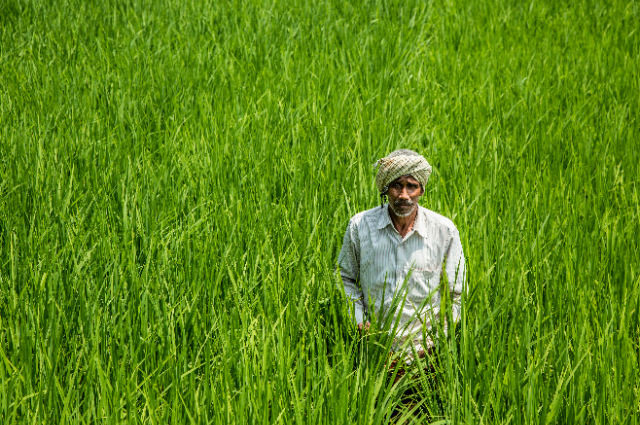
The summer of 2015 was particularly merciless in Yavatmal district of Maharashtra's Vidarbha region. The sky stayed cloudless for weeks longer than it should have. Wells dropped to their muddy floors. And in the village of Kalamb, a 41-year-old cotton farmer named Rajendra Bhalerao stood at the edge of his cracked field, staring at a crop that had already decided to die before he could.
He owed the moneylender ₹1.8 lakh. His wife had sold her wedding bangles the previous winter. His eldest son had quietly stopped asking about college.
By every statistical measure, Rajendra was one of thousands — part of the grim arithmetic that makes Vidarbha one of the most documented farmer-suicide belts in the world. Researchers, journalists, politicians, and NGOs had passed through his district. Some had photographed his neighbours. Most had moved on.
Rajendra did not move on. But he also did not give up.
What he did instead became one of the quietest, most stubborn acts of reinvention that nobody outside his village talked about — until other farmers started copying it.
The Breaking Point That Became a Turning Point
In August 2015, Rajendra attended a government-organised agricultural workshop in Yavatmal town — not because he was hopeful, but because the organizers were offering free lunch and a ₹200 travel allowance. He sat in the back row, arms crossed, waiting for another PowerPoint full of promises.
Instead, a retired agronomist named Dr. Suresh Khedkar from Pune walked up and said something that cut through Rajendra's exhaustion like a blade through dry soil.
"The problem is not your land. The problem is that you are growing what the market wants, not what your land is built for."
Dr. Khedkar was not talking about abandoning farming. He was talking about polyculture — growing multiple crops suited to low-water conditions alongside cotton, rather than depending on cotton as a single cash crop. Specifically, he spoke about integrating tur dal (pigeon pea), drumstick (moringa), and seasonal vegetables into the same plots, combined with micro-drip irrigation assembled from low-cost locally available materials.
Rajendra had heard variations of this before. But that evening, instead of going home, he asked Dr Khedkar a direct question: "Will you come to my field?"
The retired agronomist, perhaps surprised by the directness, said yes.
Rebuilding from Two Acres
Dr Khedkar visited Kalamb three weeks later. What he found was not hopeless land — it was exhausted land. Decades of chemical fertiliser dependency had depleted microbial life in the soil. Rajendra had been farming the way his father had farmed, and his father had farmed the way colonial-era cash crop policy had conditioned entire generations to farm — monoculture, high input, high risk, dependent on a single price curve Rajendra had no power over.
Together, they redesigned just two of Rajendra's six acres as a pilot — the rest remained under cotton to maintain some income continuity. They planted a mix of moringa along the field border (which would grow into a windbreak and marketable crop within eight months), tur dal in intercropping rows between cotton plants, and a small raised-bed vegetable patch irrigated by a gravity-fed drip system made from locally bought pipes and repurposed plastic containers.
The total setup cost, with Dr Khedkar helping source subsidised materials through a Pune-based agricultural NGO called Shetkari Sajawat, was ₹23,000. Rajendra borrowed ₹15,000 from his brother-in-law in Nagpur. The rest came from selling two goats.
The First Harvest That Changed His Mathematics
By February 2016, the results from those two acres had already begun to rewrite Rajendra's household accounts.
The moringa — whose leaves, pods, and seeds command consistent demand from both local vegetable markets and small processing units that supply nutritional supplement companies — yielded its first harvest in under nine months. Rajendra sold moringa leaves and drumsticks at the Yavatmal APMC market, earning ₹14,000 from that single planting in the first cycle. The tur dal intercrop added another ₹9,500 after home consumption. The vegetable patch, modest as it was, meant his family had stopped spending ₹800 to ₹1,200 per month at the local market for basic vegetables.
His cotton crop that same year underperformed — prices fell, as they often do — but the blow was cushioned. For the first time in four years, Rajendra did not borrow money in the months between harvests.
He repaid ₹40,000 of his moneylender debt. He told his son that college was back on the table.
The Ripple That Nobody Planned
In a farming community, success is visible. It is visible in whether a man rides a bicycle or drives a second-hand motorcycle to the market. It is visible in whether his wife wears new clothes at Diwali. It is visible in small, quiet ways that no press release can manufacture.
By the kharif season of 2016, four of Rajendra's neighbors — all cotton farmers, all carrying various degrees of debt — came to his field asking to see what he had done. He showed them without hesitation. He connected two of them to Dr. Khedkar's contact at Shetkari Sajawat. He helped a third neighbour, Vitthal Rathod, design a similar two-acre pilot on a field with slightly different soil conditions.
By 2018, eleven families in Kalamb and two neighboring hamlets had adopted variations of the polyculture-moringa model. None of them had done so through a formal government scheme. None had appeared in a news story. They had simply watched one stubborn man refuse to accept a predetermined outcome and then followed the map he had quietly drawn with his hands and his soil.
Dr. Khedkar, when asked about Rajendra in a 2019 interview with an agricultural journal in Pune, said: "I have worked with hundreds of farmers. The ones who change things are not the ones who wait for a scheme. They are the ones who ask someone to come and look at their problem directly."
What the Numbers Behind the Story Actually Say
Rajendra Bhalerao's story is not unique in its possibility — it is significant precisely because it is replicable. The Vidarbha crisis is structural and deep, rooted in debt cycles, fragile monsoon dependence, fluctuating Minimum Support Prices, and inadequate institutional credit access. Polyculture alone is not a policy solution.
But Rajendra's experience points to something the data also supports. Studies by the International Crops Research Institute for the Semi-Arid Tropics (ICRISAT) and field research from Swaminathan Research Foundation have repeatedly shown that integrated farming systems — combining cash crops with low-water legumes, horticulture, and micro-irrigation — can increase net farm income in dryland areas by 40 to 70 percent without significant increase in land or water usage, provided the transition is managed carefully over two to three seasons.
The barrier is rarely agricultural. It is psychological and financial. Farmers in acute debt cannot afford to experiment. The risk of a single failed season, when you are already underwater, is not an abstract risk — it is the end.
What Rajendra had that many others do not was a question he was willing to ask out loud in a room where he felt embarrassed to be. And an agronomist willing to get into a bus and come to a field.
Where He Stands Today
As of 2023, Rajendra farms all six of his acres under an integrated system. Cotton still occupies three acres — he understands its market realities but no longer bets everything on it. Moringa occupies one acre and has become his most consistent income stream. The remaining two acres rotate between tur dal, seasonal vegetables, and one year he tried turmeric, which did moderately well and which he plans to expand.
His eldest son, Aakash, completed a diploma in agricultural technology from a college in Amravati and returned to the village — not because there was no option, but because he chose to. He is now helping three other young men from nearby villages learn micro-drip irrigation assembly, charging a modest fee for training.
Rajendra no longer deals with private moneylenders. He has an active Kisan Credit Card account with a nationalized bank.
He still gets up before sunrise. He still reads the sky with the particular anxiety of a man who understands that weather does not negotiate. But the relationship between his labour and his future is no longer as brutally arbitrary as it once was.
He changed it with two acres, one borrowed idea, and the discipline to follow through when there was no guarantee.
What This Story Is About
On the surface, this is a story about farming. But it is also a story about the architecture of resilience — how human beings, when pressed against the edges of their circumstances, sometimes find within themselves a form of problem-solving that no scheme or subsidy designed from a distance could have manufactured.
Rajendra Bhalerao did not become a start-up founder. He did not go viral. He did not get a government award. He simply refused, very quietly and very stubbornly, to accept the story that had been written for him — and wrote a different one, one season at a time, in the soil of a district that the rest of the country had largely learned to mourn rather than watch.
That, perhaps, is the most underreported form of courage in contemporary India.