
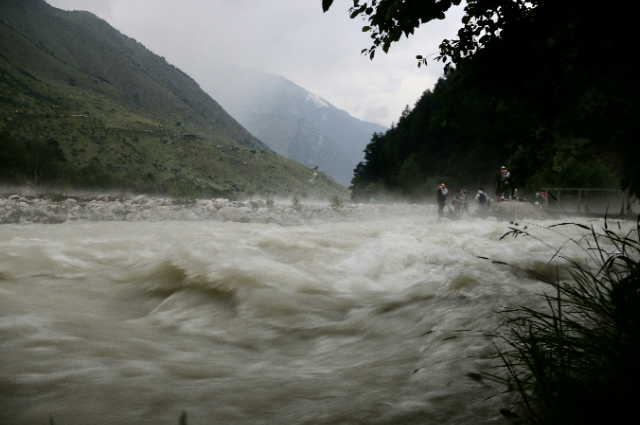
On the first of August, Kerala was once again facing floods. Rain had been pouring for days, and rivers across the state had already begun to swell. In Kannur district, Kariyankode River had burst its banks, submerging everything in its path. Somewhere in the middle of the river, in a narrow town located near Meenthulli, a sixty-one-year-old farmer named Benny was trapped. Water kept rising around him, and he had no way out.
Rajesh, a 36-year-old swimming and rappelling instructor from Kalliyoor, Thiruvananthapuram, heard about Benny’s situation. He was in Kannur that month for a training programme. He was also the president of the Kalliyoor Adventure and Disaster Management Club. Helping in times of crisis was a familiar experience for him. He had helped out in the 2018 Kerala floods as well as the 2024 Wayanad landslides. His sister later said that whenever he heard of a disaster, he would simply go. She said he seemed to find purpose in saving people. So when he heard about Benny, Rajesh did not hesitate. Along with two other rescuers, Shibin and a rafter named Jithin, he swam across the raging river to reach the town.
The river was nearly forty metres wide at that point, and they carried a rope and a life jacket with them. When they got close to Benny, they tried to throw the rope to him, but in that time his finger got caught and injured. By the time they managed to get him free, Rajesh had already reached him by swimming. Then came the decision that would cost Rajesh his life. He took off his own life jacket and gave it to Benny. For the journey back, Benny went first, followed by Shibin and Jithin in the middle, and Rajesh at the back holding on to the safety rope. They were almost at the riverbank when Rajesh lost his grip on the rope. The current pulled him down, and he disappeared from sight. For the next three days, teams searched the river for him. His body was eventually found on the fourth day, about a kilometre and a half downstream, near the Pulingome bridge.
Benny survived, but Rajesh did not. The news of his death moved the whole state. Kerala's chief minister, V D Satheesan, called it heartbreaking and said Rajesh's courage would be remembered forever. Political leaders across parties paid their respects. When his body was brought home to Kalliyoor, hundreds of people came to pay their respects, along with ministers and officials. His young children were among those who wept at the funeral. The state government later announced that it would complete the construction of Rajesh's unfinished house, as a way of honouring what he had done. But behind the tributes has a quiet reason.
Rajesh's family later said that he had taken loans just to be able to organise and participate in rescue missions such as this one. He left behind his wife Safiya and their two school-going children, along with his parents and sister. Two years ago, his brother had died in a train accident. His family had already known loss, and now they were mourning again, this time for a man who had spent his life trying to save others. Rajesh's story is being told as one of heroism, but it is also a story about what volunteering can cost the people who do it, and the families that wait for them at home. He did not have to swim across the river. He was not part of the official rescue force that day, and he went because someone needed help and he knew he could offer it. That is what makes his death so hard to sit with. The very thing that made him admirable is the same thing that took him away from the people who were loved by him. There is a simple lesson to be learned from what happened to Rajesh, though it is an uncomfortable one. The country often celebrates ordinary people who step up during disasters but rarely asks what support those people actually have while they are doing it or what happens to their families afterwards. A tribute and a house are meaningful gestures, but they arrive only after the loss has already occurred. Rajesh gave his life jacket to a stranger without thinking twice. Perhaps the least his story can leave behind is a little more thought, from all of us, about what we owe the people who keep showing up when disaster shows up.
References:
- iKerala Kaumudi, Hero to one family, heartbreak to his own: Rajesh dies saving 61-year-old Benny https://keralakaumudi.com
- The Print, Kerala CM pays tribute to swimming instructor who lost his life while saving another https://theprint.in
- WION, Kerala hero dies after giving his life jacket to save 61 year old in Kannur https://www.wionews.com
- IANS, I want to see my father: Children's cries bring tears as Kerala bids farewell to flood hero https://ianslive.in
- Manorama News, Kannur Cherupuzha Karyankode river, Rajesh's body found https://www.manoramanews.com
- Deccan Herald, Rescuer among 25 killed so far in Kerala calamities https://deccanherald.com