
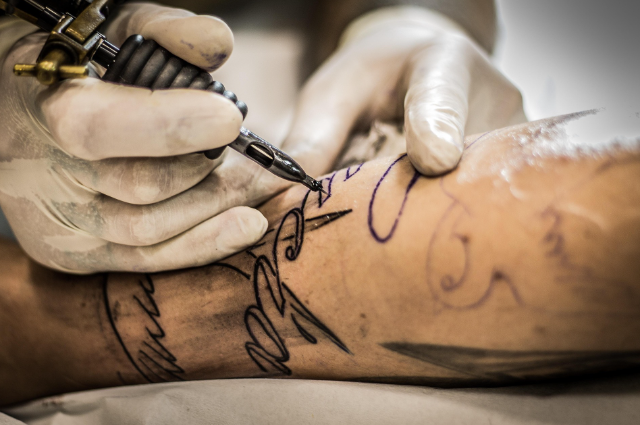
For over a century, a legendary piece of counterculture trivia has circulated through tattoo parlours and maritime waterfronts: the story of an outlaw sailor who looked at a failed piece of Thomas Edison’s office tech and re-engineered it to birth the modern electric tattoo industry. On December 8, 1891, the United States Patent Office issued “Patent No. 464,801” to Samuel F. O’Reilly for a “Tattooing-Machine.” It was a historic legal victory that effectively weaponised Edison’s own mechanical framework against his corporate grip, permanently anchoring the “Professor” of the Bowery into industrial history.
The Machine That Poked Papers
In 1875, Thomas Alva Edison developed the Edison Electric Pen. Patented the following year, it was the first consumer device powered by an electric motor in the United States.
Edison didn’t design it for skin. It was meant to be a high-speed office copier. Driven by an eccentric rotary motor mounted at the top of an iron shaft, a tiny steel rod punched holes through wax paper at roughly 50 punctures per second. This created a reusable stencil; an office clerk would then roll ink over the stencil to duplicate documents.
[ Edison's Rotary Motor ]
|
v
[ Reciprocating Rod ]
|
v
[ Pierced Paper Stencil ]
While innovative, the electric pen was a commercial flop. It required messy, volatile wet-cell acid batteries, making it heavy and impractical for Victorian-era desk clerks. By the 1880s, mechanical typewriters and mimeographs left Edison’s electric pen largely abandoned in the corners of industrial warehouses.
Enter Samuel F. O’Reilly. Born in Connecticut to Irish immigrants, O’Reilly was an adventurous, anti-authoritarian figure. Public records show he enlisted in the U.S. Navy in mid-1875, where he mastered the traditional, painful art of maritime hand-poking. Following his discharge, O’Reilly had a brief run-in with the law in Waterbury, Connecticut, on burglary charges, serving a short sentence before migrating to the crowded, chaotic underbelly of Lower Manhattan.
By 1886, O’Reilly had set up shop in the back of a barber shop at “11 Chatham Square”, the vibrant epicentre of New York City’s tattoo culture along the Bowery.
At the time, professional tattooing was a gruelling, agonisingly slow process. Artists bound needles to wooden handles by hand, puncturing the skin manually at a rate of just 2 to 3 pokes per second. A full chest piece or a sailor’s traditional “sleeve” required weeks of torment. O’Reilly knew that to dominate the booming Bowery market, he needed automation.
O’Reilly recognised that Edison’s failed office stencil pen was structurally identical to a hand-poked tattoo setup—it just needed to be adapted for human skin. O’Reilly re-engineered Edison’s rotary mechanism, making three fundamental, patented alterations:
The Integrated Ink Reservoir: Edison’s pen used dry needles because ink was applied to the paper after punching. O’Reilly added a hollow, adjustable tube assembly that acted as an ink chamber, feeding ink down the shaft via capillary action so it injected simultaneously with the puncture.
Ergonomic Hand Geometry: He redesigned the heavy, top-weighted iron framework into a balanced, tubular handle, ensuring an artist’s hand wouldn’t tire during hours of continuous operation.
Multi-Needle Drive Bars: Instead of a single needle punching paper, O’Reilly re-tooled the reciprocating drive bar to hold clusters of three to five needles, allowing artists to draw solid lines and pack heavy colour gradients at the same time.
The result was a mechanical marvel. O’Reilly’s machine converted a slow, agonising process into an efficient electric system that could puncture the dermis 50 times per second.
The Patent War: “Tattoo Artist at War”
Edison, notoriously protective of his intellectual property, fiercely guarded any technology derived from his labs. However, because O’Reilly’s modifications fundamentally shifted the machine’s utility from office duplication to an entirely new medium (dermal pigmentation), O’Reilly successfully filed and secured “US Patent No. 464,801” in December 1891.
SAMUEL F. O’REILLY - TATTOOING-MACHINE PATENT (NO. 464,801)
"With the handle A is combined an ink-reservoir E, through which the perforating-instrument passes, and if a reciprocating motion is imparted to said perforating-instrument its point or points are supplied with ink, which enters the perforations made in the skin…”
The patent gave O’Reilly a legal monopoly on the manufacture of electric tattoo machines, rendering him immensely wealthy. Calling himself “Professor O’Reilly,” he tattooed sideshow attractions, high-ranking naval officers, and even eccentric members of European nobility who travelled to the Bowery incognito.
The legal battles didn’t end with Edison. O’Reilly’s patent was so lucrative that it sparked bitter copycat feuds. On February 6, 1900, The New York Times published an article detailing a massive lawsuit titled “Tattoo Artist at War,” charting a public court battle between O’Reilly and his former partner, Elmer Getchell, who claimed he had invented the device independently. O’Reilly successfully defended his title, firmly remaining the undisputed godfather of the mechanised tattoo.
The Legacy of the 1891 Breakthrough
O’Reilly’s reign ended abruptly in April 1909 when he suffered a fatal fall while painting his house in Brooklyn. His business and machine designs were passed down to his prize student, Charlie Wagner, who would later adapt the rotary design into the dual-coil electromagnetic machine layout still widely used today.
Edison’s name is in every history textbook for lighting up the world. But every time an artist flicks a switch and a tattoo machine hums to life at 50 beats per second, it is the legacy of an Irish-American sailor who beat Edison at his own game.
References
- United States Patent Office: Patent No. 464,801: “Tattooing-Machine”, Granted to Samuel F. O’Reilly, December 8, 1891.
- The New York Times Archives: “Tattoo Artist at War” (February 6, 1900) – Historical coverage of the Southern District of New York patent infringement case.
- The Smithsonian Institution (Lemelson Centre): “What’s Edison Got to Do with Tattoos?” – Documentation on the structural evolution of the 1876 Autographic Printing Pen into the 1891 tattoo drive.
- New-York Historical Society: Edison and the Tattoo Records – Collection detailing the history of 11 Chatham Square and “Professor” O’Reilly’s cultural reach among early 20th-century New York society.
- The Tattoo Archive: Samuel O’Reilly & Charlie Wagner Biographies (Carmen Forquer Nyssen, Buzzworthy Tattoo History) – Archival lineage tracking Navy enlistment rosters, local directories, and the transition of early rotary devices.