
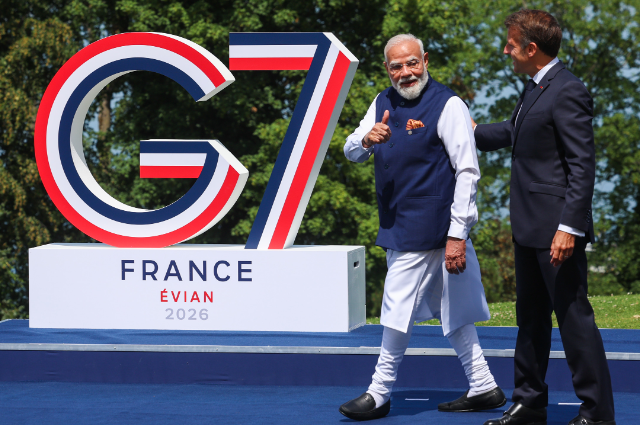
Whenever Prime Minister Narendra Modi arrives at a Group of Seven (G7) summit, the domestic political machinery and mainstream Indian media routinely broadcast the imagery as definitive proof of India's ascent to the pinnacle of global governance. Red carpets, warm handshakes with Western heads of state, and prominent placement in family photos are framed as an implicit admission into the world’s most exclusive club. However, a structural dissection of the G7's architecture reveals a sharp distinction between symbolic visibility and systemic integration. India’s engagement is characterised strictly by an invitation, not inclusion.
The Architectural Legacy of the G7
To understand India's modern status at these summits, one must look at the genesis of the forum itself. The G7 began informally in the wake of the 1973 oil crisis, initially convening as the Library Group inside the White House. By 1975, it solidified into a regular summit of highly industrialised, advanced market economies, comprising seven nations: the United States, Canada, the United Kingdom, France, Germany, Italy, and Japan, with the European Union participating as a non-enumerated member. Unlike formal international organisations such as the United Nations or the International Monetary Fund, the G7 possesses no permanent secretariat, no founding charter, and no legally binding voting mechanisms. It operates purely as a consensus-driven directorate of wealthy, aligned democracies. The exclusivity of this club is zealously guarded. While Russia was tentatively integrated in 1998 to form the G8, an experiment in post-Cold War assimilation, it was swiftly suspended and subsequently ejected in 2014 following its annexation of Crimea. Tellingly, China, despite rising to become the world’s second-largest economy, has never been extended an invitation to join the core fold due to its lack of open democratic systems and adversarial posture toward Western market structures.
The Mechanics of the 2026 French Outreach
Under the G7 configuration, the host nation of the annual summit holds complete discretionary authority over the agenda and the guest list. For the 2026 summit hosted by France, the leadership in Paris extended guest invitations to a select cadre of non-member nations, including India, Brazil, Egypt, Kenya, and South Korea. This Outreach mechanism serves a dual structural function for the host. First, it offers a veneer of global representation to an institution frequently criticised as a legacy artefact of the 20th century. Second, it allows the core Western powers to lobby pivotal regional actors on contemporary global crises, from supply chain resilience to emerging Special Geopolitical technological standards. Yet, for all the diplomatic pageantry, these invited nations do not sit in the core deliberative chambers. They do not possess a vote, they do not participate in drafting the core economic communiqués, and they remain structural outsiders to the principal agreements forged by the seven permanent members.
Category | Nations | Functional capabilities and limits. |
Core members | US, UK, France, Germany, Italy, Japan, Canada, EU | Full deliberative rights; draft core communiqués; determine global financial sanctions and alignments. |
Invited guests | India, Brazil, Egypt, Kenya, South Korea | Participation limited strictly to specific Outreach sessions; no voting rights; no role in primary executive decisions. |
Systemically excluded | China (never invited), Russia (permanently ejected) | No structural access; explicitly the targets of G7 regulatory, economic, and counter-strategy frameworks. |
The Real Value: Sidebar Bilaterals over Collective Communiqués
Because the formal sessions of the G7 offer little legislative leverage to guest invitees, New Delhi's diplomatic apparatus approaches these summits with clear-eyed realism. The actual value of Prime Minister Modi's attendance lies almost exclusively in the sidebar bilaterals—the ad-hoc, face-to-face meetings negotiated on the margins of the main event. On the sidelines of the French summit, the Indian delegation routinely bypasses the restrictive multilateral agenda to conduct rapid-fire transactional diplomacy. Free from the constraints of formal joint statements, India can negotiate d technology transfers with France, secure critical mineral access with Canada, and manage complex trade friction points with the United States. These bilateral corridors provide India with the diplomatic premium of a high-profile international stage without forcing it to bend to the collective geopolitical mandates of the G7 core, particularly regarding aggressive joint stances against Moscow or rigid economic frameworks that could hamper developing economies.
Strategic Autonomy: Why Total Inclusion May Not Be India's Goal
While commentators frequently lament India’s exclusion from the formal G7 mechanism, total inclusion might structurally undermine New Delhi’s foundational foreign policy doctrine: strategic autonomy. If India were ever offered formal membership, it would face immediate, suffocating pressure to align its foreign policy with the Western consensus fully. India's geopolitical weight relies on its unique status as a bridge. Achieving full membership in an exclusively Western-aligned bloc would severely compromise its leadership of the Global South and its crucial Eurasian partnerships. The G7 demands strict policy cohesion on global security and economic warfare. For India, a formal seat would necessitate a painful and dangerous rupture with Russia, a country that remains India’s primary supplier of defence hardware and a critical provider of discounted crude oil. Furthermore, as an official member, India would be forced to endorse Western-centric climate mandates and trade restrictions that directly conflict with its domestic industrial imperatives. By remaining a perennial guest, India enjoys an optimal geopolitical sweet spot: it commands the prestige of the Western table while retaining the absolute freedom to disregard its decrees.
Ultimately, the G7's invitation to Prime Minister Modi is an acknowledgement of India's undeniable systemic weight, not an admission of institutional equality. The G7 cannot credibly address global challenges like supply chain security, semiconductor manufacturing, or artificial intelligence without engaging New Delhi. However, India's status remains firmly designated as an input provider rather than a core decision-maker within this specific forum. For India, the annual trip to the G7 is a calculated exercise in leverage, accepting the invite for its practical bilateral utility, while remaining comfortably distant from a structural inclusion that would constrain its sovereign freedom.
References:
- Bayne, N. (2020). Hanging in There: The G7 and G8 Summitry in Maturity and Renewal. Routledge.
- Jaishankar, S. (2020). The India Way: Strategies for an Uncertain World. HarperCollins India.
- Kirton, J. J. (2016). G7 Governance in a Multipolar World. Ashgate Publishing.
- Pant, H. V. (2024). "India and the G7: Navigating the High Table of Global Diplomacy." Observer Research Foundation (ORF) Analysis.