
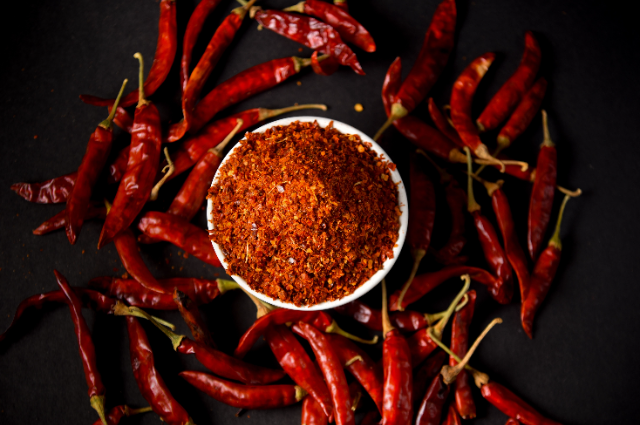
The illusion of heat.
While humans categorise spiciness as a component of flavour, it does not engage classical gustatory (taste) pathways. Instead, the sensation of heat from chilli peppers is mediated by the somatic sensory nervous system, specifically through chemesthesis.
The primary molecular culprit is capsaicin, a lipophilic vanilloid compound found in plants of the genus Capsicum. When consumed, capsaicin binds selectively to the Transient Receptor Potential Vanilloid 1 (TRPV1 receptor. Discovered during seminal cloning work in the late 1990s, TRPV1 is a ligand-gated, non-selective cation channel predominantly expressed on the peripheral terminals of primary afferent nociceptors, such as unmyelinated C-fibres and thinly myelinated A$\delta$ fibres.
Physiologically, TRPV1 acts as a molecular thermometer and polymodal detector. Under basal conditions, it is activated by noxious physical heat (temperatures greater than 43°C) and tissue acidity (pH less than 6), prompting a defensive influx of calcium and sodium ions that depolarise the neuron and trigger an action potential.
Capsaicin lowers the physical activation threshold of TRPV1 from greater than 43°C to standard human oral temperatures (~37°C). Consequently, the channel opens at room temperature, sending an identical electrochemical fire alarm along the trigeminal nerve pathway to the somatosensory cortex. The brain experiences a full-scale thermal emergency even though the tissue temperature remains entirely unchanged.
The Neurological loop: Pain, relief, and craving.
Because the brain interprets trigeminal nerve signals from TRPV1 as a genuine localised thermal threat, the central nervous system activates endogenous survival mechanisms. To mitigate the perceived physical trauma, the arcuate nucleus of the hypothalamus and the pituitary gland trigger a systemic release of beta-endorphins. These endorphins bind to mu-opioid receptors on presynaptic nerve terminals, inhibiting the further release of substance P and attenuating the pain signal. Simultaneously, this physiological stress response stimulates the mesolimbic pathway, leading to a localised release of dopamine within the nucleus accumbens—the brain's reward centre. The downstream effect is an accidental neurochemical reward, the co-activation of analgesic relief and mild euphoria occurring in response to an entirely phantom injury. Over time, individuals develop a conditioned behavioural craving for spice, effectively chasing this neurochemical payoff.
Tachyphylaxis vs Drug tolerance: the mechanism of spice tolerance
Regular spice consumers experience a marked decrease in their sensitivity to heat over time. While this mirrors the clinical progression of drug tolerance, the underlying cellular mechanics differ significantly.
In pharmacology, traditional drug tolerance often involves receptor downregulation or changes in metabolic clearance rates. The desensitisation observed with capsaicin is a specialised form of rapid, short-term tolerance known as tachyphylaxis. When capsaicin chronically stimulates TRPV1, the sustained influx of intracellular calcium activates calcium-dependent enzymes like calmodulin and calcineurin. These enzymes desensitise the pore through dephosphorylation, forcing the TRPV1 channels to temporarily uncouple from the cell membrane or change their conformation so they no longer open efficiently. Furthermore, prolonged activation causes the profound depletion of substance P and calcitonin gene-related peptide (CGRP) from peripheral nerve terminals. Without adequate stocks of substance P to act as the primary neurotransmitter crossing the synaptic cleft into the dorsal horn of the spinal cord, the peripheral pain signal is functionally bottlenecked. The sensory nerve endings fall into a state of chemical exhaustion, demanding significantly higher concentrations of capsaicin to force the remaining active receptors into an open state.
The psychology of pungency: benign masochism.
The human drive to overcome chemical pain for culinary enjoyment is an evolutionary anomaly. In nature, plants evolved capsaicin as an adaptive defence mechanism to deter mammalian herbivores while allowing birds (who lack TRPV1 receptors) to distribute seeds. Humans are the only mammals known to actively seek out and consume capsaicin. This unique behavioural phenomenon was categorised by psychologist Paul Rozin as benign masochism—the enjoyment of innately negative, threatening, or painful bodily sensations in an environment where the individual experiences a baseline cognitive assurance of absolute safety. Rozin posits that spicy food represents a clear victory of mind over body. The primitive, subcortical regions of the brain register a severe physiological threat, producing defensive autonomic responses like sweating, gustatory tearing and elevated heart rate. Concurrently, the highly developed prefrontal cortex exercises a cognitive override, recognising that no structural cellular damage is actually taking place. The juxtaposition between the body's defensive panic and the mind's safety appraisal creates an experience of pleasure, transforming a biologically hardwired warning signal into a deeply complex loop of thrill-seeking and reward.
References
- Fattori, V., Hohmann, M., Rossaneis, A., Pinho-Ribeiro, F., & Verri, W. (2016). Capsaicin: Current understanding of its mechanisms and therapy of pain and other pre-clinical and clinical uses. Molecules, 21(7), 844. https://doi.org
- Louis-Gray, K., Tupal, S., & Premkumar, L. S. (2022). TRPV1: A common denominator mediating antinociceptive and antiemetic effects of cannabinoids. International Journal of Molecular Sciences, 23(17), 10016. https://doi.org
- O'Neill, J., Brock, C., Olesen, A. E., Andresen, T., Nilsson, M., & Dickenson, A. H. (2012). Unravelling the mystery of capsaicin: A tool to understand and treat pain. Pharmacological Reviews, 64(4), 939-971. https://doi.org
- Petran, E. M., Periferakis, A., Troumpata, L., Periferakis, A. T., Scheau, A. E., Badarau, I. A., Periferakis, K., Caruntu, A., Savulescu-Fiedler, I., Sima, R. M., Calina, D., Constantin, C., Neagu, M., Caruntu, C., & Scheau, C. (2024). Capsaicin: Emerging pharmacological and therapeutic insights. Current Issues in Molecular Biology, 46(8), 7895-7943. https://doi.org
- Rozin, P., Guillot, L., Fincher, K., Rozin, A., & Tsukayama, E. (2013). Glad to be sad, and other examples of benign masochism. Judgment and Decision Making, 8(4), 439-447. https://doi.org
- Rudd, J. A., Nalivaiko, E., Matsuki, N., Wan, C., & Andrews, P. L. (2015). The involvement of TRPV1 in emesis and anti-emesis. Temperature, 2(2), 258-276. https://doi.org