
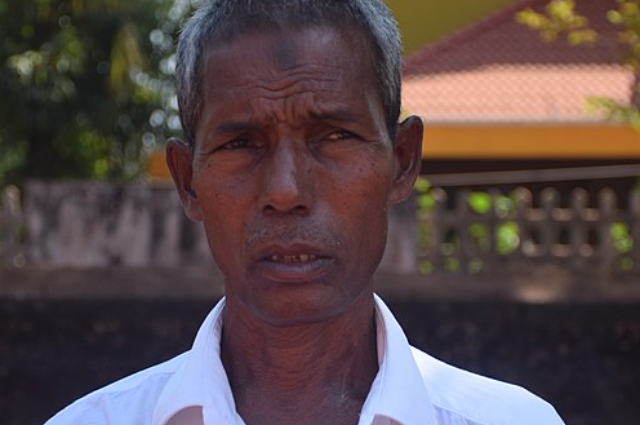
On a normal day in the life of Harekala Hajabba, a humble seller of oranges from Karnataka in India, it turned out to be one that would become the defining point in the life of Hajabba and even shape the development of an entire village. While selling his goods on the highway of Mangaluru, Hajabba came across a foreign tourist looking to buy the fruits and inquired about their cost in English. With a lack of literacy and understanding of the language, the tourist was left disappointed and walked away. While most people would consider it a simple, embarrassing experience, for Hajabba, it became an unforgettable experience of what education can do and how much one loses by not having it.
Hajabba, who was born in the poor family of Harekala village, did not have the opportunity for formal education. Like many other children in rural India, due to poverty, he had to work from a very young age to earn a living by selling oranges and support his family on a meagre salary. In spite of not being literate, he always had faith in the power of education. It was the continuous frustration of his inability to communicate with the foreign tourist that always reminded him that lack of knowledge was due to the circumstances and not due to any personal inadequacy.
In 1999, Hajabba made an extremely unusual move. With the savings of money that he had accumulated from selling oranges over the years, he started a school in the village of Newpadpu, which did not have sufficient facilities for educating young kids before that. It was an exceptionally daring act considering that Hajabba did not have rich donors, financial support from the government, connections, or even any schooling for himself. However, he did have determination. The school started with 28 kids in it and was housed in a small building with little means. People wondered how an uneducated fruit seller like Hajabba would start up a school, but Hajabba firmly believed that education was the best gift that he could give to his village.
The impact of his decision became increasingly clear. Parents, who had previously lacked easy access to a school, now had reasons to be hopeful again. Children, who would have otherwise led a life working as labourers or staying back at home, now learned reading and writing and dreamed of better things in the future. Gradually, the school grew in a sustained fashion, until it educated roughly 175 children up to class 10. For a village which had been ignored for long, the school was more than just an institution of learning; it became a source of hope and dignity and change. It became clear through Hajabba’s dream that development need not always come from the actions of the government or rich people. At times, it starts with one lone man and his determination to bring about change.
What is more remarkable about Hajabba's journey was the conspicuous contrast between his entry into life and the outstanding achievements of his life. He held the realisation of education in higher regard than those who have been well-educated. As he put it himself, he did not want children to experience the insult of ignorance as he had during childhood.
This goes to show that the importance of education is well appreciated not just as a skill of literacy but also as a sense of purpose, confidence, independence and the know-how to interact with the outside world. His example defies the claim that qualifications are the recipe for leadership and that "vision and compassion" count for much more.
The recognition and praise for his work finally came from the uppermost echelons of the country. In 2020, the Government of India awarded him the Padma Shri (which is the fourth most important civilian honour given by the government) for his services in the spheres of education and social service. Even at this time of national accolade, however, Hajabba remained modest. He went barefoot for the award ceremony, explaining that the honour was not for himself but for the school and children it would serve in the years to come. His humility was an inspiration to millions and confirmed the integrity of his vision. Unlike many other recipients of awards and public attention, Hajabba had never been a man to work for applause but was only interested in doing what he set out to accomplish: make sure every child in his village was able to be educated. Today, Hajabba is fondly remembered as "Akshara Santha" - The Saint of the Alphabet. This designation, however, is more than just a tribute to his single-minded pursuit of the cause of education. It is a reminder of the values he espoused: devotion, persistence and hope. It also demonstrates that education is perhaps the most effective way of disrupting poverty and achieving social change on a large scale, and that citizens as individuals as you and me are capable of addressing the world-changing problems around us. Hajabba was not that rich, nor was he influential or well-educated, but he had empathy based on experience and the courage to undertake action.
In a time when debate over educational change tends to focus on spending, buildings and bureaucracy, Hajabba's message provides a welcome change. It shows that true change is born from kindness of heart and taking personal responsibility. It encourages teachers, government officials, children and voters to see that a single act of courage has the potential to extend out across time. The children who learned in the school built by this one man will, in all probability, have a huge impact on their family's future. Each graduating class is one more life transformed by a man who did not wallow in his pain.
In the end, Harekala Hajabba has shown us how the story of an orange seller can become the story of a school. It shows us that we can beat any obstacle with resilience, that we can break any barrier with determination, and that just one simple question asked can lead to an incredible legacy. Imagine the irony that the foreign tourist who interactively revealed Hajabba's lack of English had unwittingly agreed to awaken a dormant people's yearning for education. Decades on, the answer to the question that went unanswered in the cold desert air is waiting for us in the warm glint of children's smiles, as they step into class and open books to their new life. Hajabba has shown us that education is not what paper degrees we hold, but the future we build in the minds of others. His inspired journey is a timeless treasure of how one person's implausible aspiration can uplift an entire nation.
References:
- The Print article
- The Indian Express article
- India Today article
- Padma Awards 2020 Notification