
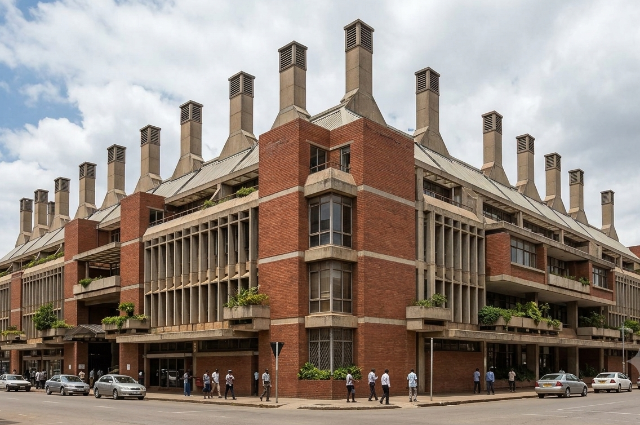
Among the buildings that best showcase sustainable architecture is the Eastgate Centre in Harare, Zimbabwe. At first glance, the centre seems to be just another shopping mall and office block; however, within its walls, there is an amazing natural cooling mechanism. The building was designed by the famous architect Mick Pearce, who cooperated with engineers from Arup in the 1990s. Contrary to the widely held belief that large commercial buildings built in tropical areas have to be equipped with an artificial cooling system to be comfortable, the Eastgate Centre demonstrates how it is possible to design such a building and significantly reduce its energy consumption and operating expenses s. Instead of expensive cooling systems, the building employs a natural ventilation system similar to termite mounds. It proves how important observations of nature can be for solving difficult engineering tasks that people face.
The country has hot temperatures for most parts of the year, and hence cooling of these buildings is quite challenging. Conventional buildings have to keep running their air conditioners throughout the day to ensure that there is a good indoor environment; this consumes plenty of electricity and hence causes high carbon emissions. At the same time, during the latter part of the twentieth century, Zimbabwe had been facing an energy crisis, and thus it became quite necessary to look for other means of cooling than conventional methods. The architect Mick Pearce had a theory that manmade buildings need to cooperate with nature rather than fight against it using technology.
Termitaria, especially those constructed by African termites, keep their internal temperature almost constant despite huge temperature variations in the external environment. On a clear, sunny day, the outside temperature is exceptionally hot, and at night it is unusually cold. However, the temperature in the termitarium does not change in a manner that threatens the survival of the termites and the fungus that they grow. This exceptional achievement is made possible by a series of tunnels and vents that facilitate circulation of air. The warm air ascends and goes out through the top vents while the cool air goes in through the bottom. There is always an endless circulation of the air due to the force of convection.
In order to implement a similar system within the design of the Eastgate Centre, Mick Pearce borrowed ideas from this biological process. Air movement occurs continually within the Eastgate Centre because it has an advanced system of air passages, chimneys, and air ducts. As temperatures cool during the night, fresh air is brought inside the building, and the coolness is captured by the concrete floors and walls of the building. This happens because concrete has a large thermal mass and can retain cooler temperatures for longer durations. On the other hand, when temperatures increase during daytime, the warm air rises due to its lighter nature through the chimneys, and new air replaces it.
While the Eastgate Centre mainly employs the technique of passive cooling, the use of mechanical fans is another strategy employed to ensure proper circulation of air if need be. These mechanical fans, unlike conventional air conditioners which consume large amounts of electrical energy, require very little energy since they function according to the natural flow of air in the building and not forced artificial cooling. The temperature inside the building is measured by sensors, thus ensuring that the ventilation is adjusted depending on weather changes. Through such a combination of natural and technological approaches, the structure has managed to find an effective balance between comfort and energy efficiency.
One of the most remarkable features of the Eastgate Centre is its great energy efficiency. Research has indicated that the building utilises up to 90% less energy compared to other similar buildings fitted with standard air-conditioning systems. This leads to huge financial gains for the building owners and occupants since reduced electricity usage equates to lower costs of operation, thus reducing costs for office space. For areas where electricity is costly and unreliable, savings such as those made at the Eastgate Centre become especially useful. The Eastgate Centre shows that green architecture can also be highly economical.
In addition to saving energy, there are various environmental advantages associated with the building. Traditional air conditioners emit considerable amounts of greenhouse gases due to their heavy use of electricity and even their refrigerants in some instances that can damage the atmosphere. Due to the significant reduction in the use of air conditioners in the Eastgate Centre, the building becomes less environmentally harmful and thus saves resources. Also, due to the reduced load on the electrical power grid, the building is of particular value to those countries where there might be difficulties in generating electricity. Additionally, the building provides healthy indoor air quality through passive ventilation of the air.
The Eastgate Centre has been well known around the globe as one of the best buildings that use the concept of biomimicry. Biomimicry refers to the process whereby designs are based on strategies found in nature in order to address human problems. Nature is not seen as something to overcome but rather as something to learn from after millions of years of evolutionary processes. The success of the Eastgate Centre has motivated architects and engineers across the globe to consider designing their buildings through similar concepts. There are now many environmentally friendly buildings using passive cooling and other designs from the biological world.
This is because of its architectural significance. With rising temperatures due to climate change and increasing demands on energy consumption, it becomes necessary for cities to develop buildings that use less energy but still provide a comfortable environment. Eastgate Centre serves as an excellent example for future generations of buildings. Instead of depending only on technology in the form of bigger machines to overcome environmental problems, architects can design buildings that work hand in hand with nature and their surroundings.
The Eastgate Centre will always stand out as an example of how innovation can start from nature itself. Using designs of termite mounds, Pearce designed an office building that would be globally recognised as an icon of sustainable engineering. The passive cooling system, the use of thermal mass, and the ventilation system show how environmentally friendly designs can surpass traditional designs in terms of efficiency and costs as well. Over three decades since its construction, the Eastgate Centre continues to inspire architects and environmentalists, proving that the future of architecture is not with machines but within the wisdom of nature itself.
Sources: -
- The Eastgate Centre (Official Information) Eastgate Centre, Harare, Zimbabwe https://www.eastgate.co.zw
- Arup (Engineering Partner), Eastgate Centre, Harare https://www.arup.com
- Biomimicry Institute: Termite-inspired building ventilation and biomimicry https://biomimicry.org
- Encyclopaedia Britannica: Biomimicry https://www.britannica.com