
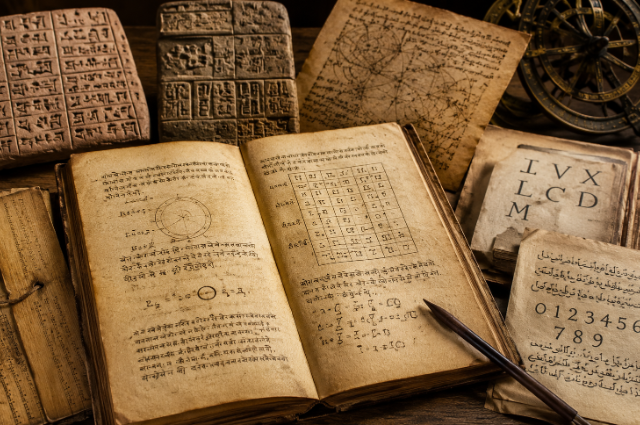
Picture a world where there was no such thing as zero. No base numbering systems, no algebra as we know it today, no computers, and no modern technological developments. However, for most of humanity’s existence, the idea of zero either did not exist or was not understood. Different societies and cultures had their own interpretations of zero – until finally, it was the Indian civilisation that made the transition from simply representing a value in a number to giving it its own identity as a number.
For example, ancient societies like the Babylonians and Mayans used symbols in their numerical system to signify an empty place; however, those symbols were never thought of as numbers per se. They served to organise the calculations, but they did not have significance as a number in and of themselves. Thus, while they alluded to the concept of 0, they did not truly understand what it meant.
An important milestone occurred in India, where Brahmagupta (c. 628 CE) became the first mathematician to define the digit 0 as a number and create systematic procedures (i.e. arithmetic) for doing arithmetic operations with it. This was a groundbreaking moment in mathematics when a number was officially identified as a mathematical object eligible for mathematical operations.
Brahmagupta explored the effects of adding and subtracting 0 to/from other numbers and defined rules for negative numbers, which were not well understood in most parts of the world at that time. Although today many of the rules that he developed, particularly those related to dividing by 0, have been significantly refined, his contributions are the basis of modern mathematics.
The zero concept diffused from India and rapidly reached the Islamic world, thanks to the work of traders and scholars. Arabic mathematicians improved upon the work of their Indian predecessors and continued to refine and advance this body of mathematics. Through many translations of material from Arabic to Latin and ongoing intellectual exchange, zero was imported into Europe.
Europeans were not quick to accept zero as a number. Many scholars and institutions were doubtful of the new number system. The number system at that time, the Roman number system, was already strongly established as the standard for trade and trade-related activities and had been for hundreds of years. The introduction of zero was viewed as a challenge to the way in which mathematicians and number theorists traditionally thought about numbers and mathematics.
The turning point in the history of mathematics came with the publication of “Liber Abaci” (The Book of Calculation) by Leonardo of Pisa (Leonardo Pyrrhus), who will be commonly referred to as Fibonacci. In “Liber Abaci”, written in thirteenth-century Italy, the Hindu-Arabic numeral system (including zero) was presented to a wider European audience. Throughout Europe, merchants, scientists, and mathematicians began to adopt this new numeral system because of its practical advantages.
Zero is so foundational to our current system of mathematics that it’s hard to imagine the world today without it. It is the building block of the decimal numerals; it is necessary for performing complicated calculations; and it is at the centre of the binary code (computer language). All of the technology we currently use, including phones, satellites, and computers, is based upon a mathematical system where zero is essential.
The story of zero is more than an account of mathematical exploration; it shows how major ideas that change the course of civilisation can originate from one society, cross many continents, and ultimately have a profound impact on humanity. While many civilisations have experienced the concept of nothingness, it was in India that civilisation created the true mathematical nature of zero.
Although zero indicates 'none,' there is no way to quantify how much it has affected humanity. As such, zero is considered one of humanity's greatest achievements in terms of intellectual accomplishment. This shows that sometimes, the greatest ideas come from the simplest of concepts.
References: -
- Brahmagupta. Brahmasphutasiddhanta (628 CE), the work in which Brahmagupta defined zero as a number and established arithmetic rules involving zero.
- The Crest of the Peacock: Non-European Roots of Mathematics. Princeton University Press, 2011.
- Zero: The Biography of a Dangerous Idea. Penguin Books, 2000.
- A History of Mathematics. John Wiley & Sons, 2011.
- Fibonacci. Liber Abaci (1202), which introduced Hindu-Arabic numerals, including zero, to Europe.