
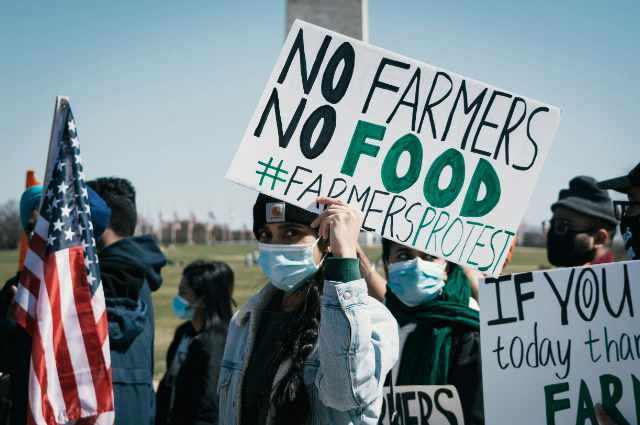
Protesters on the move once again descended on the national capital as thousands of farmers from Punjab, Haryana, U.P., Rajasthan and other states converged under the Desh Bachao Morcha to oppose the proposed India-US trade deal. The people’s movement highlights the deepening anxiety within India’s farming community, which believes that the trade agreement may open up the Indian farm sector to cheaper American produce. Police sealed dozens of entry points into Delhi, diverted traffic, and deployed a heavy police force to block off access to the capital’s central government buildings for the protesters. In a further escalation, one of the major rural protest leaders was detained by police before he had the chance to participate in the march. This protest fell on the day following a huge rally in the capital by the Cockroach Janta Party.
Why Are Farmers Protesting?
Th of the protests are the fear that the India-USA trade deal could force India to bring down import duties on many agricultural products. Farmers contend that American agriculture, bolstered by generous government support, class-leading technology and huge mechanised farms, can produce foodstuffs at much lower prices than Indian farmers.
As tariffs are decreased, there could be an increase in importing all sorts of things into Indian markets– maize, soybean, dairy, apples, almonds, poultry products, processed foods, etc. Farmers are concerned that falling prices due to imports may hit the traders for the local crops and decrease the prices of the local commodities, making livelihood unsustainable for millions of farmers.
Most of the farm land holdings are less than two hectares, and farmers adjust their farms to uncertain monsoons, high input prices and poor technology. The protesters say, It would be impossible for us to compete with heavily subsidised agriculture in the U.S.
Concerns Beyond Prices
The federation of farmers organisations says the crisis is not just about market competition. They are concerned that the trade deal could lead to the erosion of the country’s public procurement and food security system. Protestors also warned that further market liberalisation could impact the safety net provided by the government through the price mechanism of Minimum Support Price and procurement of wheat and paddy.
Despite the repeated government assurances that MSP is not going to be compromised, numerous farmer unions continue to express reservations, recalling the farmers' movement at the national level against the farm laws, which have now been done away with. According to protest leaders, assurances of the government are not enough, and fundamental trading agreement cannot be done without legally binding assurances to uphold MSP and protect native farming. Farmers are also worried about tighter intellectual property restrictions on seeds and technology. Several unions are afraid that this would lead to increased control over seed markets by global corporations, further tying the farmers into costly commercial seed use.
Government's Position
According to the Union Government, trade negotiations are prepared for increasing Indian exports, attracting investments, and creating new economic possibilities. Indians state that even if there is an agreement with the U.S., the broad core agricultural interests would be safeguarded, while Indian exports and services would be offered larger markets.
During the trade negotiations, representatives of the government consistently informed stakeholders that sectors such as agriculture would be safeguarded. Furthermore, they assured that INDIA has been fighting for its farmers all along and will do it always. However, the fact that no information about the present negotiations has become available to the public has left farmer groups in a state of limbo requesting more transparency and consultation before any deal is signed.
Police Action and Security Arrangements
With thousands of protesters entering Delhi, police arranged numerous checkpoints on highways linking districts of Punjab and Haryana with the national capital. The police placed concrete barricades and diversion routes and mobilized more security forces.
Pre-emptive efforts to disrupt the demonstration included the police detention of leading farmers' representatives, of which at least one was senior until after the demonstration had started. Farmer groups condemned their detention as harassment to prevent a peaceful protest and reaffirmed that they would carry on with their agitation until the government made positive responses to farmers' grievances against the trade deal.
Diversion and security restrictions affected vehicular movement for several hours in several parts of Delhi and adjoining NCR.
Political Implications
The protests have taken on a political dimension in no time. Opposition parties have criticised the government for neglecting farmers' interests and focusing instead on negotiations at the international level. Many of opposition leaders voiced support to protesters and urged Parliament to be enlightened about the specifics of the deal being negotiated with the United States. The ruling establishment has also justified its present stance, contending that long-range economic development and international trade linkages are the indispensable backbone for country development. Government authorities asserted that it has remained focused on integrating international economic concerns with farmers' interests. Political analysts see the protests as likely to impact future debates over agricultural reform, particularly because Pakistan's elections depend on farmers' votes in northern India.
The Larger Debate
The protests underscore a larger policy dilemma India faces. On the one hand, the country is looking toward greater integration into the global supply chains and fostering closer economic ties with large economies like the United States. On the other hand, agriculture employs about half of the Indian population, and millions rely on small-scale farming to survive. While there is consensus that trade liberalisation benefits developing countries in the short run, economists are divided on whether this also holds in the long run. There is evidence that competition will lead to efficiency and access to a wider choice of imports and prospects for export. However, safeguards may be needed to protect impoverished farmers from being unable to compete with subsidised foreign products.
Numerous planting specialists believe that if India goes ahead with the deal, then stepwise, it has to bolster income subsidies, increase rural infrastructure, achieve higher agricultural output, and upgrade safety specifications for small cultivators.
The farmers' demonstration in opposition to the proposed India-US trade agreement signifies an effort by farmers to combat more than a mere trade agreement; it embodies resistance rooted in years of apprehensions regarding the sustainability of agricultural practices, the integrity of rural economies, market equity, and the clarity of economic policy. To the government, trade negotiations are merely a tool for economic expansion; to the farmers, however, the absence of safeguards could mean unfair predation and financial ruin.
While negotiations are still ongoing, policymakers’ dilemma will be to weigh the benefits of setting up wide-ranging "global economic partnerships" versus the damage it will do to millions of farmers who rely on agriculture for their livelihoods. Whether through negotiation, protective policies, or transparency, managers would need to work on these existing issues, so as to avoid duplication of earlier unrest, and also safeguard the interests of its farming community from future uncertainty.
References:
- Press Information Bureau (PIB), Government of India. https://pib.gov.in
- The Hindu. Reports on Indian agriculture and farmer protests. https://www.thehindu.com
- The Indian Express. Coverage of trade policy and farmer issues. https://indianexpress.com
- Business Standard. Economic and trade policy reporting. https://www.business-standard.com