
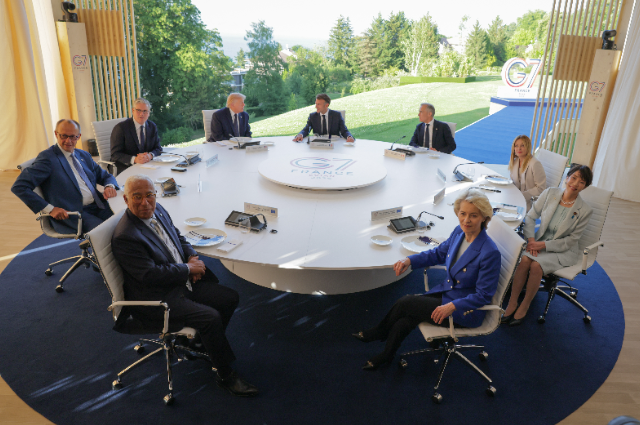
The Group of Seven (commonly referred to as G7) is one of the largest international forums in the world. It consists of seven leading advanced economies the United States, Canada, the UK, France, Germany, Italy & Japan, along with the European Union, which are brought together in one place in order to allow for these Leaders to have open dialogue and develop coordinated responses to the challenges they face as part of the Global Economy. Although G7 has a Global presence and influence, unlike other international organisations that have built-in structures, the G7 does not have a Permanent Secretariat, nor a Standing Staff or Rules to govern how it operates. Therefore, while the G7 lacks structure compared to some International Organisations, this does not mean the G7 is unsuccessful, as flexibility and effectiveness are what make it successful.
G7 was established during the oil crisis of 1973, when World Leaders required an informal space for candid dialogue regarding the uncertain economic situation throughout the world. Rather than create another completely international organisation with all the associated layers of bureaucracy, the G7 Leaders created an informal organisation designed primarily for the purpose of bringing together Leaders.
Unlike international organisations such as the UN or WTO, the G7 does not have a permanent staff or office. It does not have a dedicated headquarters where members can hold meetings year-round. The annual host nation is responsible for organising meetings, developing priorities and supporting discussions during its presidency only; once its term is complete, all responsibilities related to those activities are transferred to the next host nation(s). Another major feature of the G7 is its lack of a permanent staff. To assist in formulating agenda items, drafting statements and coordinating strategies among member states, each country provides officials (often ambassadors) representing their respective governments; this allows the G7 to remain efficient by not creating a large bureaucracy. Thus, member states will concentrate on addressing specific issues needing resolution rather than maintaining a complex administrative structure.
The G7, like the EU, does not have formal treaties or laws to guide its work or decision-making processes, which are usually based on a consensus rather than a vote. Therefore, where leaders agree to take action, they can do so by issuing a single written statement or commitment; these then become just political commitments rather than legally binding obligations. By doing this, the G7 allows its member states to readily respond to the new international challenges, and to act quickly without being burdened by lengthy procedures.
Flexibility is another benefit of this informal style of operation. Global challenges, including financial crises, pandemics, geopolitical conflicts, and climate change rapidly. The G7 can therefore adjust its work plan each year to fit the current situation. Leaders can focus on what’s most pressing at any given time since they are not bound by formalised institutional procedures.
G7 Leaders have the opportunity for frank discussions as their format is more informal than other large-scale international meetings, which allows for direct conversations and the establishment of close working relationships. Many of the major agreements and diplomatic understandings created by G7 Leaders are created through informal actions rather than official negotiations.
The informal structure of the G7 has also attracted criticism. They are not bound by any treaties, and therefore the G7's decisions can only be implemented through the political will of its members. Another criticism is that the G7 does not represent a significant enough percentage of the world economy and therefore does not adequately represent the interests of emerging economies.0 Countries such as China, India, Brazil, and South Africa are not permanent members of the G7; however, the countries that host G7 summits often invite representatives from those countries as guests.
When Russia became part of the group in 1998, that made it the G8, but after it annexed Crimea in 2014, its membership status was suspended, and the group became the G7 again, with China has never being part of the G7, but definitely an economic power.
The G7 continues to have significant input into the shaping of the world's economic policies, developing the world's security policies, developing technological solutions to international problems, developing solutions to the world's energy needs, and developing solutions to the world's climate change challenges. The G7 does not have an 'office', a 'staff', or 'formal rules', but it has a major impact on the world by virtue of members' holding and representing a large portion of the world's wealth and political power.
To sum up, the G7's unusual structure is not accidental, but an intentional design decision. By avoiding permanent bureaucracy and/or rigid procedures, the G7 as a group allows for flexibility and promotes cooperation, directly among members. Therefore, the G7 derives its true power, not from institutions or formal authority, but by bringing powerful nations together to work cooperatively to resolve the many international challenges facing the world.
Sources:
- G7 Information Centre
- Official G7 Website
- Council on Foreign Relations (CFR)
- Encyclopaedia Britannica