
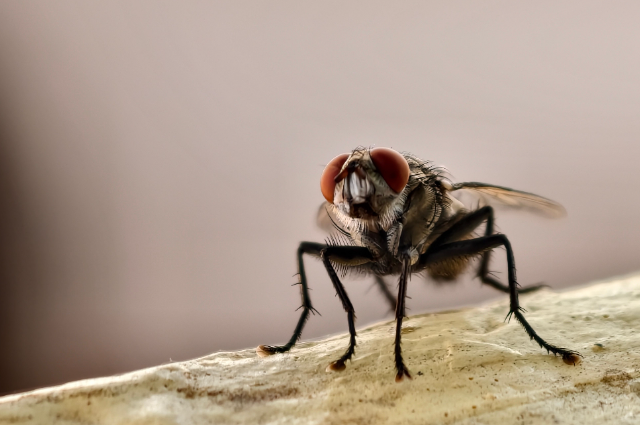
On 4th August, 2025, the first human case of New World Screwworm (NWS) in the US history was confirmed in a Maryland resident. He had recently returned from a trip to El Salvador and later recovered fully. Coming back to 2026, a case of flesh-eating New World Screwworm was detected in South Texas on 3rd June. The US Department of Agriculture notified that its National Veterinary Services Laboratories in Ames, Iowa, tested a sample of a 3-week-old calf from La Pryor, Texas.
What is the NWS fly?
NWS, or Cochliomyia hominivorax, is a species of parasitic blowfly with a lifecycle of about 21 days; it feeds on the tissue or flesh of warm-blooded animals, including humans. The metallic blue or green fly lays eggs on body openings or wounds, and the maggots hatch and eat live flesh. This infestation, known as myiasis, causes pain and a foul odour that worsens over time. NWS usually thrives at 25°C to 30°C and is native to South America and the Caribbean.
Eradication through Sterile Insect Technique
This fly used to be a warm-weather issue for cattle ranchers from the early 1920s, as it is the most favourable condition for them to breed; general pesticides were used back then. The fact that the females mate only once in their lifetime led to the conclusion that introducing sterile males can reduce generations of these flies. In a research laboratory in Texas, Bushland developed a technique to rear a large number of insects. With developments in nuclear science, cobalt-60 gamma ray equipment sterilised masses of flies. On the island of Curaçao in the Antilles, the eradication technique was successfully tested. With a plant being set up in Sebring, Florida, flies were eradicated till 1959 in Florida and Southeastern States. ARS labs in Texas also produced sterile flies; eradication began in the Southwestern States, leading to the US being free of indigenous screwworms by 1966.
Major and minor infestation cases were recorded in the US, later leading to an agreement with Mexico for complete eradication in Central America. A facility was set up in Chiapas, Mexico. In 1982, screwworms were eliminated in Northern Mexico, and the last case in Texas was recorded. Mexico, Guatemala, Belize, El Salvador, Honduras, Nicaragua and Costa Rica were successful in the eradication from the 1990s to the 2000s. The permanent barrier zone was established at the Darien Gap in Panama, with a permanent facility established in 2003.
Reemergence of cases
An occasional infestation case of a deer in the Florida Keys in the summer of 2016 demonstrated that relaxation in efforts could allow the return of this parasite. In 2022-23, NWS broke the Panama barrier, infesting livestock and people in Panama and Costa Rica, moving to Nicaragua, Honduras, El Salvador and southern Mexico in 2024 and further northward to Guatemala and the Mexico-US border in 2025. 185,000 cumulative cases in animals and more than 2,100 cases in humans have been reported since the containment breach in Panama.
In the US, there are currently 24 active cases out of 34 reported cases in animals since June in the states of Texas and New Mexico. In July 2025, USDA Secretary Brooke Rollins closed ports for livestock imports to prevent flies from Texas. He also blamed former President Joe Biden’s administration for poor border security, which failed to control flies’ migration.
Reasons behind the resurgence
The cause of the 2022 breach is unclear but most likely due to interruptions in sterile fly production due to the COVID-19 pandemic and illegal cattle imports. US federal Budget cuts, along with reduced foreign aid, hit the NWS control programs in Central America. The UN’s Food and Agriculture Organisation’s transboundary animal disease management reduced its screwworm surveillance as US funding was withdrawn in March 2025.
Lee Haines, an associate research professor of biological sciences at University of Notre Dame, states that climate change, as a key element, enables the spread of tropical species thrives in warm weather. The reduced cold snaps in the US and rise in mean temperatures due to climate change have developed positive situations for NWS.
“The cold snaps that once suppressed stray populations in marginal northern regions are becoming rarer and less severe, thus removing a natural biological check on the flies’ migration north. Warmer temperatures are also expanding the geographical band of suitable habitat northward.”
Steps undertaken to eliminate the threat
The USDA has recently spent 21 million dollars for the refurbishment and increase in production capacities of the rearing facilities in Mexico to restart production of sterile flies. A new facility at Moore Air Base in Edinburg, Texas, is being built, costing 8.5 million dollars.
The fly threatens the 113 billion-dollar cattle industry of the US. It poses fatal risks not only to livestock but also to pets, wildlife and humans working in agricultural fields. A ban on Mexican cattle can surge already high prices of meat products even higher. Families facing food insecurity can be driven to the edge and increase the risk of health issues.
The cost of maintaining the barrier in Panama is certainly less than the costs of achieving preparedness incurred by the US livestock producers. Maintenance lapses in the facility and climate shifts in weather patterns make a small screwworm a serious hazard.
References:
- https://encrypted-tbn0.gstatic.com
- https://www.usda.gov
- https://www.nal.usda.gov
- https://asm.org
- https://yaleclimateconnections.org
- https://www.theinvadingsea.com
- https://www.genomicepi.com