
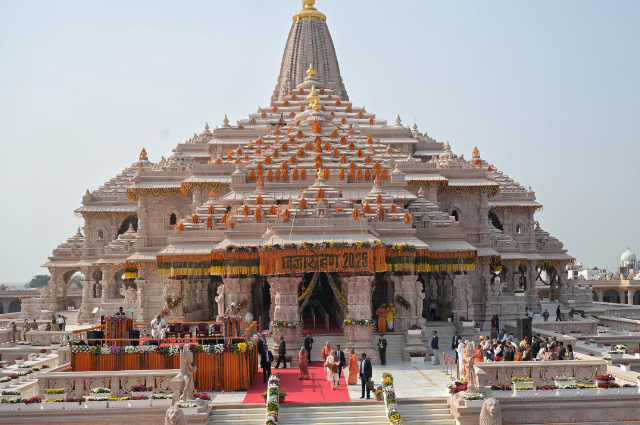
Consecrated on 22nd January, 2024, the Ayodhya Ram Mandir has attracted lakhs of pilgrims every month. Around 35 hundi boxes are installed for donations, in which devotees donate cash, silver, gold and ornaments. The Shri Ram Janmabhoomi Teerth Kshetra Trust handles these and uses them for management and other activities. The trust authorised the State Bank of India to count cash; the SBI has outsourced the counting job to a private agency.
Chadhava Chori Kaand
In early June, allegations of embezzlement of funds and valuables from the donations surfaced in the local media. More light was shed on the matter when Samajwadi Party Supremo and former Uttar Pradesh Chief Minister, Akhilesh Yadav, tweeted on the platform X on 7th June, urging the court to take suo motu cognisance. While initially the unaccounted donations were claimed to range from Rs. 5 to 7.5 crores, media reports now suggest that missing funds might exceed the Rs. 200 crore estimates. Allegedly, CCTV footage dating back 7 to 8 months is missing. Furthermore, over 10 chest boxes of gold, silver, and jewellery were allegedly removed without being c audited.
Named as a whistleblower, Mahipal Singh, claiming to be a former account-in-charge at the temple, alleged that theft of donations has been going on for some time. He claimed to have reported the matter to Champat Rai, the Trust’s General Secretary and other members, but he was ousted from his position the next day. Speculations intensified when some low-paid staff members allegedly made real estate purchases, bought expensive vehicles and businesses beyond their known income of Rs. 18000-20000. Two employees purchased land worth 1.5 crores and 40 lakhs, respectively. Dharmsena founder Santosh Dubey claimed theft to have begun since 1989, explicitly naming Champat Rai as 1250 Ramshilas or Ram stones made up of gold, silver, diamonds, rubies, and eight metals have now “disappeared” and only clay Shilas remain at Karsevakpuram.
Government SIT formed
The Trust rejected these claims, stating that no irregularities have been detected in fund management. On 13th June, Uttar Pradesh Chief Minister Yogi Adityanath formed a three-member Special Investigation Team (SIT) to probe “chadhava chori” claims and submit a preliminary report within 7 days and the final report within 15 days. UP Police SIT arrested a cash counting staff member, Lavkush Mishra, when Rs. 10 lakhs were recovered from his house. Additionally, a public interest litigation (PIL) has been presented before the Lucknow Bench of the Allahabad High Court seeking a time-bound CBI investigation into the alleged fiscal inconsistencies.
Long History of Allegations
The Nirmohi Akhara, centuries-old Ramanandi Sadhus and a primary litigant in the dispute earlier accused the Vishwa Hindu Parishad (VHP) of swindling over Rs. 1400 crores since the late 1980s to early 1990s. Donations meant for the groundwork of the temple were used to fund their organisational infrastructure and gain votes, allegedly. Under the Shila Pujan campaign, VHP collected Ram Shilas across Indian villages with some cash offerings during 1989-1990. Akhara alleged that the VHP had no account for the cash and mismanaged the structural components. Before the final verdict in 2019, the court appointed a receiver to manage the inner temple, but Akhara leaders argued that the collections to be siphoned off to VHP run private trusts. VHP has dismissed all the allegations and claims to have a meticulous record of all the donations collected since its formation in 1964. In November, 2019, the Supreme Court denied Akhara’s absolute claim over the land but directed the government to give appropriate representation in the new Trust.
In 2021, leaders of the opposition allegedly made a purchase of land for Rs. 2 crores by individuals and were being sold to the Trust for Rs. 18.5 crores within a few minutes, as later confirmed through media reports. The Trust defended itself, stating the Rs 18.5 crores price was in accordance with the updated market price at the time of purchase. Ramakant Pandey, a local temple priest and a land administration clerk, was booked under an FIR for selling an ancient religious asset, the Naya Anand Bhavan Temple, to the Trust for Rs. 6 crores. Though priorly the court had stripped the priest of his ownership due to his misconduct, he allegedly forged the documents to mislead or coordinate with the Trust to buy forged land. In the course of the consecration ceremony of the temple, digital portals falsely claim association with the Trust. An estimated Rs. 3.85 crores were collected for free shipping of prasad domestically and internationally, later clamped down by the Ayodhya cyber police.
The Trust & its Functioning
The Trust is an autonomous body headed by the chairman, which comprises the treasurer, general secretary and other members. Since the formation of the Trust, it has functioned independently. The financial guidelines state routine internal audits and management accounts, though the detailed reports are not available in public domain. Additionally, a UP bureaucrat represents the state government, while a joint officer nominated by the centre and the Ayodhya District Magistrate s ex-officio member. They do not possess voting rights in the Trust.
Investigators reviewed reports from 1st April 2025 to 28th February 2026, the Trust had the total income of approximately Rs. 221 crores, including donations and interest incomes. The Trust holds around Rs. 1900 crores worth of investments. Expenditure records account for spending on construction, storage facilities, prasad facilities, employee salaries, maintenance works, soil filling works and works related to Angad Tila. The Dharmdhwaja installation ceremony held on 25th November, 2025, was attended by VVIPs costed Rs. 10 crores approximately. Reportedly, some questions were raised regarding the detailed expenditure statement of the event. The Trust also bought two plots for about Rs. 26.69 crores for a pilgrim facility and hospital, and another near the temple. Probe seeks to establish how alleged thefts could occur despite Rs 10 crores spent for CCTV systems and security purposes, as per the records.
Why common man fear questioning?
In human psychology, cognitive biases are systematic patterns of deviation from rationality in judgment, which play an important role in strengthening faith. Confirmation bias acts as the brain usually favours information that aligns with existing beliefs. Confirmation also works when people belong to a group of like-minded individuals; our brain stops questioning the beliefs, often driven by the need for belongingness and for solace. Social pressure and group identity create an atmosphere where questioning the beliefs is discouraged. Groupthink promotes the idea of harmony over individual thoughts; also, the loyalty leads you to defend the group in face of contradictory evidence. Acceptance by authoritative figures of the group overdrives critical thinking in individuals. Indian temples are held in profound reverence by Hindus worldwide, making questioning of temple practices socially and psychologically difficult.
In a research findings revealed that the perceived value of experience and feelings of awe increase the emotional connection with the place, thereby having a positive effect on the donations made by the visitors. Since the Ram Mandir is an extremely crucial and popular place for devotees, the donations received by the temple are very high.
Accountability to the Public
Another research examines religious endowments under both Hindu law (danam) and Muslim law (waqf); despite existing laws such as the Hindu Religious and Charitable Endowments Act, the Charitable and Religious Trusts Act, the Waqf Act, and provisions of the Income Tax Act, religious donations have grown rapidly. It argues that the excessive concentration of donations may divert resources from other essential sectors of the economy. Also, risks of corruption, embezzlement, and a lack of transparency in the management. This substantiates government intervention and oversight for the proper usage of the funds in the broader public interest.
In Southern states of Tamil Nadu, Andhra Pradesh and Karnataka, donations are audited and managed by the government, which means a portion of funds is used for welfare schemes, though many people argue allegations of misuse and disparity in law, as only Temples are under this regulation.
With no Investigative report published or relation established by the SIT in Ayodhya, the real question remains, whose pockets receive the blessings?
References
- PICTURE: https://share.google
- https://ijirl.com
- https://pmc.ncbi.nlm.nih.gov
- https://www.unpluggedpsych.com
- https://sundayguardianlive.com
- https://m.thewire.in
- https://www.opindia.com