
Before Independence: The King's Face
When India was under British rule, Indian currency notes had the face of the British King on them. At that time, notes showed King George V and later King George VI. Along with the king's face, there were also pictures of animals like tigers and deer, and some decorative symbols. All of this was chosen by the British rulers, not by Indians.
So the money that Indian people used every day had the face of a foreign king on it. This was a sign that India was under someone else's control. When India got independence in 1947, one of the first things that needed to change was this: the king's face had to go.
After Independence: The Lion Capital Came First
After independence, people thought that Gandhi's face would be put on Indian notes. He was known as the Father of the Nation. He had fought for India's freedom. It felt natural that his face should be there. But that did not happen right away.
In 1949, India printed its first new one-rupee note after independence. Instead of Gandhi's face, the government chose the Lion Capital of Ashoka from Sarnath. This is the same symbol that is on India's national emblem today. After that, in 1950, notes of Rs 2, Rs 5, Rs 10, and Rs 100 were also printed with the Lion Capital symbol. From 1951, the name of the note issuer and the denomination were also printed in Hindi for the first time.
But why was Gandhi not chosen? The RBI says that designs with Gandhi's face were made and considered. But in the end, the government felt that the Lion Capital was a better symbol because it represented all of India, not just one person. Also, Gandhi himself never wanted to be celebrated like this. He was a very simple man and would not have liked his face on money.
1969: Gandhi Appeared For The First Time
For more than 20 years after independence, Gandhi's face was not on any Indian note. Then in 1969, the RBI printed a special Rs 100 note to celebrate Gandhi's 100th birth anniversary. This note had Gandhi's face on it, along with a picture of the Sevagram Ashram, which was the place where Gandhi used to live and work in Maharashtra.
But this was only a commemorative note. This means it was a special note made for a special occasion, not a regular note that everyone used every day. After this, Gandhi's face went away from notes again for many more years.
1987: Gandhi Came Back On Rs 500 Notes
18 years later, in October 1987, the RBI printed a new Rs 500 note. This note featured Gandhi's face as well as the Ashoka Pillar watermark. This was the first time Gandhi's face appeared on a regular, everyday note. But even now, his face was only on the Rs 500 note.
1996: Gandhi Finally Came On All Notes And The Real Reason Why
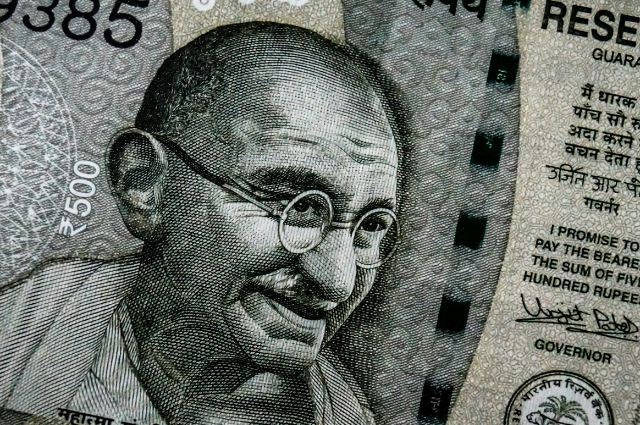
In 1996, the RBI made a big change. They introduced a new series called the Mahatma Gandhi Series. In this series, Gandhi's face was put on all notes from Rs 5 to Rs 1000. The Lion Capital symbol was moved to the side, and Gandhi's face became the main picture on the front of every note.
But why did this happen in 1996? The main reason was not just to honour Gandhi. The real reason was to stop fake notes. By the 1990s, printing technology had become very advanced. People were making very good fake notes that looked almost real. The RBI said that pictures of objects like animals or buildings are easy to copy. But a human face is very hard to copy and fake perfectly. Every small line and detail of a human face is very difficult to print exactly. So putting a human face on notes makes it much harder for people to make fake notes.
And why Gandhi's face specifically? The RBI said that other freedom fighters like Bhagat Singh, Subhas Chandra Bose, and others were very popular in some states but not equally known in all parts of India. Gandhi was the only leader who was respected by everyone in every state, every religion, and every community. He was truly a national face. So his face was chosen.
Where do you think the photo on the note came from?
There is one more interesting thing about Gandhi's photo on Indian notes. The photo that is used is not a drawing or painting. It is taken from a real photograph that was clicked in 1946. In that photo, Gandhi was standing with a British politician named Lord Frederick William Pethick-Lawrence. The picture of Gandhi was cut out from that photo and then flipped to make it look like a mirror image. This is the smiling face of Gandhi that we see on every note today.
And here is something surprising: nobody knows who took that photograph. The name of the photographer is not known. And nobody knows who exactly decided to use that specific photo for the notes. It just became the standard, and it has been there ever since.
2016: The New Gandhi Series After Demonetisation
In November 2016, the government announced demonetisation. The old Rs 500 and Rs 1000 notes were cancelled overnight. New notes were printed. These new notes also had Gandhi's face, but they were smaller in size and had new colours and new security features. This new series is called the Mahatma Gandhi New Series, and these are the notes we use today.
Final Thought
So the story of Gandhi's face on Indian currency is not as simple as most people think. After independence, a foreign king's face stayed on notes for some time. Then the Lion Capital replaced it. Gandhi appeared for the first time only in 1969, and that too on just one special note. He came on regular notes in 1987 and finally on all notes only in 1996, and the main reason was to stop fake notes, not just to honour him. It took almost 50 years after independence for the Father of the Nation to come on every Indian note. That is a story not many people know.
References:
- Zee News Hindi
- Dainik Bhaskar
- Aaj Tak Hindi
- navbharattimes.com
. . .