
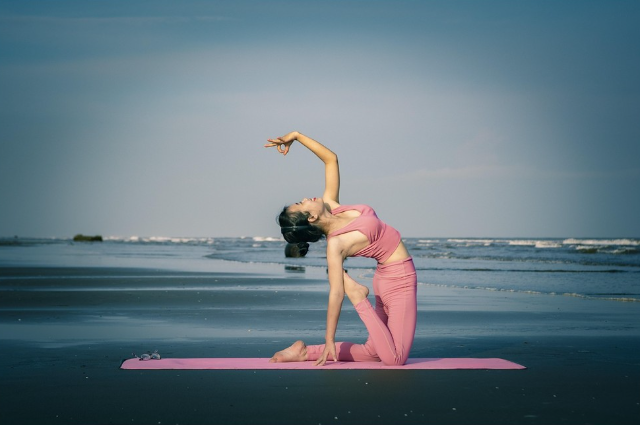
Image by Hà Cao from Pixabay
Sport has genuinely helped me. Not only because of discipline, appearance, or numbers on a scale, but because when my body feels better, my mind becomes quieter too. I have back problems, and when I move regularly, I almost forget about the pain. I do not mean that sport makes everything disappear forever. I still have limits. I still have days when my body feels tired or uncomfortable. But movement gives me energy, confidence, and a feeling that I still have some control over my body and my day.
For me, this feeling of control is very important. Control over the body does not mean that I can control everything that happens to it. I cannot always control pain, tiredness, stress, hormones, asthma, or the limits my body sometimes places on me. But through sport, I feel that I am not only a passive person living inside a body that hurts. I have become active again. I can choose to move. I can choose to strengthen myself. I can choose to help my body rather than only be frustrated with it.
When the body feels weak or painful, it can affect the whole inner world. Pain does not stay only in the back, chest, muscles, or lungs. It enters the mood, the patience, the confidence, and even the way we see the day ahead. When my back hurts, I can feel limited before the day even begins. I think about what I cannot do, what may hurt, and what may become difficult. When breathing becomes hard, the fear is even stronger. Breathing is something we usually do without thinking. But when it becomes difficult, suddenly the body feels unsafe.
I experienced this strongly after COVID. When I was sick, my asthma became much worse. It was serious enough that I needed a portable inhaler, and asthma became part of my daily fear. After my second pregnancy, I gained around 15 kilograms, and during that period, my asthma became very difficult. I used my inhaler almost every day, sometimes more than once. Hot weather could trigger it. Cold air from the air conditioner could trigger it. Sometimes it felt as if anything could trigger it.
I had asthma so many times in my life that it truly frightened me. It was not only a physical problem. It became emotional, too. There is a special kind of fear that comes when you cannot breathe freely. You start to listen to your body all the time. You ask yourself, “Will I be okay if I walk fast? Will I be okay outside? Will the air be too hot? Will the room be too cold?” The body becomes something you monitor, not something you simply live in.
I want to write about weight very carefully, because I do not believe that a person’s value, beauty, or health can be judged by size. I do not think weight is a moral issue. I am not saying that being heavier is bad, and I would never want my experience to sound like criticism of anyone else’s body. Everybody has their own story, genetics, medical background, pregnancies, stress, hormones, and private struggles. I am only sharing what happened in my own body.
For me, at that time, the extra weight felt like an obstacle. It was not about looking a certain way. It was about feeling that my body was carrying something that made movement and breathing harder for me. I felt heavy in a deeper sense, as if I was living in a body that did not fully feel like mine. I was inside it, but I was not connected to it. I felt limited, uncomfortable, and sometimes even trapped.
Four months ago, I started exercising. I did not begin with something extreme. I did a little Zumba, some Pilates for about 30 minutes a day, and sometimes yoga for about 20 minutes. It was simple and realistic. I did not start as an athlete. I started as a woman who wanted to breathe better, move better, and feel less afraid of her own body.
Within the first month, I lost 5 kilograms. In the second month, I lost another 5 kilograms. I did not follow a strict diet. I still ate carbohydrates, proteins, and fats, though maybe with more awareness. I still liked cakes, buns, and tarts. I did not try to punish myself with food. I did not want sport to become another form of pressure. I wanted it to become support.
The weight loss was exciting, of course. But what amazed me most was not the number. It was my breathing. Since I started exercising regularly, I have had asthma only once. For me, that felt unbelievable. After using my inhaler almost every day, the change felt like freedom. I could walk faster. I could run a little. I could move without immediately waiting for asthma to appear. I began to trust my body again.
Again, I know this is my personal experience. Asthma is a real medical condition, and I am not saying that exercise or weight loss is a solution for everyone. People should follow medical advice and listen to professionals. But in my own case, I understood that the weight I had gained was affecting me more than I had realised. It was not just about appearance. It was connected to breathing, confidence, fear, movement, and daily life.
The most emotional part of this change was the feeling that my body came back to me. Before, I often felt as if my body and I were separated. My mind wanted one thing, and my body answered with pain, heaviness, or shortness of breath. I wanted to move freely, but my body resisted. I wanted to feel strong, but my body reminded me of weakness. I wanted to forget about asthma, but asthma kept interrupting my life.
Now I feel more whole. My body is not my enemy. It is not only a source of problems. It feels more like a partner. When I exercise, stretch, dance, or breathe through movement, I feel that my body is working with me. This does not mean it is perfect. It means I have a relationship with it again.
Sport gave me a kind of quiet confidence. Not the loud confidence of appearance, compliments, or comparison. It gave me the private confidence of knowing that I can help myself. I can begin with one movement. I can choose a small routine. I can strengthen my back. I can improve my breathing. I can take 20 or 30 minutes and use them not only for burning calories, but for returning to myself.
This is why control over the body matters so much to me. If I feel that I cannot control anything in my body, it becomes harder to believe that I can control my life. The body is the place where we live every experience. We work through it. We care for children through it. We carry groceries, sit at desks, climb stairs, hug people, breathe, cry, laugh, and rest through it. When the body feels out of control, life can feel out of control too.
But when I move, I remind myself that I still have choices. I may not choose every pain. I may not choose asthma. I may not choose how my body reacts to every situation. But I can choose small actions that help me feel stronger. I can choose to stretch instead of staying frozen in discomfort. I can choose to dance for 30 minutes even if I am tired. I can choose to treat my body with respect instead of anger.
Movement changed something in my mind, too. After exercise, I often feel calmer. My thoughts become less crowded. Problems that felt heavy before seem more manageable. Maybe it is energy. Maybe it is dopamine. Maybe it is simply the feeling that I did something good for myself. Whatever the reason, sport gives me a pause from anxiety and a return to presence.
I think many people see sport only through the lens of discipline or appearance. But for me, sport became emotional. It became a way to say to my body, “I am here with you.” It became a way to reduce fear. It became a way to feel alive inside my own skin again.
The biggest lesson I learned is that the body is not something separate from the self. When my body suffers, my mind suffers too. When my body feels supported, my mind becomes softer. Taking care of the body is not selfish, and it is not only about looking better. Sometimes it is about breathing better, sleeping better, walking without fear, and feeling that life is open again.
Sport did not make my life perfect. But it gave me back something very important: the feeling that I am not helpless. My body and I are not two separate sides fighting each other. We are one whole. And when I move with care, I feel that wholeness again.