
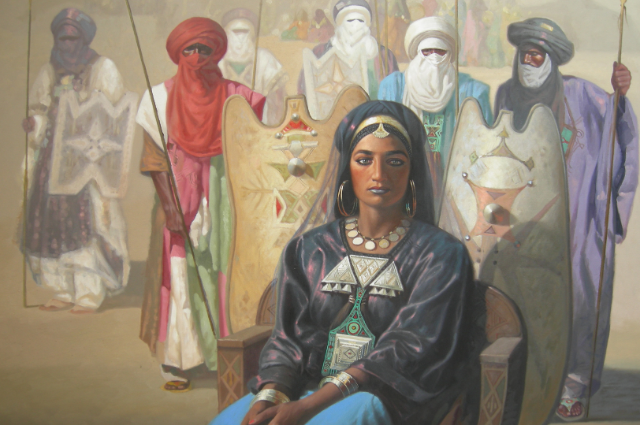
The Tuaregs are indigenous people who are renowned for their rich cultural heritage, distinctive blue garments, and a social structure that differs significantly from many other societies. They are found in Mali, Niger, Algeria, Libya, Burkina Faso, and Chad. The Tuaregs speak mainly Tamasheq, and call themselves Imohag, which means free men. Their culture has so many fascinating things about it, one of it being that it is men and not women who traditionally cover their faces. In most cultures, it is usually the woman who covers her face. But in the Tuareg culture, men cover their faces, and this shows the beginning of maturity and owning responsibility.
At the age of 25, men are expected to wear a long indigo-dyed veil known as tagelmust, sometimes referred to as litham. So even though many people assume that this practice is rooted in Islamic teachings on modesty, the custom actually predates the spread of Islamacross theSahara, and is regarded as a cultural tradition rather than a religious obligation. The tagelmust serves many purposes, one being the practical purpose of protecting whoever wears it from the desert's intense sunlight, dust, sand, and extreme temperatures. Beyond its practical value, however, it is a symbol of adulthood, dignity, honour, and self-discipline. Any man who wears the veil demonstrates that he has reached maturity and is prepared to face the responsibilities expected of him in the community. In many Tuareg communities, men continue to keep their faces covered when they interact with strangers or elders, as it shows respect and restraint. The veil also reflects the value the Tuareg people place on privacy and trust because, according to their culture, unveiling one's face is often reserved for close family members and trusted companions. Historically, the indigo dye used in the cloth sometimes rubbed onto the skin, earning Tuareg men the nickname "the Blue People of the Sahara." Although modernisation and urbanisation have influenced how the Tuareg veil is worn today, it remains one of the strongest symbols of the Tuareg people's identity and cultural pride. Their tradition challenges common assumptions about gender and clothing by demonstrating that customs sur and modesty vary greatly among different cultures and people.
Equally remarkable is the position traditionally occupied by women in Tuareg society. Unlike many societies or communities where men lead, the Tuareg have historically practised a matrilineal system in which family lineage is traced through the mother's line, and important forms of inheritance and family identity are linked to women. Women traditionally own tents, household possessions, and other forms of property, and these assets often remain under thewomen's control even after they get married. In the Tuareg culture, women also enjoy greater freedom of movement, social interaction, and participation in community life than women in many other cultures. Tuareg women have long been respected as custodians of culture, preserving oral traditions, poetry, songs, and historical knowledge across generations. Many are also literate in the traditional Tifinagh script, which they use to write messages, poems, and records, helping preserve the community's language and heritage. Also, marriage customs
reflect how women actually hold high status because they generally retain significant influence in the household, and even divorce does not necessarily result in the loss of their property or social standing.
Even with all this, it is important to recognise that the Tuareg were not a matriarchy, since many formal political and military leadership positions were traditionally occupied by men. Instead, women exercised considerable social, economic, and cultural influence through their control of family property, lineage, and the transmission of knowledge. Today, although there have been many economic changes, conflicts, and more that have altered aspects of traditional Tuareg life, many of these cultural values continue to shape the community's identity. The Tuareg remain one of the world's most compelling examples of how gender roles can differ across societies, illustrating that women's influence does not always depend on holding formal political office and that customs surrounding masculinity, femininity, inheritance, and social responsibility can take forms that challenge what many people widely believe. Their hi us that cultural diversity offers valuable lessons in the many ways societies can organise themselves and that both men and women can hold influence without limiting either gender. The Tuareg culture shows that authority, identity, and influence can be shared in different ways while preserving the unique roles that both men and women play in society, as their tradition challenges common assumptions about gender and clothing by demonstrating that customs surrounding dress and modesty vary greatly among different cultures and people.
Reference
- The Tuareg, the Nomadic inhabitants of North Africa https://www.bradshawfoundation.com
- The Tuareg People- Wikipedia https://en.wikipedia.org