
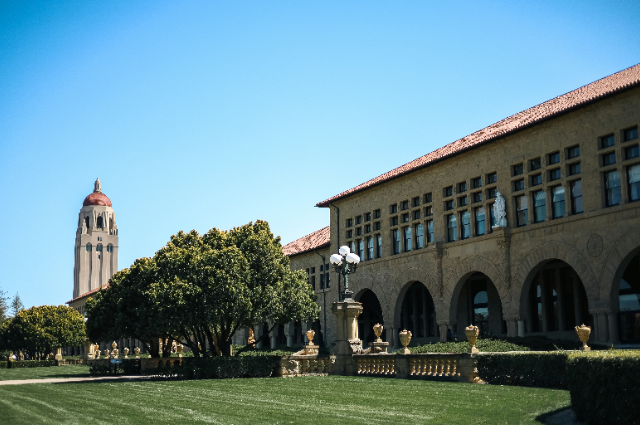
Stanford University organises a commencement ceremony to recognise its graduates; this event is always held at the end of the spring term. Usually, in this ceremony, changemakers are invited to the commencement ceremony to admonish and talk to the graduating students. The Stanford University 135 took place on the 14th of June, 2026, at the Stanford Stadium. On this day, Sundar Pichai was invited as a keynote speaker for the event that later became one very much talked about. During Sundar Pichai’s speech, encouraging the students to embrace uncertainty and continue learning, something very unexpected happened. An estimated number of 200 students reportedly walked out, chanting.
What was meant to be a celebration ceremony became a platform for political expression.
Who is Sundar Pichai, and why was he invited?
Sundar Pichai is an Indian-born American executive born on June 10, 1972, in Madras, Tamil Nadu, India. At a young age, Pichai showed a deep interest in technology, and after he earned a bachelor's degree in metallurgy in 1993 at the Indian Institute of Technology, Kharagpur, he was awarded a scholarship to study at Stanford University, where he earned a master's degree in engineering and materials science in 1995. In 2004, he joined Google as the head of product management and development. He was mainly involved in the development of Chrome, a Google browser, which was released in 2008, and became Vice President of Product Development the same year. He continued in the more active role, and in 2014, he was the Senior Vice President. He was announced as the CEO of Google in 2015, and in 2019, he was also named the CEO of Alphabet. It was, therefore, also no surprise that a man of such great calibre was invited as a keynote speaker at the Stanford ceremony.
But why did the students walk out during Pichai's speech?
The Students for Justice in Palestine is a Palestinian student activist organisation in the U.S., Canada, and New Zealand, which was founded in 1993 by Hatem Bazian. This network campaigns for Palestinian liberation, functions, BDS initiatives, boycott, and an end to Israeli occupation. “We aim to develop a student movement connected, disciplined, and equipped with the tools necessary to pursue Palestinian liberation on our campus” - National SJP. On this day of the commencement ceremony, 14th June 2026, during Pichai’s speech, an estimated number of 200 of these students reportedly walked out protesting.
Google’s involvement in Project Nimbus, arguing that the technology could potentially be used in ways they opposed, while they chanted, "Free, free Palestine."
What is Project Nimbus?
Project Nimbus, with an estimated worth of over $1 billion, is a contract between Google, Amazon, and the Israeli government. The Israeli government would receive cloud services, and this project was set to run for an initial period of seven years and had a possibility of a 23-year extension if the government wanted it. The cloud system is to serve as a system where the government can store data, run applications, and use computing tools such as AI and machine learning. The Project Nimbus, though accepted by some people who found nothing wrong with it, faces controversy from people, including some Google and Amazon employees, who argue that because Israel's defence and security institutions are connected to this project, the technology could support military operations during the Israeli-Gaza conflict or actions against Palestinians. And although Google and Amazon have come out squarely on how the project is only meant to support government digital services and that their cloud computing services have rules against harmful uses, many individuals still think otherwise.
Reactions and debate
The Stanford walkout received different reactions from the public. While some viewed the protest as students exercising their rights to express their opinions and argued that the graduation ceremony was, in fact, the perfect time for it, others criticised the demonstration, arguing that a commencement ceremony should solely be a celebration of the students' achievement and not a platform for political protests. The reaction also extended beyond Stanford, as technology investor Vinod Khosla was among the critics of the protest and strongly disagreed with it, while Congressman Ro Khanna, a U.S. representative, defended the students, stating they have the right to freely express their opinions. These opposing reactions demonstrate the wider disagreement surrounding the events. Some see the actions as a peaceful, harmless expression of views, while others see them as an inappropriate disruption of academic events.
The bigger picture: technology and ethics
Beyond the Stanford campus, this controversy shows a great need for discussion about technology and ethics. Modern companies do not only create consumer products, but they also provide essential digital infrastructure used by businesses and governments worldwide. As artificial intelligence and data systems become more powerful, questions about responsibility, accountability, and ethical decision- making have become very important. The Stanford graduation walkout was more than a disagreement at a commencement ceremony. It showed how technology, policies, and human rights are increasingly connecting. As technology continues to shape the current world, debates like these are likely to continue coming up as discussions about innovations and ethics.
References:
- Britannica. (n.d.). Sundar Pichai| Biography, Google, & Facts. Encyclopaedia Britannica.
https://www.britanica.com - BBC News. (2026). Dozens walk out as Google boss Pichai addresses Stanford graduates. BBC News.
https://www.bbc.com - Forbes.(2015). Who is Google’s New Chief, Sundar Pichai? Forbes.
https://www.forbes.com - The Hindu. (2026). What is Google’s Project Nimbus, and why are students protesting against it?
https://www.thehindu.com - The Stanford Daily (2026). Google CEO addresses graduates amid student walkout. Stanford Daily.
https://stanforddaily.com - National Students for Justice in Palestine (National SJP). (n.d.). About National SJP.
https://www.nationalsjp.org