
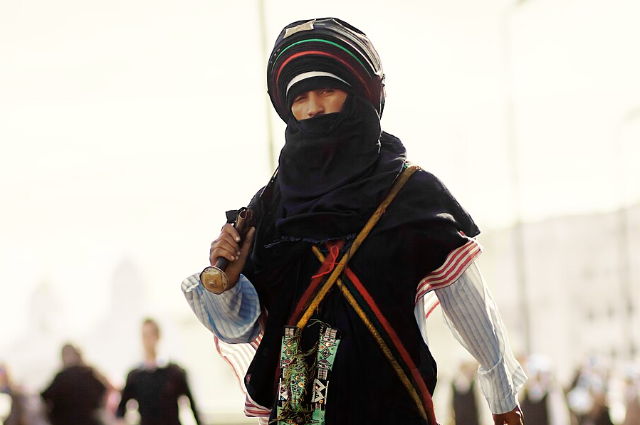
Who are the Tuareg people
Tuareg people are a Berber ethnic group; they are traditionally nomadic pastoralists who have lived across the Sahara Desert in countries like Mali, Niger, Algeria, Libya, and Burkina Faso, with smaller communities in Chad and Sudan. Their population is estimated to be 4-5 million worldwide. The majority of the Tuareg people speak the Tuareg language, which includes Tamsheq, Tamahaq, Tamajeq, and Tawellemmet.
They're a semi-nomadic people who mostly practice Islam. The word Tuareg is an Arabic word that means Abandoned by God; they call themselves Imoha,,g translated as “free men”
No one knows the true origin of Tuareg, where they came from or when they arrived in the Sahara Desert.
The veil of men in Tuareg
Tuareg is mostly popular because of their interesting tradition of “The Veil,” which is quite normal since it has been part of many cultures and religions,ons but the interesting part is that the men of the Tuareg wear the veil while the women don't.
The men of the Tuareg start wearing the veil to cover their faces as they hit puberty; in their culture, it's seen as disrespectful to not cover their faces in front of elders or people they don't know well. It symbolises adulthood, respect and maturity.
They are known as “the blue men” because they wear a blue robe called tangelmust (a type of turban) that is dyed using indigo, which over time taints their skin slightly blue; hence they're called the blue men.
Tangelmust also play a protective role, shielding them from the harsh sunlight in the scorching heat and the blowing sand in the desert,t as the sand can be quite unpredictable during sandstorms.
The women in Tuareg
The women of Tuareg don't cover their faces like women do in most of the cultures; in fact, they're more educated and independent than women in neighbouring societies. They are leaders of their society and family. In the Tuareg community, the family lineage and inheritance pass through the female line. Tuareg women often handle family decisions, manage finances and are involved in social and political discussion. The women are known as Tabards, the traditional jewellery-making and leatherwork which shows their artistic skills. Hence, they have a higher level of respect and have more freedom than most women.
Cultural or religious
People often misunderstood the tangelmust tradition as an Islamic obligation, which is not true. Islam teaches modesty to both men and women; however, neither of them is required to cover their faces. It is more of a cultural thing of the Tuareg people to wear tangelmust and cover their faces. The people see the veil as a sign of maturity and respect.
Lifestyle of Tuareg people
The life of Tuareg people isn't easy, they live in Sahara deserts, the desert cover over 3.5 million square miles, with temperature reaching up to 50°C during the day and plummeting at night despite all this the Tuareg men has not only survived but lived with honour for centuries, their intimate knowledge of the land and Nomadic lifestyle surely helps, they travel through places with camels and live in tents as they're easy to set up and move. Tuareg people are traders. They trade goods like salt, gold, slaves, spices and cloth. Their caravans often consist of hundreds of camels. They even need to travel for weeks sometimes because of their deep knowledge about deserts, which has been passed down through generations. They became famous as skilled traders.
The struggles in the modern world
The Tuareg have kept their traditions alive for hundreds of years, but today they face many problems. One major challenge is political conflict. The Tuareg live in countries like Mali, Niger, Libya, and Algeria, where there has been unrest and instability. In Mali, many Tuareg groups have asked for more rights and freedom to protect their culture. Because of these conflicts, many families have had to leave their homes and face difficult living conditions.
Climate change in the Sahara Desert is making the atmosphere hotter and drier, making it harder to find grass and water for animals there; hence,ce many Tuareg people are finding it tough to continue their traditional nomadic lifestyle. Some people move to cities to look for work, but they often suffer from unemployment.
Despite the struggle, the Tuareg community has thrived for years; they're even called the “people of the Sahara” because they've lived there for years. Tuareg people are unique, and they're simply proud of their culture. Their traditional Tanghelmust is undeniably unique and beautiful,l but it also makes life tough for the men of Tuareg. Tuareg helps us understand the importance of respecting and preserving different cultures around the world.
References:
- https://wanderlust-magazine.com
- https://wanderlust-magazine.com/
- https://carnegieendowment.org/
- https://www.britannica.com/topic/Tuareg
- https://jinhaagency.com