
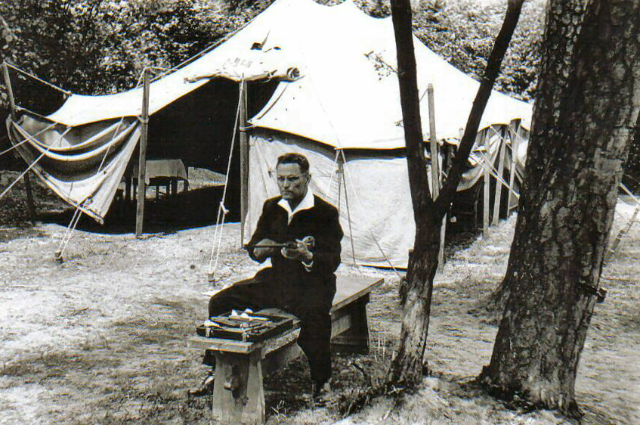
In 1938, a grenade accident cost Károly Takács his right hand. Ten years later, he stood on an Olympic podium with a gold medal around his neck.
Some setbacks alter a life; others seem to close it down altogether. For Károly Takács, the distinction was almost academic. In 1938, a grenade exploded during a military exercise in Hungary and destroyed his right hand - the hand with which he had trained for years to become one of his country's finest pistol shooters.
At the time, Takács was 28.
The accident did not merely injure him. It appeared to remove the very means by which he had pursued his ambition.
Takács, however, did something easier to describe than to understand or do. While recovering in hospital, he began learning to shoot with his left hand.
There was no guarantee that the experiment he was keen on working on would work. Shooting was not simply a matter of strength. It’s a sport which demands precision, control and years of muscle memory. Takács had spent much of his career developing those qualities in his right hand. Now he had to begin again from scratch.
Interestingly, within a year, he had won the Hungarian national championship with his left hand.
The achievement was remarkable, but it did not immediately make him an Olympic champion. Takács's story was interrupted by something larger than his own misfortune: history itself. The 1940 and 1944 Olympic Games were cancelled because of the Second World War. The years in which an athlete might ordinarily expect to reach his peak passed without an opportunity to compete on the world's biggest sporting stage.
When the Olympics finally returned in 1948, Takács was 38.
At the London Games, he entered the 25-metre rapid-fire pistol event. He was not simply competing against younger athletes. He was competing after an accident that had taken his shooting hand, after years of retraining and after a war that had delayed the Games themselves.
Before the competition, Argentine shooter Carlos Enrique Díaz Sáenz Valiente, the reigning world champion and one of the favourites, reportedly asked Takács why he had come to London.
Takács's answer was understated: he was there to learn.
He did considerably more than that.
Takács won the gold medal with a score of 580, finishing ahead of Valiente. The man who had once been expected to shoot with his right hand had won an Olympic title with his left.
Four years later, at the 1952 Helsinki Olympics, Takács returned to defend his title. He won again, scoring 579.
By then, his first Olympic victory could no longer be dismissed as an extraordinary comeback or a fortunate moment. It had become evidence of something more difficult to explain: the ability to reconstruct a skill, a career and perhaps even one's idea of the future after circumstances have made the original plan impossible.
Takács competed at the 1956 Melbourne Olympics as well, finishing eighth in the same event at the age of 46.
His career therefore contains none of the neatness that biographies sometimes impose on sporting lives. There was no single moment of triumph after which everything fell into place. There was an accident, followed by retraining; a championship, followed by a world war; an Olympic victory, followed by another Olympic victory; and finally another Games at an age when most athletes had long since retired.
What makes Takács's story worth remembering is not simply that he overcame the loss of his hand. That description, though true, is incomplete.
The more interesting part is what happened after the obvious route disappeared.
It is easy, in retrospect, to look at a person who has achieved something extraordinary and describe their response as courage, determination or resilience. Such words are useful, but they can also make difficult decisions sound simpler than they were. Takács did not know, in 1938, that he would become a two-time Olympic champion. He could not know whether his left hand would ever become good enough. He could not know when the Olympics would return, or whether he would still be capable of competing when they did.
What he could do was practise. That distinction matters.
Much of modern ambition is built around fixed plans: a particular examination, a particular college, a particular career, a particular definition of success. When circumstances interfere, the temptation is to interpret the disruption as proof that the destination itself is no longer possible.
Takács's career offers a different way of looking at failure. Sometimes the destination remains intact even when the route does not.
He lost his shooting hand. He did not lose the reason for shooting.
There is nothing sentimental about that distinction. It does not suggest that every setback can be overcome, or that determination can erase every disadvantage. Some losses are permanent. Some ambitions genuinely have to be abandoned. Real resilience is not pretending otherwise.
It is recognising what has changed, and then deciding what can still be done.
Károly Takács could no longer shoot the way he had before 1938. So he learned to shoot differently.
Ten years after losing his right hand, he stood on an Olympic podium in London. Four years later, he stood there again.
Perhaps that is the most enduring part of his story. Not that he refused to accept reality, but that he accepted one reality and then refused to let it dictate the rest of his life.