
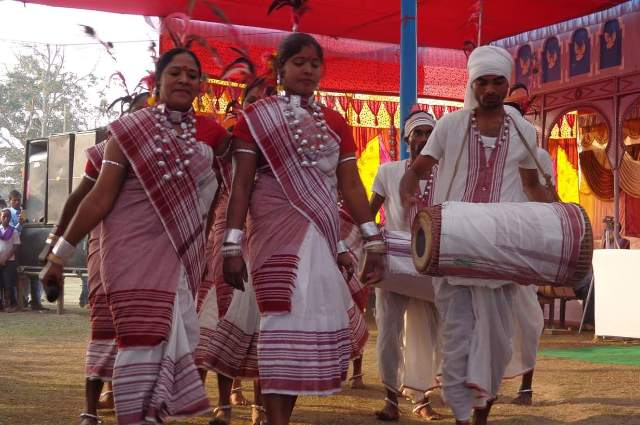
Many upper-caste Indians come from well-to-do and educated backgrounds, yet some continue to hold conservative views regarding caste and marriage. W Adivasi people of India were progressive even though they are not well educated; still, they are more progressive than upper-caste people in India, who still believe that marrying within their caste will protect their social status.
We tend to assume that progressive values emerged only through recent social movements and legal reforms. However, the history of India tells a more complex story. Long before these ideas became part of public debates, some Adivasi communities had already developed social systems that gave women greater autonomy and recognised the importance of choice and dignity.
Among those Adivasi, there is one tribe called the Muria tribe of present-day Chhattisgarh; the institution of the Ghotul played an important role in community life. This institution functioned as a place where adolescents could learn responsibility, discipline, cooperation, and social values. Young boys and girls interacted freely without any judgments, formed friendships and had the opportunity to choose their life partner according to themselves.
Unlike in upper caste society where marriages are arranged without any consent of boy or girl, in the Murai tribe, a boy was allowed to give flowers so they could meet if they want. She had a right to accept or reject the proposal; the decision rested on her. In this system, consent was not treated as an afterthought but as an essential part of relationships.
Whether it’s a young boy or girl both of them have a right to make a decision based on their opinions and what they think. No one can force them to get married.
There is also one tribe, the Khasi community of Meghalaya, known for its matrilineal traditions. In many parts of India where fathers’ property is transferred to son, but in this community father’s property was given to daughter of the family. This is rarely happens in India, where people consider dau burden; they never consider daughters a burden. More likely the daughter of this community also takes the responsibility of her ageing parents. After marriage, the boy comes to girl’s place and children inherit the mother's surname.
Having this progressive mindset, these community people still had to face some social challenges. Rapid modernisation has led to the gradual decline of some traditional practices. The younger generation are getting influenced by m norms quickly sometimes results in the loss of indigenous knowledge and cultural values. Many Adivasi have had to face economic challenges as well limited access to quality education and healthcare, and social ma. Their contributions to society often remain overlooked, making it important to preserve and respect the values and traditions that have shaped these communities for generations.
It’s important to recognise that not all societies are perfect they have to face social challenges Highlighting these practices does not mean idealising every aspect of tribal life. Instead, it encourages us to question the belief that progress always moves in one direction or originates from social groups.
These examples remind us that knowledge systems contain valuable lessons about human dignity. They demonstrate that respect for women's choices and shared responsibility values are not exclusively modern concepts. In some cases, they have existed quietly for generations.
Being modern does not mean that their mindset is also modern; people who appear modern may still hold conservative mindsets. Wearing western clothes does not mean that their thought are not na. People have less knowledge, but they are still being progressive.
The important lesson is that we can’t measure the progress through technological advancement or economic development. A society's ability to consent, respect and value it’s daughters and recognise the agency of individuals is equally significant.
These communities remind us that true progress is reflected not only in education and wealth but also in empathy, equality, and respect for human choices.
By recognising and learning from these indigenous practices, modern society can build a future that values both development and human dignity.
As modern India continues to debate issues of gender equality and personal freedom, it may be worth looking more closely at the wisdom embedded within its own diverse communities. Sometimes, the answers to today's questions are not entirely new. They may already exist in traditions that have long been overlooked.
The stories of the Muria and Khasi communities challenge stereotypes about who is considered "advanced" and who is not. They remind us that dignity, autonomy, and respect are timeless values. True progress lies not only in changing laws but also in creating societies where every individual has the freedom to choose, the right to be heard, and the opportunity to live with equality.
References:
- Adivasi of India as Indigenous People in Postcolonial World | Springer Nature Link
- Adivasi - Wikipedia