
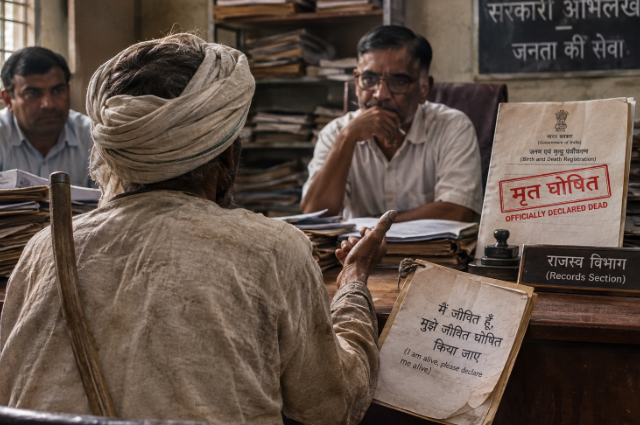
There is a particular kind of horror that does not announce itself with violence. It arrives instead in the quiet, indifferent stamp of a rubber seal, in the clatter of a typewriter long since replaced by a screen, in the calm voice of a clerk who tells you, without malice, that according to the records you do not exist. Somewhere in the vast plains of northern India, decades ago, a farmer discovered that his own relatives had bribed a minor official to have him declared dead, so that family land might pass more conveniently into other hands. What followed was not a swift correction, not an apology, not even outrage from the machinery that had made the error. What followed was nineteen years of a living man petitioning a government to acknowledge that he was, in fact, alive. He wrote letters. He staged his own funeral processions to draw attention to the absurdity of his situation. He demanded, again and again, the simple right to be counted among the breathing. For nineteen years, the state looked at him and, in its official capacity, saw nothing at all.
This story is not really about one man, or one country, or one clerical blunder. It is about the strange metaphysics that modern bureaucracy has quietly constructed, in which existence itself has become a matter of documentation rather than biology. We tend to imagine identity as something intrinsic, carried in memory, in relationships, in the simple continuous fact of being alive from one day to the next. But the modern administrative state has invented a rival form of personhood, one that lives not in flesh but in files, and this paper self can diverge from the living one in ways that are almost impossible to repair once the divergence has occurred. When the two selves fall out of alignment, it is not the paper that yields. It is the human being who must contort himself, sometimes for years, sometimes for a lifetime, to try to matter again in the eyes of a system that was never built to notice him in the first place.
The Colonial Skeleton Beneath the Modern Office
To understand why such a thing becomes possible, it helps to look at where these systems came from. Much of the administrative architecture that governs daily life in postcolonial nations was not designed with the wellbeing of ordinary people as its founding purpose. It was designed, in an earlier century, to extract revenue efficiently from a subject population and to maintain control over a territory whose interests were secondary to those who ruled it. Behaviours that threatened that control were criminalised not because they were harmful but because they were inconvenient to the extraction of resources and the preservation of order. The clerks and inspectors and record-keepers of that era were rewarded not for compassion or responsiveness but for procedural fidelity, for following the correct form in the correct sequence regardless of what happened to the individual caught inside that form.
When independence came, the buildings remained standing and, more importantly, so did the logic that had built them. A structure engineered to extract and control does not spontaneously transform into a structure engineered to serve, simply because the flag above it has changed. The habits of an institution outlive the empire that created them, and they pass from one generation of officials to the next like an inherited accent, unconscious and difficult to shed. This is why so much of bureaucratic life today still feels less like public service and more like a test of endurance.
When Process Becomes the Point
The system rewards adherence to process rather than the achievement of a humane outcome. A file must move through the correct number of desks, acquire the correct number of signatures, sit in the correct number of trays, before a decision can be reached — and the human being attached to that file is, in the meantime, simply asked to wait. Waiting becomes a kind of civic duty in itself. The measure of good administration quietly shifts from "did this person's problem get solved" to "was the procedure followed correctly," and once that shift has happened, an outcome as grotesque as declaring a living man dead can occur without anyone along the chain feeling personally responsible. Each clerk did his job. Each form was stamped in order. The tragedy slipped through precisely because everyone was following the rules.
This obsession with procedure over outcome is compounded by a second problem: distance. Institutions built to extract rather than to serve tend to remain physically and psychologically remote from the people they govern. Offices are intimidating by design, filled with a vocabulary that ordinary citizens do not speak, staffed by officials who hold, however unconsciously, more power over a person's paperwork than that person holds over his own life. A farmer trying to correct a clerical error has to travel to unfamiliar towns, fill out forms in a language of bureaucratic jargon, and return again and again to offices that have no urgency to match his own. The imbalance is stark: the citizen is desperate, the institution is patient. And patience, in the hands of the powerful, can be its own quiet form of cruelty.
The Machinery That Refuses to Change
Underneath all of this sits a deeper inertia — an entrenched attachment to the status quo. Reform requires someone, somewhere, to admit that the current way of doing things is broken, and admitting fault is rarely rewarded inside a hierarchy built on the appearance of order. So the system defends itself. Technology that could simplify a hundred-year-old process is delayed. Committees are formed to study reforms that other committees studied a decade earlier. The machinery does not resist change out of malice; it resists change because change threatens the comfort of predictability, and predictability is the only currency that a risk-averse institution knows how to protect.
And yet bureaucracy is not, by nature, an enemy of the people. At its best, it is the very instrument that turns a government's promises into lived reality. Behind every policy — a vaccination drive, a rural employment scheme, a disaster response — sits an army of officials translating abstract intention into concrete delivery. They provide the technical expertise that shapes a policy before it is written, the administrative machinery that carries it out once it is law, and the data and feedback that tell a government whether its promises actually reached anyone at all. Without this permanent, unelected layer of administration, no democracy could function beyond the length of a single election cycle. The tragedy of the bureaucratic ghost is not that bureaucracy exists. It is that a system with such enormous potential to serve so often curdles into a system that merely persists.
The Uneasy Search for New Blood
One attempted remedy has been to let outsiders in. In recent years, governments have experimented with recruiting specialists directly from industry and research institutions into senior administrative roles, bypassing the decades-long ladder that traditional civil servants must climb. The logic is straightforward: certain positions demand technical expertise that a generalist career bureaucrat may never acquire, and the sheer shortage of trained officials leaves thousands of vital posts unfilled. Bringing in outside talent, in theory, injects fresh thinking into institutions that have calcified.
But the remedy carries its own tensions. Critics worry about the fairness of selection processes that skip established recruitment quotas designed to ensure representation. Others point to the cultural friction that awaits a private-sector professional dropped into a world built on seniority, protocol, and unwritten hierarchy. And perhaps most tellingly, there is resentment among career officials who spent decades climbing a ladder now that outsiders can simply step past. The debate over lateral entry is, in miniature, the debate over the entire bureaucratic apparatus: is the solution to fix the machine from within, or to keep bolting new parts onto an engine whose basic design was never meant to serve the people running through it?
Living With Problems That Cannot Be Solved
There is also a harder truth that anyone who works inside large institutions eventually learns: some problems are not meant to be solved, only managed. Every sprawling bureaucracy, whether civil or military, carries within it a handful of what might be called forever problems — issues so deeply woven into the organisation's identity that they persist no matter how much funding or attention is thrown at them. Recruitment shortfalls, morale, safety failures, corruption: these are not glitches to be patched but permanent weather systems that officials must learn to navigate rather than eliminate. The wisdom passed down to those assigned to tackle such problems is not to abandon ambition, but to hold it alongside a sober realism. Failing to eliminate a forever problem is not personal failure. It is simply what it means to work at the upper reaches of any bureaucracy, where the scale of the institution guarantees that some wounds will never fully close.
Corruption as an Imbalance of Power and Time
Nowhere is this more visible than in the corruption that so often accompanies bureaucratic delay. When an official can choose to slow a process down, and a citizen cannot afford to wait, an imbalance of power opens up — and into that gap flows the quiet transaction of a bribe. Delay becomes leverage. Urgency becomes vulnerability. The bureaucrat is rarely a cartoonish villain; he is simply a man who has discovered that time itself can be monetised, and that the citizen on the other side of the counter has no equivalent weapon. The proposed cure is not merely legal reform, though laws matter. The deeper cure is the construction of systems so transparent and so automated that honesty becomes the path of least resistance, and corruption becomes not just illegal but genuinely inconvenient. Equally important is a shift in the culture that surrounds corruption — the quiet, almost affectionate way societies sometimes joke about a "small bribe" or a "little adjustment," normalising the very behaviour that keeps ordinary people like the farmer trapped in bureaucratic limbo for years at a time.
What It Means to Be Seen
What makes the story of a man fighting to prove he is alive so unforgettable is that it distills, into a single absurd image, everything wrong and everything necessary about the modern administrative state. It shows us a machine so powerful that its paperwork can override the plain evidence of a beating heart, and yet so essential that no modern society could survive without some version of it. The lesson is not that bureaucracy should be abolished. It is that bureaucracy must be built, finally, to remember why it exists — not to protect its own procedures, not to preserve the comfort of those who run it, but to see, actually see, the people standing on the other side of the counter, waiting, sometimes for decades, simply to be believed.