
The deep sea is one of our world’s last great frontiers, encompassing 95% of Earth’s habitable space and 70% of its surface, yet we have explored less than 5% of it. Ironically, we continue to look throughout space for signs of other life. Yet, we remain unaware of what undiscovered creatures live among the mysterious hydrothermal vents in the darkness at the depths of our oceans. Despite its proximity, parts of the deep sea remain less explored than the surface of Mars. What we do know, and continue to learn about the darkness within the ocean, continues to transform our understanding of life on Earth.
The term “deep sea” refers to the global ocean deeper than 200 metres. Of course, charting these depths as the mere gill-less humans that we are presents its own challenges. One might think the fact that we made it to the moon, without oxygen no less, should mean we can explore all the corners of the planet we inhabit. But some considerable barriers are preventing us from doing so. The deep sea is cold and dark, and it is subjected to powerful pressures capable of turning poorly designed equipment into very expensive scrap metal (WHOI, 2023).
Communication is unreliable, expeditions are costly, and the ocean alone is vast enough to make even our most ambitious efforts resemble fishing for a dropped earring in an unfathomably large swimming pool. Space may be farther away, but in some ways it is easier to explore; at least rockets do not have to contend with hundreds of atmospheres of pressure. As a result, much of the world beneath the surface remains unseen, untouched, and waiting patiently for us to catch up.
Life at the bottom of the ocean creates its own light, and poetic as this might sound, I mean this literally. The deep sea puts on, arguably, the most spectacular light show in nature. You have surely seen an Instagram story from someone you went to high school with, their toes at the shore of sand and sea, in awe of the neon light dancing at their feet. This is not an LSD hallucination brought to life, but the process of bioluminescence, a chemical reaction that creates light without heat. What you see on the surface increases tenfold underneath. Some species use it to lure prey, communicate, attract mates, or even camouflage themselves against the faint light filtering down from above (Haddock et al., 2010).
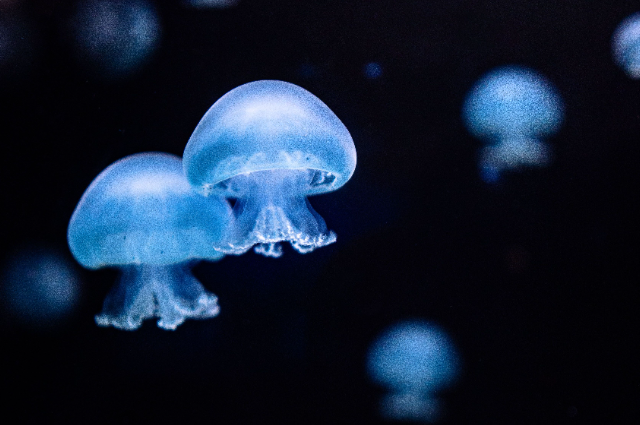
You will remember the anglerfish from Finding Nemo, dangling a glowing lure in front of its mouth like the world’s most sinister fishing rod. Lanternfish and jellyfish flicker and pulse through the darkness like drifting stars. These living lights are a reminder that evolution is endlessly inventive. In a world where sunlight never reaches, life learned to make its own light (Martini & Haddock, 2017).
For a long time, scientists assumed that all life on Earth ultimately depended on sunlight. Then they found hydrothermal vents. Scattered across the deep ocean floor, these underwater geysers erupt with mineral-rich water heated by magma beneath the Earth’s crust. If they were anything like a volcano here above sea level, one might assume they actively discourage life around them: crushing pressure, complete darkness, and temperatures that swing from near freezing to far beyond boiling within metres of one another.
Yet these vents support entire ecosystems. Somehow, specialised bacteria learned to exploit the chemicals released by the vents, producing energy through a process known as chemosynthesis. These microscopic organisms form the foundation of thriving communities of tube worms, crabs, mussels, and a myriad of other creatures found nowhere else on Earth.
The discovery of these ecosystems has transformed our understanding of what life needs to survive. Bewilderingly, sunlight no longer appeared to be a requirement. If life can persevere in such seemingly impossible conditions on our own planet, it raises an exciting possibility: perhaps worlds hidden in places we cannot see, worlds we once assumed barren, may be a little less lifeless than we imagined (Corliss et al., 1979; Van Dover, 2000).
Perhaps no creature captures the mystery of the deep sea quite like the giant squid. We have all seen depictions of enormous tentacled beasts engulfing sailors’ ships, remnants of stories largely dismissed as exaggerations born from too much rum and too much time at sea. Then, rather inconveniently for the sceptics, the giant squid turned out to be real. Even today, despite being one of the most famous inhabitants of the deep, much of its life remains a mystery. There is still much to learn about its behaviour, breeding habits, and how it spends its time in the darkness kilometres beneath the surface.
The giant squid is not alone in its strangeness. It is accompanied by transparent fish, octopuses that appear to have borrowed their ears from Dumbo the elephant, and carnivorous sponges, to name a few. Countless other organisms live amongst the giant squid, each seeming less and less like products of evolution and more like a bored teenager's science-fiction sketches.
We are still very much in the discovery phase of understanding our own planet. Researchers estimate that millions of marine species may remain undocumented, hidden within habitats that humans have barely begun to explore. There is more at stake than satisfying human curiosity. New species can reshape scientific theories, reveal how life adapts to extreme environments, and provide compounds with potential medical applications, holding answers to questions we have not even learned to ask (Leal et al., 2012).
Somewhere in the darkness, there may be creatures unlike anything currently known to science, carrying solutions to problems we have searched high and low to solve. In this sense, the deep sea remains Earth’s largest living laboratory.
Perhaps the most exciting part of all this is that we know how much we do not yet know. How much remains to be discovered about the world we already occupy? The greatest unknown world is not orbiting another star. It is sitting beneath the waves of our own planet.
References
- National Oceanic and Atmospheric Administration (NOAA). (2024). How much of the ocean have we explored?
- Woods Hole Oceanographic Institution (WHOI). (2023). Deep-sea exploration technologies.
- Haddock, S. H. D., Moline, M. A., & Case, J. F. (2010). Bioluminescence in the sea. Annual Review of Marine Science, 2, 443–493. https://doi.org/10.1146/annurev-marine-120308-081028
- Martini, S., & Haddock, S. H. D. (2017). Quantification of bioluminescence from the surface to the deep sea demonstrates its predominance as an ecological trait. Scientific Reports, 7(1), 45750. https://doi.org/10.1038/srep45750
- Corliss, J. B., Dymond, J., Gordon, L. I., Edmond, J. M., Von Herzen, R. P., Ballard, R. D., Green, K., Williams, D., Bainbridge, A., Crane, K., & Van Andel, T. H. (1979). Submarine thermal springs on the Galápagos Rift. Science, 203(4385), 1073–1083.
- Van Dover, C. L. (2000). The Ecology of Deep-Sea Hydrothermal Vents. Princeton University Press.
- Leal, M.C., Puga, J., Serôdio, J., Gomes, N.C.M. and Calado, R. (2012) 'Trends in the discovery of new marine natural products from invertebrates over the last two decades', Marine Drugs, 10(4), pp. 713–742.