
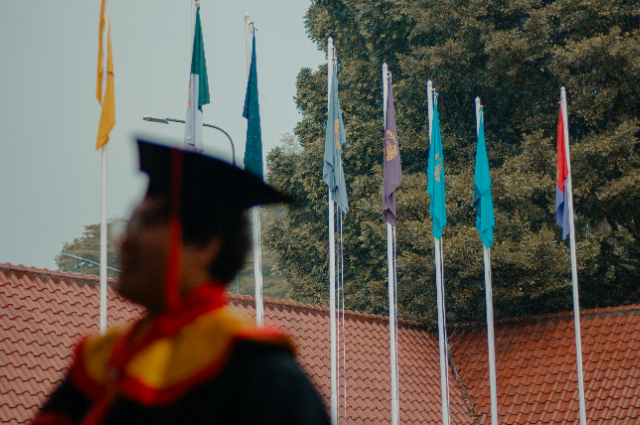
At their 2026 commencement ceremony, Stanford graduates interrupted Google CEO Sundar Pichai’s self-gratifying victory lap for Google. Pichai’s controversial appearance led to the ceremony becoming the latest battleground in the seemingly never-ending conflict between Big Tech, campus activism and Israel's war on Gaza.
On June 14th, Pichai addressed Stanford Stadium, his opening words difficult to make out amongst the sound of hundreds of graduating students chanting “Free, free Palestine!” whilst exiting the stadium in protest. The walkout was organised by Stanford Students for Justice in Palestine and other activist groups opposed to Google's involvement in Project Nimbus (Times of India, 2026; SFGate, 2026). Political demonstrations at academic events have become commonplace since various universities and their affiliates have come under scrutiny for associations with the Israeli government.
Google’s role in Project Nimbus, a controversial $1.2 billion cloud-computing and artificial intelligence contract held jointly by Google and Amazon with the Israeli government, has led to global uproar (TechCrunch, 2022). As Google’s CEO, Pichai became the face of the controversy in this instance.
The deal has become one of the most contentious and infamous agreements in the technological industry. Project Nimbus opens itself up to enormous criticism on two levels: promoting AI on a global scale and utilising AI for government and military agencies. Signed in 2021, the agreement provides cloud infrastructure and AI services to Israeli government agencies. Critics argue that such technology could support military operations and surveillance activities connected to Israel’s ongoing war in Gaza (The Guardian, 2021).
The walkout had been planned for weeks by Stanford Students for Justice in Palestine. Yet its symbolism carried far beyond a single campus protest. The demonstration highlighted a growing reality facing Silicon Valley: major technology contracts are no longer viewed as neutral business decisions. Increasingly, they are being treated as moral and political statements.
Whilst students have historically been the most outspoken against morally ambiguous business ventures of Big Tech, there is now also an emerging rise in opposition from within the companies themselves. Google and Amazon employees have publicly criticised Project Nimbus and called for the companies to withdraw from the contract (The Guardian, 2021). Shareholder groups have likewise raised concerns about the human-rights implications of providing advanced AI technologies to governments engaged in active conflicts.
There is much discussion, both within the companies and among those campaigning against them, about whether supplying tools that can be used in military operations makes the supplier responsible for how those tools are ultimately used. Are Google and Amazon liable if the Israeli government uses the advanced technology provided to commit war crimes? Activists argue yes. Corporations cannot separate themselves from the consequences of services they have provided whilst fully aware of the risks.
Stanford's commencement ceremony offered a uniquely visible stage on which that argument was made. Targeting a traditionally celebratory moment of unity effectively transformed an academic ritual into a political statement.
Pichai's response was notable largely because it wasn't a response at all.
Despite leading one of the world's most influential artificial intelligence companies during a period of intense debate over technology's societal impact, Pichai avoided discussing AI entirely. Instead, he focused on a more conventional commencement message, offering graduates three pieces of advice: choose optimism, work on hard things, and pursue what excites you (Business Insider, 2026). Perhaps he was naive to the irony of promoting optimism whilst supplying technological systems to a government accused by critics of committing grave human-rights abuses.
He reflected on his own journey from Chennai, India, to Silicon Valley and recounted lessons from his early years helping to build Google Chrome. The speech remained largely personal and aspirational, steering clear of the controversies surrounding both Project Nimbus and the broader political climate.
That omission was likely intentional considering the increased scrutiny technology leaders have faced after addressing contentious political issues. By avoiding the issue entirely, Pichai successfully sidestepped involving Google in any further discussion.
Omission, however, is beginning to highlight how unrealistic it has become for tech executives to separate themselves from the political and environmental implications of business ventures. In the past, CEOs could skirt issues by refusing to address them, and they would eventually fade into the next news cycle. These days, the public is so acutely aware of the consequences of Big Tech that the separation has become nearly impossible.
The walkout also sparked a familiar debate about protest itself.
Venture capitalist Vinod Khosla sharply criticised the demonstration, describing it as "biased, idiotic, shortsighted, and very selfish" (Fortune, 2026). His comments reflected a view held by many in the technology sector who see commencement ceremonies as inappropriate venues for political activism and who argue that graduates should have respected the occasion.
On the other hand, Congressman Ro Khanna defended the students, arguing that they were exercising a fundamental democratic right by challenging powerful institutions. From this perspective, the protest represented exactly the kind of civic engagement universities claim to encourage: questioning authority, expressing dissent, and participating in public debate.
The disagreement leads one to ask a significant question: When is the right time to demonstrate political activism? What is the right setting to protest a genocide? It is unlikely that the students who participated in the walkout are ever going to be in the control room with Netanyahu himself, begging him to take his finger off the button. There is only so much ordinary people can do, only so many small demonstrations they can make. The people with the real power to enact change are the very people, like Pichai, whose attention activists seek.
Critics of the protest think that it disrupted a celebratory milestone and unfairly targeted a commencement speaker. However, it is undeniable that it demonstrated the willingness of a new generation to use public platforms to draw attention to issues they consider urgent.
Either way, the protest succeeded in its immediate objective. Discussion of Stanford's commencement quickly shifted away from Pichai's speech and directly toward Project Nimbus.
For Google, a company that has spent years cultivating an image of innovation and social responsibility, the renewed attention toward Project Nimbus may be a frustrating lesson. Despite its efforts to maintain a carefully curated public image, the contract continues to generate headlines that place Google at the centre of geopolitical controversy.
The Stanford walkout illustrated a shift in our culture. Major technology companies, billionaire CEOs and public figures can no longer easily remain above politics or humanitarian issues. As AI becomes more integrated into government operations, the contracts signed in Silicon Valley will continue to attract scrutiny once reserved only for governments themselves.
On June 14th, Stanford students did more than protest a graduation ceremony. They broadcast a public reminder that the biggest debates in technological responsibility are no longer about innovation. They are about who those technologies serve, and more critically, who pays the price when they are used.
References:
- Business Insider. (2026, June 15). Sundar Pichai chooses "optimism" over AI (and boos) for his Stanford graduation speech. https://www.businessinsider.com
- The Guardian. (2021, October 12). We are Google and Amazon workers. We condemn Project Nimbus. https://www.theguardian.com
- SFGate. (2026, June 15). Google CEO Sundar Pichai passes on artificial intelligence in Stanford commencement address. https://www.sfgate.com
- TechCrunch. (2022, September 1). Google workers protest $1.2B Project Nimbus contract with Israeli military. https://techcrunch.com
- Fortune. (2026, June 15). Vinod Khosla tears into ‘idiotic, shortsighted, and very selfish’ Stanford protests of Google CEO. https://fortune.com
. . .