
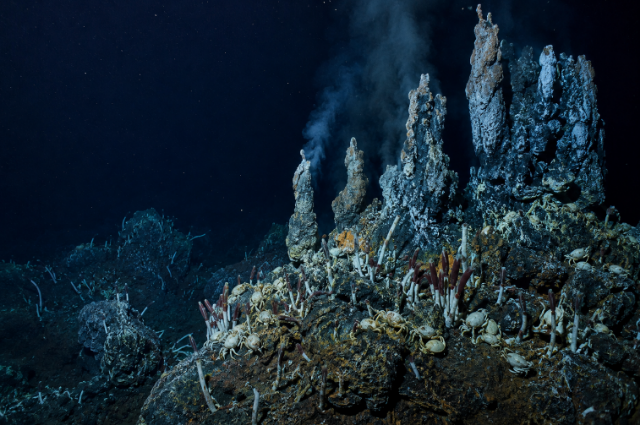
Imagine a world where the sun never rises, the temperature hovers just above freezing, and the weight of the water above you presses down with unimaginable force. This isn't a distant alien planet. It's our own deep ocean.
The deep sea is a vast midnight realm that covers most of our planet, yet more than 95% of it remains unexplored. For centuries, scientists believed these abyssal depths were nearly lifeless. Their reasoning seemed simple: without sunlight, the fundamental source of energy for life on Earth, nothing should be able to survive. They were wrong.
Far beneath the waves exists a thriving world filled with extraordinary creatures. But surviving here requires an entirely different set of rules. To endure the crushing pressure, endless darkness, and scarcity of food, deep-sea organisms have evolved a remarkable survival strategy, a completely different evolutionary playbook.
Welcome to the Deep-Sea Survival Code.
Rule One: Master the Pressure
At the bottom of trenches such as the Mariana Trench, pressure exceeds 1,000 times that at sea level. Imagine an entire commercial airliner balanced on your big toe. That's the kind of force these creatures experience every second of their lives. Any land animal brought to these depths would be crushed almost instantly. Air-filled spaces, such as lungs, would collapse under the immense pressure. Deep-sea creatures survive by eliminating the problem entirely.
The Mariana snailfish (Pseudo-liparis swirei), the deepest-living fish ever observed at around 8,000 meters, has no air-filled swim bladder. Instead, its body is soft, flexible, and gelatinous. Rather than resisting the pressure, it exists in equilibrium with it. But the battle against pressure doesn't stop at the level of the body. It happens inside every cell.
Extreme pressure can distort proteins, causing them to lose their shape and stop functioning. To prevent this, many deep-sea animals accumulate special compounds known as piezolytes. One of the most important is trimethylamine N-oxide, or TMAO.
Research led by marine biologist Dr Paul Yancey revealed a fascinating pattern: the deeper a fish lives, the more TMAO it contains. This molecule helps stabilise proteins, protecting them from the crushing forces of the deep ocean and allowing essential biological processes to continue.
Rule Two: Create Your Own Light
As you descend through the ocean, sunlight gradually disappears. Below about 200 meters, daylight fades into twilight. By 1,000 meters, darkness becomes absolute. This region is known as the Midnight Zone, a place where the sun has never been seen. In a world without light, survival depends on either seeing the faintest glow or producing your own. Many deep-sea species have evolved enormous eyes to capture every available photon. Others have mastered something even more extraordinary: bioluminescence. An estimated 75 to 90 per cent of deep-sea organisms can generate their own light through chemical reactions involving luciferin and luciferase. This isn't simply decoration. It's a powerful survival tool.
The black seadevil anglerfish (Melanocetus johnsonii) carries a glowing lure suspended above its mouth. Hidden in the darkness, it dangles this tiny beacon like bait on a fishing line. Curious prey swim closer, unaware that the light is actually a trap. Other species use light as camouflage.
By producing a soft blue glow from organs called photophores on their undersides, they match the faint light filtering down from above. This clever strategy, known as counterillumination, makes them nearly invisible to predators looking upward from below.
Rule Three: Rewrite the Energy Equation
Every ecosystem on the surface ultimately depends on sunlight. Plants capture solar energy through photosynthesis, forming the foundation of the food web. But what happens when sunlight is completely absent? For decades, scientists believed deep-sea life survived entirely on "marine snow", a slow shower of dead organisms, organic debris, and waste sinking from the surface. Then everything changed. In 1977, scientists aboard the research submersible Alvin discovered hydrothermal vents near the Galápagos Rift.
These underwater geysers release superheated water rich in chemicals such as hydrogen sulfide. The environment is toxic, dark, and seemingly hostile to life. Yet it hosts some of the most productive ecosystems ever discovered.
At the heart of these communities are specialised bacteria capable of chemosynthesis. Instead of using sunlight, they obtain energy directly from chemical reactions. These bacteria form the foundation of an entirely different food web.
One of the most remarkable residents is the giant tube worm (Riftia pachyptila). It possesses no mouth, no stomach, and no digestive system.
Instead, it houses billions of chemosynthetic bacteria inside a specialised organ called the trophosome. The bacteria provide nutrients to the worm, while the worm supplies them with oxygen and chemicals from the vent environment. Together they form a self-sustaining ecosystem that exists completely independently of the sun.
The Final Mystery
Every time a robotic submersible descends into the deep ocean, it reveals something unexpected.
Scientists discover creatures that challenge what we thought life was capable of becoming. Giant squids with eyes the size of dinner plates. Microbes thrive in volcanic heat. Fish living under pressures that would instantly destroy most forms of life. The deep sea teaches us a profound lesson: life is far more adaptable than we once imagined. And its mysteries are still unfolding.
By understanding how organisms survive in the deep ocean, scientists are developing the blueprint for searching for life elsewhere in the Solar System. Missions such as NASA's Europa Clipper are investigating Jupiter's moon Europa, where a vast ocean may exist beneath an icy crust, an environment surprisingly similar to Earth's deep sea. Remarkably, humanity knows more about the surface of Mars than it does about much of its own ocean floor. The deep sea is not a barren void. It is one of the greatest frontiers left on Earth, a hidden world that continues to surprise us, challenge our assumptions, and reveal the extraordinary resilience of life itself. And what we learn there may help define how far life can reach.
Scientific References (For Verification)
- Yancey, P. H., et al. (2014) — Marine fish may be biochemically constrained from inhabiting the deepest ocean depths
- Journal: Proceedings of the National Academy of Sciences (PNAS)
- Direct Link: https://www.pnas.org
- Corliss, J. B., et al. (1979) — Submarine thermal springs on the Galápagos Rift
- Journal: Science
- Direct Link: https://www.science.org
- Haddock, S. H., Moline, M. A., & Case, J. F. (2010) — Bioluminescence in the ocean
- Journal: Annual Review of Marine Science
- DirectLink: https://digitalcommons.calpoly.edu
- Hand, K. P., et al. (2009) — Astrobiology and the Potential for Life on Europa
- Book/Publisher: Europa, University of Arizona Press (Hosted via NASA ADS)
- Direct Link: https://ui.adsabs.harvard.edu