
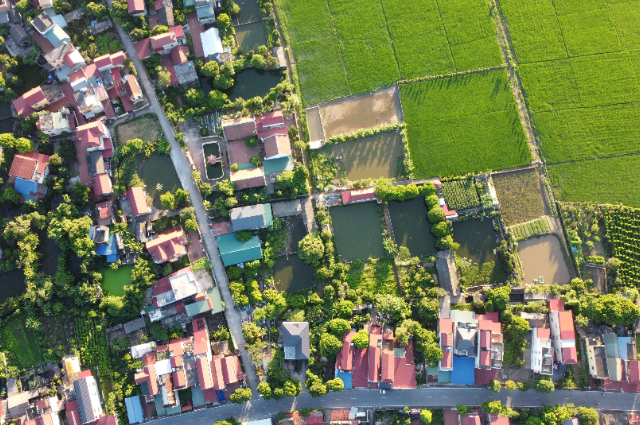
Development projects are usually shown as signs of a country doing well, with people getting jobs and other countries putting in money. Governments talk about construction and tourism projects as ways to make local areas better and get money from other countries. Some people have to deal with the bad side of these big projects. The Trump-branded golf resort that might be built in Hung Yen Province, Vietnam,m is an example. This project says it will bring tourism and help the economy, but it is also causing a lot of problems. Thousands of families have to move old family graves have to be moved. People are wondering about who owns the land and if they are getting a fair deal. The Trump-branded golf resort is making a lot of people unhappy. Development projects like the Trump-branded golf resort can be very bad for people who live in these areas.
The project in Hung Yen province, southeast of Hanoi, is worth around $1.5 billion. It will have a luxury golf course, hotels, homes, and recreation areas. This project can bring in tourists and create jobs. It can also make Vietnam an attractive place for foreign investors. The government thinks big projects like this one can help the economy grow and improve the region. The project in Hung Yen will make Vietnam stronger. It will have hotels and a golf course. The $1.5 billion project is good for Vietnam.
The people who live in the area are really worried about what the project's going to mean for them. A lot of people than 4,000 households might be affected by the project taking their land. For families, es the land is not just a piece of property. It is a part of their history, their culture and who they are. The project is a deal for these families because they have lived in these villages for a very long time. Some families have even had their ancestors buried in these villages,ges and these burial sites are very important to them. The land and the burial sites are a part of families' lives and culture, and they are very emotional about it. The project is going to affect the residents and the land that is so important to them.
The project is really tough when it comes to moving graves. People are being asked to dig up and move the remains of their family members, some of whom have been buried for a long time, even before 1967. In culture, people have a lot of respect for their ancestors. Graves are places where families go to honour the people who came before them. They do this by saying prayers and having ceremonies every year. It is very hard for many people to think about disturbing these graves. They only want to do it if they really have to. Moving ancestral graves is a big deal, and it hurts a lot of people. Ancestral graves are a part of the Vietnamese culture,e and people do not want to move them.
For people who live in the village, moving graves is not just about moving the bodies of their family members who have passed away. It is about changing the history of their family and the customs that have been passed down. The people of the village believe that their ancestors are still connected to them in a way and the places where they are buried are special because they remind them of this connection. When the villagers are forced to move these graves so that someone can build something,g they feel like their customs and beliefs are not being considered, and that money is more important.
Another thing that is worrying the villagers is the money they are being offered to move. Some people say they have been offered about $12 for every 10 feet of land they give up. The villagers do not think this is an amount of money because it does not take into account how much their land is really worth or how much they will lose when they have to leave their homes and the fields where they grow their food. When the government calculates how money to give the villagers they usually use the official value of the land, but the villagers think this is not enough because it does not consider the emotional attachment they have, to their land, i ts cultural importance or the opportunities they will miss out on in the future when they are gone.
Land ownership in Vietnam is really different from a lot of countries. In Vietnam, the state owns the land. People get the right to use the land, but they do not own it forever. The government can take the land back if they want to use it for something that helps the country. Usually the people who lose their land get some money. Sometimes they do not think it is enough. People in the communities often do not have a big say in what happens to their land.
The new golf resort is also getting attention from countries because it is happening at the same time that the United States and Vietnam are talking about trade. Some people think the golf resort is a sign that the United States and Vietnam are working together closely,y but others are worried that big businesses are getting what they want while the people who live nearby are not being heard. This is making people think about who benefits when big projects like this happen. Land ownership in Vietnam is still an issue, and the golf resort is just one example of how it can be a problem. The people who live in Vietnam and land ownership in Vietnam are affected by these projects.
People who like the project say that money from countries can be really good for us. When we build things, it gives people jobs and makes our roads and other things better. It also brings in money from people visiting. New hotels, ways to get around,d places to eat and things to do for fun can give jobs to a lot of people. Help our local economy get better. The government says that this kind of development helps make rural areas more modern and makes life better for people over time.
Some people do not think this is a good idea. They think that we should not make life worse for people who live here just so we can make money. They believe that we should talk to the people who live he, re pay them fairly, and respect the things that're important to them. Many people who know a lot about this say that the best way to make development work is for the government to make sure that making money does not hurt peoples rights, traditions and old buildings. The project supporters and critics both talk about the project and its effects on communities and economic growth,h but in different ways.
The Hung Yen golf resort issue also shows a problem worldwide. Many big projects like airports, highways, dams, industrial areas and luxury resorts have moved people out of their way for development. These projects can bring benefits, but they also make people lose their homes, farms, cultural sites and old traditions. So governments and developers are under pressure to make transparent policies that involve the community, and fairly acquire land.
The Hung Yen story is not about a golf course. It asks questions about how we define progress and who pays the price for economic growth. For investors, this project means chance and growth. For families, it means losing homes, memories and family ties that are hard to replace. Economic growth and keeping culture do not have to be against each other. Achieving both needs careful planning,g treating affected communities fairly, ly and truly respecting the people whose lives are changed.
As Vietnam gets international investment and strengthens its global economy the challenge will be making sure development helps not just businesses and governments but also the communities that have lived on these lands for generations. The Hung Yen project reminds us that behind every development are real families whose stories, traditions and futures deserve just as much consideration as economic goals.
References:
- Reuters. (2026). Vietnam villagers relocate ancestral graves for Trump-branded golf resort amid land dispute.
- BBC News. (2026). Vietnam golf resort project raises concerns over land rights and community displacement.
- The Associated Press. (2026). Families displaced as luxury golf development moves forward in Vietnam.
- Government of Vietnam. (n.d.). Land Law of Vietnam. https://english.luatvietnam.vn/
- World Bank. (2023). Land Governance Assessment Framework. https://www.worldbank.org/
- United Nations Human Settlements Programme (UN-Habitat). (n.d.). Land, Housing and Shelter. https://unhabitat.org/