
“The same colonial project that imposed this moral architecture is now celebrated as a pioneer of queer liberation, while pointing to the East as the site of backwardness — a backwardness it largely created.”
The Good Indian
Architectural art is a kaleidoscope of lives arrested in stone. Indian temples, in particular, serve as living archival spaces where culture, aesthetics, and social life converge. Stella Kramrisch described the Indian temple structure as the microcosm of the cosmos. The art that covers these temples serves as a record of how the cultural, social, and spiritual relationships in Indian society evolved. But the modern understandings of these spaces — especially around sexuality and its relationship with religion — have been profoundly shaped by inherited colonial and nationalist ways of seeing. To fully understand these cultural cornerstones, we have to attend more carefully to the threads that connect them to our society.
However, I did not always consider temples a source of knowledge. Like many Indian children of the 2000s, my relationship with religion was ambivalent at best and disdainful at worst. For years, temples were synonymous with the claustrophobic press of bodies in narrow hallways and the relentless screech of temple bells. Growing up, I trailed through muddy temple floors, dodged gruff priests, and slowly came to recognise “the good Indian” — the smiling devotee trained to bow, join their hands, and endure the crush of bodies for a single glimpse of the idol. Only now do I realise that there were never any passive believers, but rather a kind of observer historically conditioned not to analyse the object of their worship.
So, when I was finally given the space to decide for myself, I chose to distance myself from religion, which by then had come to represent little more than conservative dogma and increasingly commercialised ritual. Accepting my own identity and beliefs felt inseparable from that distance, as I did not want to make space for something that seemed to have no space for me. Yet it never felt like a loss, perhaps because my relationship with religion had never extended beyond performance and ceremony.
However, rediscovering religion as an academic allowed me to interrogate the assumptions I had long held about it and finally attend to the stories that the temple walls had been telling all along. What fascinates me most about history and culture is the instability of meaning. Both are in a perpetual state of flux, depending on the eyes through which they are interpreted. My academic engagement eventually led me to two dominant interpretive frameworks that continue to shape modern understandings of Indian culture and morality. The first was the European colonial gaze, informed by Victorian ideals of purity and philosophical traditions of mimesis, which often reduced Indian artistic and religious practices to the irrational or barbaric imaginings of “devil worshippers.” The second was the postcolonial nationalist gaze, shaped by overcorrection and the desire to construct a purified national identity untouched by so-called Western corruption. Ironically, this process ended up reproducing the very purist moral frameworks introduced by the colonialists themselves. Together, these perspectives profoundly shaped the anxieties, moral discourses, and cultural fears of the modern Indian imagination. One significant consequence was the transformation in attitudes towards queer communities and diverse forms of gender and sexual identity.
Kama Without Shame
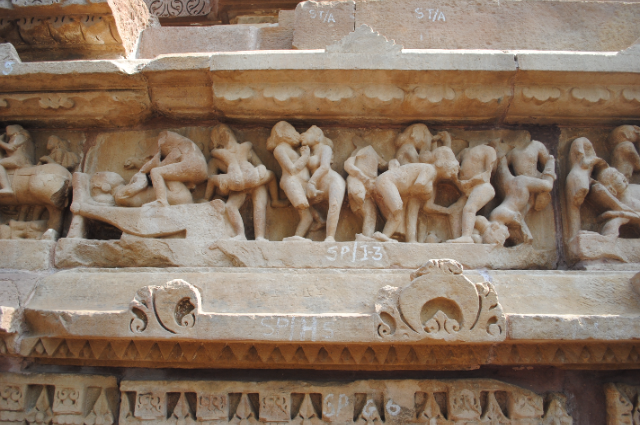
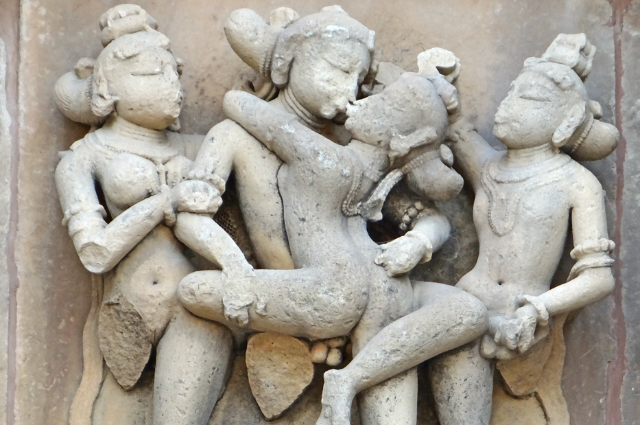
These anxieties become especially obvious in the way that certain religious texts and temple art are censored or selectively remembered in modern India. Why do guides and priests wilfully ignore the queer art panels in Indian temples? Why do people ignore the explicitly non-binary nature of gods like Vishnu, who had female alter egos like Mohini? Sculptural and textual depictions of diverse forms of sexuality and desire that once formulated the philosophical and cosmological underpinnings of Indian imagination are now often treated as sources of embarrassment — or inappropriate additions to something as holy as temples and scripture.
However, unlike many Western philosophies and religious practices, sexual desire and diverse gender identities were never a matter of shame in India. In the anthology Same-Sex Love in India, scholars Ruth Vanita and Saleem Kidwai trace homoerotic relationships across Indian cultural history, including within the Kama Sutra. While in much of the Western imagination the text has long been reduced to an exoticised manual of heterosexual excess, the Kama Sutra is more accurately a philosophical meditation on desire. It speaks of intimacy, pleasure, and even same-sex desire without requiring moral justification. Within ancient Indian philosophy, kama was understood not as sin, but as an essential pursuit of pleasure, love, and emotional fulfilment.
Even ancient Indian linguistic structures go beyond mere tolerance of gender and sexual variance and have actually built a systematic conceptual architecture around them. Devdutt Pattanaik’s work on Hindu theology documents how ancient Indian scholarship distinguished between the physical body (Dravya-purusha / Dravya-stri) and the emotional body (Bhava-purusha / Bhava-stri). This allowed scholars to conceptualise diverse, non-binary identities and recognise a person’s essence beyond their physical body.
“Unlike many Western philosophies and religious practices, sexual desire and diverse gender identities were never a matter of shame in India.”
The Irony of Empire
We can find distinctive evidence of this on our holy temple walls. The Kandariya Mahadeva temple at Khajuraho in Madhya Pradesh, nestled amongst the widely renowned art panels, features a figure of a man openly pleasuring another man, flanked by statues of two divine deities. From cross-dressing figures on the pillars of Madurai’s Meenakshi temple to two naked women depicted in an intimate embrace on the walls of Kanchipuram temple, the images of queer and erotic love feature throughout India. The question then becomes not whether queerness existed in Indian cultural history, but when and how we begin to see it as something shameful — something to be ignored, erased, or explained away.
Many contemporary post-colonial scholars argue that the homophobia and transphobia of modern India are a direct consequence of the moral frameworks of purity and naturalness that were integrated into our society through British anti-sodomy laws during the colonial era. However, the Western encounter with India was not limited to its legal dimensions. Colonial and pre-colonial scholars’ encounter with Indian temple art, in particular, was largely informed by Christian ideals and the aesthetics of Western classical art. The eroticism and cosmological multiplicity that informed Indian mythology and its art were deemed obscene or demonic. Diverse gods with multiple heads and hands, according to Hegel, were the representation of excessive abstraction and a consciousness that hadn’t reconciled with itself.
Even when European architects and aestheticians admired the intricacy of Indian craftsmanship, Indian art remained legible to them only when filtered through Greco-Roman frameworks of beauty and proportion. What could not be translated into European aesthetic vocabulary was ultimately treated as primitive, barbaric, or aesthetically unresolved.
So it’s not unreasonable to assume that when the British encountered a culture whose temples depicted same-sex intimacy and whose philosophical texts documented third genders, they concluded that what they were seeing was evidence of degeneracy requiring correction. The irony is almost too neat: the same colonial project that imposed this moral architecture is now, in its own countries, celebrated as a pioneer of queer liberation, while pointing to the East as the site of backwardness, a backwardness it largely created.
In the postcolonial nationalism that emerged in an attempt to purge the country of its Western influence, a lot of colonial ideals ended up absorbed into Hindu nationalist discourse, and queerness got turned into a Western import threatening Indian traditional culture. Yet can colonialism alone account for the prejudices of the present? The moral frameworks introduced during colonial rule cannot entirely absolve contemporary India of its responsibility for sustaining, institutionalising, and eventually mistaking them for tradition itself.
It was within this sociocultural atmosphere that I grew up distancing myself from Hinduism, and while my academic engagement with it has complicated many of the assumptions I once held, it has not entirely resolved my relationship with religion. Yet the questions these temple walls raise extend far beyond personal faith. They force us to confront which histories we choose to legitimise, which traditions we choose to protect, and whose interpretations we continue to privilege. What the “good Indian” dismisses as foreign may in fact reveal less about the past than about the anxieties through which the present continues to interpret it.
Sources
Textual Sources
- Kramrisch, Stella. The Hindu Temple (2 vols.). University of Calcutta, 1946.
- Vanita, Ruth and Saleem Kidwai (eds.). Same-Sex Love in India: Readings from Literature and History. St. Martin’s Press, 2000.
- Pattanaik, Devdutt. Shikhandi and Other Stories They Don’t Tell You. Penguin Books India, 2014.
- Vatsyayana. Kama Sutra. Trans. A.N.D. Haksar. Penguin Classics, 2011.
- Hegel, G.W.F. Aesthetics: Lectures on Fine Art. Trans. T.M. Knox. Oxford University Press, 1975.