
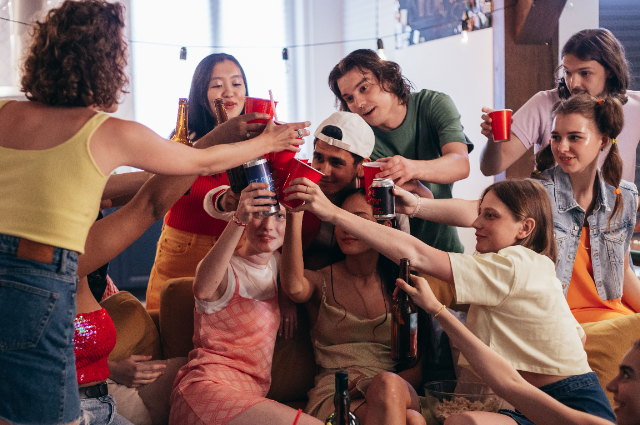
Back in school in the mid-2010s, our little acts of rebellion included bunking school on the back of our scooters or meeting behind the school building to watch fights, and if we were feeling particularly daring, someone would try to sneak in a cigarette. Although I wouldn’t really hold up the school experiences of a severely repressed teenager as any sort of authoritative anecdote, even I can argue that the first taste of alcohol was a similar fantasy. Less a substance and more a symbol of adulthood and freedom. Drinking was the forbidden adult ritual everybody was theoretically queuing up for, and actually liking it was never really part of the conversation. After all, tequila with lime juice or cans of cheap beer rarely make for a refined drinking experience.
A decade later, the queue among that same Gen Z group seems to have thinned quite a bit. As someone standing half in and half out of it, alcohol seems to have lost much of its teenage charm. Gallup, the analytics and polling firm, recently reported that the share of US adults under 35 who drink at all has fallen from 72% to 62% in the last two decades, and this aesthetic is visible among the Indian Gen Z population as well. Even with India’s punishing state excise duties making every night out a small financial event, while the night outs have not particularly suffered, the popular orders have definitely shifted. If you walk into the upmarket cafés of Hauz Khas and Bandra these days, the menus and trends seem more focused on kombucha flights, zero-proof menus, and sober-curious influencers (The Established, 2024). So is it really true that, amid the rising tide of health-conscious culture, controlled calorie intake, and experimental diets, we’ve decided to ditch the beer belly for something kinder to the body, or are the motivating factors something else entirely?
While it’s true that I still enjoy a pint or a glass of wine now and then on social occasions, drinking is hardly the go-to indulgence for Gen Z anymore. For a generation juggling rising rents, never-ending side gigs, and dead-end jobs, giving up a 900-buck cocktail is hardly a grand sacrifice, and if we do indulge, it’s to nurse that single overpriced drink the whole night till you can barely taste the alcohol against the melted ice. So with an ever-fluctuating economy that promises endless opportunity but only ever demands unreasonable amounts of work with next to no guarantees or proper pay, we are not really health-conscious teetotallers. Instead, we are just broke and unimpressed. IWSR’s 2025 consumer study seems to agree and blames the global dip in drinking on a lack of disposable income and people prioritising essentials over alcohol. However, has Gen Z’s visible abstention or more conscious drinking been an actual result of wanting to step away from dependency or have the interests simply migrated?
Take cannabis, for example, the most obvious heir to alcohol. The United States federal survey data found that 38.2% of young adults aged 18 to 25 had used marijuana in the past year, the highest rate of any age group surveyed (SAMHSA, 2023). By one international estimate, Delhi and Mumbai ranked as the third and sixth largest cannabis-consuming cities in the world, burning through 38.2 and 32.4 tonnes a year, respectively (ABCD, 2018). However, if we try to analyse the shift towards this interest, beyond the economic reasons, it feels relevant to look at the mental health environment surrounding Gen Z. It's worth noting that even for a generation that grew up under the mixed influence of millennial ideals, the vocabulary of boundaries, burnout, and mental health breaks is an acquired one. Back in school, when we were grinding between coaching, after-school classes, entrance exams, and never-ending studies, taking a break in the name of burnout was a concept that simply didn’t exist. Whether Gen Z's mental health vocabulary marks the rise of a more conscious working individual or is just a pretentious excuse made by undisciplined, privileged people can be argued to death. But the underlying living conditions that produced this discourse are worth considering. Given the fast-paced, suffocating lifestyles we are now forced to live, developing some sort of dependency as a coping mechanism seems almost inevitable. Stretched between too many commitments, the constant threat of becoming irrelevant, and the continual suffering of existing in a state of social and economic decline, smoking a blunt seems like a perfectly good alternative for calming a mind that feels permanently on the verge of a panic attack while simultaneously feeling dead. And since indulging in the hangover-inducing, wallet-draining revelry of alcohol isn’t all that feasible, getting high while playing video games, or sucking on a watermelon-flavoured vape mid-workday seems like a reasonable alternative. And for Indian Gen Z especially, whose relationship with weed has always been blurred by culturally approved, festival-sanctioned bhang, it ends up feeling less like an illicit drug and more like a historically approved mode of treating modern-day stress.
This cavalier attitude of perceived harmlessness, along with the touted medicinal benefits, has become a point of concern among addiction psychiatrists. And cannabis is only the visible end of the self-medication spectrum. The Ministry of Social Justice and Empowerment’s national survey estimated 22.6 million opioid users in India, with pharmaceutical opioids second only to heroin (Ambekar et al., 2019). For students cramming for entrance exams like NEET and JEE and for corporate-exhausted twenty-somethings, self-medication has become common. For instance, using something like benzodiazepines for sleep, codeine syrups for escape, and misusing ADHD medication for focus are almost considered necessary for staying productive in increasingly demanding times. And where heroin and prescription opioids might sound too scary, the simpler vices prove just how little legal prohibition achieves in the face of such attitudes. India banned e-cigarettes outright in 2019, yet a study of educated young Indians found 23% had used them anyway, sourced through vape shops, tobacconists, or friends (Pettigrew et al., 2023). A survey of over a thousand school students across Delhi-NCR, Mumbai, Pune, and Bengaluru found that 96% of 14- to 17-year-olds didn’t even know vapes were banned, and over half of those unaware of the harms considered vaping completely harmless, even cool (Think Change Forum, 2023).
But one of the most pressing concerns for Gen Z isn’t even these somewhat traditional addictions to substances and medications, but rather it is tech that has infiltrated every part of our lives. No matter how many digital cleanses one goes through or how many timers and app blockers one installs, technology remains pervasive, and the ways we use it have become increasingly troublesome. Social media, specifically designed to keep you hooked, has spent a decade training us to crave unpredictable little rewards, and following this trend of providing dopamine hits, another temptation has emerged: paid games. In an increasingly connected world built on smooth operations and fewer steps for tasks, like paperless UPI payments, mobile games have all but turned into gambling dens. India has roughly 444 million gamers, 138 million of whom play real-money games such as fantasy cricket, rummy, poker, and opinion trading (Reuters, 2025). But how does a generation too broke for bar cocktails end up wagering their meagre paychecks over an IPL match? It’s simply because these enticing betting apps, unlike the bar, present themselves as a means rather than an expense. The betting games become dopamine-driven rewards that, with some perceived skill, can fix the very brokenness that has led Gen Z to cut back on an indulgent social life in the first place. With cheap entry fees and payments that are comfortably just a tap away, the reward schedule that these games operate on is the same variable, unpredictable drip that defines the addictive behaviour promoted through social media. A generation raised on never-ending stress and the infinite scroll automatically becomes the perfect customer for such gaming applications. The gambling apps have become so common in fact that even when the Indian government banned real-money gaming outright in 2025, citing addiction and financial ruin (Reuters, 2025). But as e-cigarettes have already proven, banning the counter rarely disperses the queue.
So while we can argue, at the surface level, that Gen Z is the most sober generation, the difference lies only in the mode of consumption. Where previous generations engaged with alcohol in guilty silence or destructive excess, the so-called sober generation has simply learned to diversify, to present a deceptively clean picture. It is rather wishful, then, to argue that Gen Z has become sober-curious or conscious of its dependencies. More accurately, we have merely swapped our whiskey bottles and card tables for blunts and fantasy games. While we have become better at making our addictions functional and quieter, until we address the conditions that necessitate them- the ones that turn curiosities into necessities- calling ourselves sober would be nothing more than rebranding. The alcohol queues we stood in as teenagers haven’t thinned but rather split into more diverse lanes where sobriety has become nothing more than a costume of pretence.
References:
- ABCD. (2018). Cannabis Price Index 2018. ABCD Analytics.
- Ambekar, A., Agrawal, A., Rao, R., Mishra, A. K., Khandelwal, S. K., & Chadda, R. K. (2019). Magnitude of substance use in India. Ministry of Social Justice and Empowerment, Government of India / National Drug Dependence Treatment Centre, AIIMS. https://socialjustice.gov.in
- Gallup. (2023). Young adults in U.S. drinking less than in prior decades. https://news.gallup.com
- IWSR. (2025). Bevtrac consumer insights: Gen Z alcohol participation, March 2025. IWSR Drinks Market Analysis.
- Pettigrew, S., Santos, J. A., Miller, M., Raj, T. S., Jun, M., Morelli, G., & Jones, A. (2023). E-cigarettes: A continuing public health challenge in India despite comprehensive bans. Preventive Medicine Reports, 31, 102108. https://doi.org
- Reuters. (2025, September 9). India's online gaming ban may drive addicts underground. Thomson Reuters Foundation. https://www.context.news
- Substance Abuse and Mental Health Services Administration. (2023). Key substance use and mental health indicators in the UnitedṄ States: Results from the 2022 National Survey on Drug Use and Health. U.S. Department of Health and Human Services. https://www.samhsa.gov
- The Established. (2024, April 19). Why is the consumption of alcohol among Gen Z seeing a decline? A peek into young India’s drinking habits. https://www.theestablished.com
- Think Change Forum. (2023). Ideas for an addiction-free India [Survey report]. Reported by Press Trust of India.