
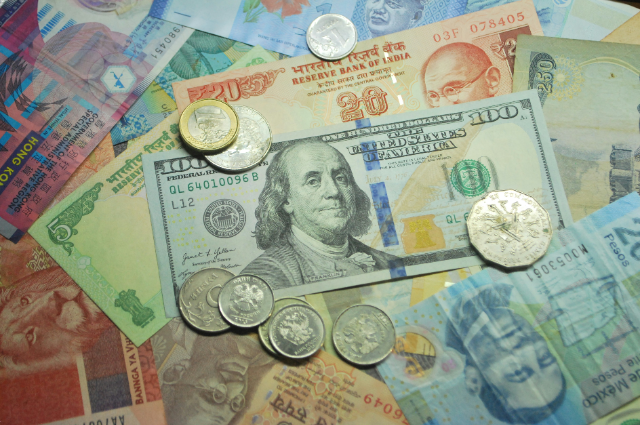
Over the last couple of years, the Indian rupee has seen unprecedented depreciation against the dollar and the pound, but the 2026 figures are the most disturbing. In May 2025, 1 Indian rupee roughly equalled 3.29 Pakistani rupees; only a year later, that value has fallen to 2.90. So what exactly is the reason for this 12% fall, given that Pakistan's economy was doing much worse than ours, yet, with the IMF’s support, has managed to balance itself better than India?
The rupee is currently the weakest it has ever been, at about 97 rupees to a dollar, which is mostly attributed to the war in West Asia and the resulting rise in oil prices, since India imports most of its oil. While this is definitely part of the reason, it doesn't explain the whole situation. Our neighbours like Bangladesh and Pakistan are affected by the same war, yet they haven't lost as much ground as the Indian rupee. So it forces one to ask whether there are other, internal circumstances contributing to the fall of the Indian rupee.
“It’s the war” is only half the story
Since India imports most of its oil, much of it from the Middle East, the war with Iran and the jump in crude prices that followed were always going to hurt the Indian rupee. But crude is a shared shock: Bangladesh and Pakistan also import heavily, so what doesn't make sense is the Indian rupee falling against its neighbours' currencies as well.
If oil can't explain the gap, the next usual suspect is a strong dollar. But that doesn't hold up either. The US dollar fell 9.4% in 2025, its worst year in almost a decade, and still hasn't really recovered. So when the world's main currency is itself weakening, and the rupee still loses ground against it, the issue cannot be solely global; it must be a reflection of the economic state within the country itself.
Kaushik Basu, former Chief Economic Adviser to the Government of India and former Chief Economist of the World Bank, said that the rupee's slide past 96 in May was "not just because of the war", and that it was time to move from politics to actual policy.
Follow the money out of the door.
But before we get into the mechanics of economic policymaking, let's first understand how the value of a currency works. In simple terms, the more people exchange their currency for Indian rupees, the more the rupee's value increases; and if a lot of people swap rupees for dollars, it depreciates, weakening the currency. In 2026, the rupee has been exchanged for dollars not just by foreign investors but also by homegrown companies that are meant to boost the Indian economy instead of weakening it.
As Goldman Sachs reported, foreign investors had sold around $22 billion of Indian shares by the middle of 2026, more than in any full year ever recorded. Foreign companies have been cashing out of their Indian branches too. So what has prompted businesses that, only recently, considered India one of the world's fastest-growing markets to cash out instead of investing for more growth?
The answer, ironically, is that Indian shares have become too expensive. The same company is now valued far higher in India than at home: Nestlé India's shares trade at nearly 77 times its profits, compared with 22 times for its Swiss parent. So foreign companies have been listing their Indian branches on the stock market and selling part of their stake to Indian buyers, without raising any new money for the business. Hyundai and LG led this wave of listings, in which foreign parent companies took home nearly $5 billion. For every dollar raised for the Indian business, more than $59 went back to headquarters abroad. Economists at MUFG Bank have named this IPO boom as one important contributor to the rupee's weakness.
The government, meanwhile, would rather talk about record foreign direct investment than about the falling rupee. And $94.5 billion came in during 2025–26. But $53.6 billion was taken back out by foreign owners, and Indian companies sent another $33.3 billion abroad. What actually stayed in India was just $7.65 billion. Our own biggest firms, from Sun Pharma to Tata Steel, are choosing to build and buy overseas rather than at home.
Thus, when both foreign and Indian capital decide that Indian shares are better to sell than to build upon, it almost becomes a self-fulfilling prophecy: a weakening currency trapped by the verdict of the very companies that could revive it.
Rules made in a hurry, failures blamed on someone else.
One of the biggest reasons foreign investors in particular are pulling out is opaque and erratic policy. For instance, in 2022 India's cyber-security agency ordered VPN companies to store their users' names and IP addresses for five years, which worked directly against the purpose of a VPN. So, to no one's surprise, companies like ExpressVPN, NordVPN, Surfshark and Proton pulled their servers out of the country. While the money lost here was relatively small, and the companies could still serve Indian users through their servers abroad, it sent a message to the global market that Indian economic policy would be littered with opaque regulations and sudden changes.
Analysts have since linked the stall in foreign direct investment to exactly this kind of regulatory opacity and policy inconsistency. These are policies announced first and understood later, and it is the economy that bears the brunt of consequences nobody thought through.
But like any classic ruling government, instead of accepting responsibility and implementing economic policies better, the Indian government and its agencies simply shift the blame: to the opposition, to global headwinds, or to corruption lower down the chain that led to poor implementation. But corruption is not an excuse when you are the one who chose the people running the system. A government that puts loyalty ahead of competence does not get to act surprised when its policies are badly carried out.
Take demonetisation. In 2016, the government cancelled 86% of the cash in circulation overnight, promising to flush out black money. By 2018, the RBI reported that 99.3% of the banned notes had come back into the banks. Rather than admit it had failed, the government kept moving the goalposts, from black money to digital payments to widening the tax base, while the informal economy paid the price.
The GST rollout a year later followed the same pattern. Industry warnings that the system needed more testing were brushed aside, and when the network broke down, officials blamed Infosys, the company that built it. Reuters reported, citing people involved in the rollout, that no government official accepted any responsibility for the glitches.
All of this happens while the government's political energy goes into identity and symbolism rather than the economy. In 2021, as the second Covid wave left hospitals short of oxygen, the government declared its roughly ₹20,000 crore Central Vista project, a new Parliament and a redesigned heart of Delhi, an "essential service" so that construction could carry on through the lockdown. The new Parliament building alone was budgeted at ₹971 crore, nearly five times the ₹201 crore being spent on 162 oxygen plants. The government argued that it was spending far more on vaccines, but what it chose to keep building during a national emergency said enough. A government can only fight so many battles at once, and it has chosen which ones matter to it.
At the mercy of Washington
None of this means the outside world is innocent. In August 2025, the US slapped a 50% tariff on Indian goods, half of it as punishment for buying Russian oil. It was cut to 18% in February only after India promised to stop those purchases and buy American instead. US interest rates, US trade wars and the US-Israeli war on Iran have all hit the rupee harder than almost anything decided in Delhi.
But that is exactly the point. A country this exposed to decisions made by other people's governments needs a plan to become less exposed: more domestic manufacturing, less dependence on imported oil, a stable home for long-term investment. After more than a decade in power, this government has not built one. Indians feel the result every time they travel. The number of countries an Indian can visit without a visa has fallen to 55, and the passport ranks lower today than it did in 2006.
Who pays
The cost does not land on billionaires. It lands on everyone else, through a chain that starts in ordinary homes. Urban middle-class wages stopped growing, and in 2024 fell for the first time since the pandemic. People cut back. Companies like Hindustan Unilever and Maruti Suzuki reported weaker sales. Weak profits made Indian shares look overpriced, so foreign investors left. The rupee fell. And a weaker rupee makes fuel, phones, medicines and foreign degrees more expensive, which squeezes the same households all over again.
That is the cycle the government will not name, because naming it means admitting it starts at home.
What the government will say
It will say India's foreign exchange reserves are huge, and they are: they peaked at $728.5 billion in February. India is not facing a 1991-style crisis, and nobody should pretend otherwise. But reserves are a cushion, not a policy. The RBI has spent billions defending the rupee, and that money is only buying time.
It will point to record gross investment. That figure means little when most of it walks straight back out. And it will note that even some opposition voices, like Shashi Tharoor, blamed global forces. Global forces explain the storm. They do not explain why India's boat is taking on more water than its neighbours'.
A rough sea, and the wrong captain
Before he took office in 2014, the man who is now Prime Minister mocked the government of the day every time the rupee slipped. A falling currency, he suggested, was a sign of a failing government. He was right then, and the same test applies now.
The rupee near 100 to the dollar is not a number on a trading screen. It is a measure of how much the world, and India's own businesses, trust the people running the country. Right now, they are voting with their money, and they are leaving. Until the government stops blaming the weather and starts fixing the ship, ordinary Indians will keep paying for it.
References:
- ProPakistani: INR down 12% against PKR
- Arab Times: Rupee falls against regional currencies
- RBC-Ukraine/Reuters: Dollar's 2025 decline
- Business Today: Kaushik Basu on the rupee
- Tribune: Goldman Sachs on foreign selling
- Reuters via Stockopedia: Foreign firms' IPO exits
- Springboard: FY26 FDI breakdown
- Business Standard: Why India Inc invests abroad
- Inc42: Proton VPN leaves India
- Pulse: Deeper problems than the Iran war
- Scroll: US removes punitive tariff
- Business Today: Henley Passport Index, October 2026
- Business Standard: Falling wages
- People's Democracy: Forex reserves
- News Arena: Tharoor on global factors
- The Wire: Modi and the rupee
- Khaleej Times/Reuters: MUFG on IPOs and the rupee
- Aaj News/Reuters: Nestlé India valuation gap
- BloombergQuint: 99.3% of demonetised money returned
- Scroll: RBI data on demonetisation and cash
- ThePrint: Demonetisation's shifting objectives
- Dawn/Reuters: GST rollout glitches and Infosys
- Scroll: Central Vista declared an essential service
- Yahoo/The Quint: Hardeep Puri on Central Vista cost