
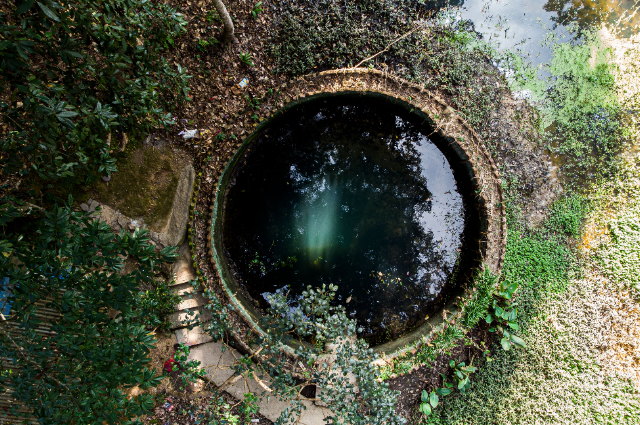
This monsoon season in India has been full of tragic news, from floods to heroic deaths to reproachable infrastructure and government response. And now we have something potentially eerie, even supernatural, happening in a well owned by farmer Pranjivan Sadariya in Saurashtra. The well sits in a remote corner of Gujarat's Morbi district and has become a subject of speculation and wonder for locals and for the owner himself.
Pranjivan had built the well roughly three months ago. On August 2, he noticed something unusual: the water was rippling and spilling over the edge. Soon this seemingly ordinary well turned into an internet sensation and a tourist attraction, with people flocking to Morbi hoping to witness the spooky well and its miniature sea waves. The reality, however, is less spooky than the videos suggest. According to officials, it is most likely the result of air trapped in rock pores, not a signal of world-ending seismic activity.
Morbi district lies relatively close to Gujarat's coastline, and some villagers believe the well moves with the tides of the Arabian Sea. But the town's more painful history is with the Machchhu River and the infrastructure built around it. In 1979, the Machchhu-2 dam failed, sending a wall of water through the town and leaving devastation in its wake. Then, in 2022, the pedestrian suspension bridge over the Machchhu collapsed, killing at least 141 people. So unusual activity in the water is hardly something locals can ignore or explain away.
It was only to be expected, then, that the state would respond as quickly as possible to ease people's fears. District Geologist J S Vadher stated that the waves were not the result of seismic activity. His preliminary diagnosis was that heavy upstream rainfall is recharging the groundwater, which is releasing air trapped in the pore spaces of rocks and disturbing the well. Officials also consulted the Institute of Seismological Research (ISR) in Gandhinagar, which confirmed that no active fault line runs through the area. Experts have also maintained that the evidence points to groundwater recharge rather than any tidal influence from the sea.
To explain this for the non-geologists among us: rocks, despite their appearance, are not solid, tightly packed objects. They are full of cracks and pores that can easily fill with pockets of air. When the water table climbs during the monsoon, the incoming water squeezes out those air pockets. Since the air can't simply disappear, it has to escape, and it rises through the water as bubbles that disturb the surface.
That does raise a question: why doesn't every well behave this way during the monsoon? Heavy rain is nothing new to India or to this region. Part of the answer is that this year's rains were particularly heavy. Successive low-pressure weather systems over the Arabian Sea delivered torrential rainfall to Saurashtra and Kutch, recharging the ground far faster than usual.
But heavy rain alone doesn't explain why this well rippled while the wells around it stayed still. One likely factor is its age. A freshly dug shaft opens a new path through the rock, offering trapped air an easy way out that older, settled wells may not provide. Investigators are also looking at whether the unique geometric shape and depth of the structure actually amplified subtle underground pressure waves.
It's also worth being honest about the term that dominated the coverage: "well seiche." A seiche is a standing wave, water rocking back and forth in an enclosed space, and in scientific literature it is most often linked to earthquakes. The US Geological Survey describes seismic seiches as standing waves set up on rivers, reservoirs, ponds, and lakes when seismic waves from an earthquake pass through the area. Wells can react dramatically to distant quakes too: after the 1964 Alaska earthquake, water in a well in northern Florida fluctuated approximately 17 feet. None of this contradicts the officials in Morbi, since no local tremor was recorded. But it does mean that giving the phenomenon a name is not the same as fully explaining it. Even the officials acknowledged that a definitive conclusion will be reached only after the expert team's investigation is completed.
In the meantime, the administration has barricaded the area and appealed to visitors not to spread unverified information and cause unnecessary fear, although that’s probably not the most reasonable request with the amount of interest this has generated. A team from the Gujarat Groundwater Department is expected to conduct a detailed scientific investigation before submitting a final report that will hopefully adequately explain why neighbouring wells stayed calm. However, for now the villagers can simply wait and hope that everything turns out well.
Resources:
- ThePrint (PTI), "Unexplained waves in well at Gujarat's Morbi, experts hint at air pressure, groundwater recharge," August 6, 2026. https://theprint.in
- Business Today, "Gujarat's Morbi 'waving well' mystery: Experts explain why water moved for days like ocean waves," August 7, 2026. https://www.businesstoday.in
- Free Press Journal, "Gujarat's Morbi Well Mystery: 18-Foot-Deep Well Produces Continuous Waves For Five Days, Experts Begin Probe," August 7, 2026. https://www.freepressjournal.in
- Republic World, "Mystery Well in Gujarat's Morbi Draws Crowds as Water Ripples for Days; Officials Rule Out Seismic Activity," August 7, 2026. https://www.republicworld.com
- IBTimes UK, "Morbi Shaking Well Explained: Geologists Confirm Groundwater Recharge, 'Not Seismic Activity'," August 7, 2026. https://www.ibtimes.co.uk
- WION, "Mysterious well in Gujarat's Morbi found generating waves, ripples," August 7, 2026. https://www.wionews.com
- US Geological Survey, "Seismic Seiches." https://www.usgs.gov/
- US Geological Survey, "How does an earthquake affect groundwater levels and water quality in wells?" https://www.usgs.gov
- Bredehoeft, Riley, and Roeloffs, "Earthquakes and Groundwater," Earthquakes and Volcanoes, 1987. https://www.wipp.energy.gov
- Wikipedia, "1979 Machchhu dam failure." https://en.wikipedia.org
- Wikipedia, "2022 Morbi bridge collapse." https://en.wikipedia.org