
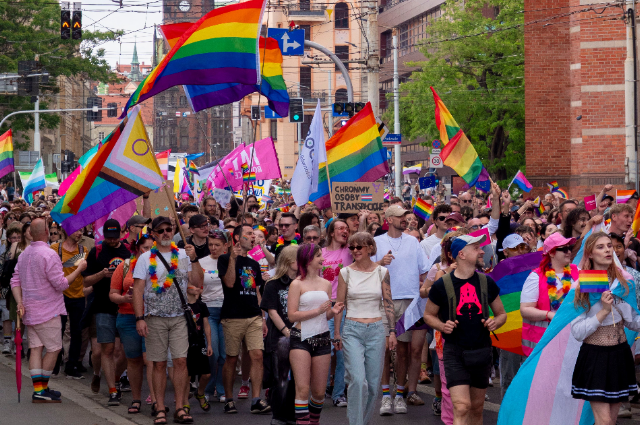
This 2026, I'm going to Pride events with my boyfriend and our friends. It's the first time I'm going with the people I love.
That’s what Pride’s about, right?
If you're with the LGBTQ+ community or an ally, there's a good chance you're also coming.
And depending on where you live, it may be a peaceful or at least semi-peaceful event.
Many years ago, that wasn’t how it was.
What's on the line...
Today, 77 countries still criminalise and pass discriminatory laws against consensual same-sex relationships.
Five countries still impose the death penalty.
A trend known as "Rights Rollback" is rising faster than your favourite queen in Drag Race.
According to the Williams Institute:
Worryingly, restrictions on LGBTQ rights can pave the way for restrictions on other rights. This process follows a familiar pattern: first, leaders cast LGBTQ people as threats, creating a moral justification for increasingly repressive measures that limit expression and assembly. These measures can then provide legal frameworks and generate social tolerance for broader constraints on civil liberties.
And given the history that LGBTQ+ people have in supporting other minorities and oppressed groups (such as the LGSM, which supported mine workers striking in the UK), if they can roll back our rights, what stops them from rolling back:
- Wage hikes for workers
- Land reform for poor farmers
- Accessibility programs for differently abled people
- Free and accessible education for the youth
- Abortion rights and healthcare for women
Knowing our history gives us bricks to rebuild our protections and rights when corrupt authoritarian leaders eventually turn us over.
Stonewall was a revolution.
Everyone in the LGBTQ+ community and their mothers know the Stonewall Riots. What they didn't know was that it wasn't just another riot that fizzled out.
It marked the beginning of a revolution.
And it all started in a little gay bar that started as a speakeasy (read: illicit bar) in Greenwich Village in Lower Manhattan, New York City.
The times were tough for the community. Between 1947 and 1950, LGBTQ+ people were second-class citizens.
- 1,700 federal jobs were denied.
- 4,380 people were discharged from the military.
- 420 were fired from government jobs.
All for being suspected homosexuals!
Surveillance was on par with the spying against communist activists in the United States. Between the 1950s and 1960s, the Federal Bureau of Investigation (FBI) and local police departments kept lists of known homosexuals, their favoured establishments and friends. The US Post Office kept track of addresses where material about homosexuality was mailed.
In 1952, the American Psychiatric Association listed homosexuality in the Diagnostic and Statistical Manual (DSM) as a mental disorder, and homosexuality would be listed as a mental disorder as early as 1974.
The revolution needed preparation.
All great revolutions had precursors.
Mahatma Gandhi, before leading a civil disobedience campaign against the British, had the Rebellion of 1857.
Andres Bonifacio, before leading the August Revolution of 1896 against the Spanish, had the publication of Jose Rizal’s novels – Noli Me Tangere and El Filibusterismo.
Ho Chi Minh founded the Viet Minh after Phan Boi Chau was assassinated by the French.
All great revolutions had inspiration, ideology and martyrs.
And for the Gay Rights Movement, this was the earlier Homophile Movement. These were the organisations and publications that supported sexual and gender minorities from the 1950s to the 1960s.
Organisations like the Mattachine Society, Daughters of Bilitis and ONE, Inc helped dispel the alienation of being alone as a gay person in society and replaced that with solidarity and community.
In 1954, nearly 60, 000 copies of ONE, Inc’s magazine were distributed, and it is admitted that its readership is much higher. These organizations inspired more people by staging acts of historic resistance against the discrimination of LGBTQ+ people.
In 1965, over 150 people participated in a sit-in when the manager of Dewey’s restaurant refused service to a “large number of homosexuals and people wearing non-conformist clothing.”
In April and May of the same year, East Coast Homophile Organization launched a sit-in at the White House.
In 1966, the Mattachine Society picketed the Chicago Tribune for routinely ignoring press material and refusing advertising from the organization.
Protests, pickets and sit-ins like these continued all the way up to and after 1969.
The police raid
Very few establishments welcomed openly gay and lesbian people in the 1950s and 1960s. Stonewall Inn which was owned by the Mafia, was one of them – catering to poor marginalized people like drag queens, transgender folk, homeless youth, and so on. The police routinely raided their bar through the 1960s, but what was typical was that the Mafia would be informed of the raid beforehand.
In 1969, they were not.
The Stonewall Raid was planned to be conducted on a Friday night when crowd sizes were expected to be their highest.
At 1:20 am, four policemen arrived at Stonewall Inn and announced, “Police! We’re taking the place!” There were four more police undercover. When they had the place, they called for back up.
There were over 200 people in the bar.
Standard procedure was to line up the patrons, check their identification and have the female officers take women-presenting patrons to the bathroom to verify their sex. They would arrest any trans woman or drag queens.
The resistance begins
The first act of resistance may not even be the brick thrown at Stonewall.
It was when women refused to go with the officers and the men in line refused to produce their identification.
The first act of resistance was refusal to partake in the system.
The police decided to take everyone present to the police station after separating those suspected of cross-dressing in a room. The police were rude, kicking patrons and forcefully pushing them away.
When some customers performed poses and saluted police in an exaggerated and sarcastic fashion, the crowd applauded.
And as the police began escorting members of the Mafia and employees to their wagons, somebody suddenly shouted...
“Gay power!”
The crowd clapped and yelled, amused, their hostility against their oppressors growing.
Fights began to break out when an officer shoved a person in drag, and the queen responded by hitting him with a purse.
Pennies and beer bottles were thrown at the wagon as a rumor spread that a queen was being beaten inside the bar.
A woman escaped the police’s grasp and began fighting with four of them.
Action began when she called:
“Why don’t you guys do something?”
Coins and bottles flew in the air. The police, outnumbered by 500 and 600 people, grabbed several of them and tried to control the crowd.
Activist folk singer, Dave Van Ronk, was one of the first thirteen arrested. Garbage, garbage cans and rocks were hurled at the building...
And then a brick was flung.
The revolution
Flame queens, hustlers and gay kids threw their volley of projectiles, uprooted a parking meter and used it to batter the doors of the Inn where they kept Van Ronk and thirteen others.
The mob lit garbage on fire and stuffed it through the broken windows as the police grabbed a fire hose. The rioters broke through the windows which prompted the police to unholster their pistols and when the doors flew open, the officers pointed their weapons at the crowd and threatened to shoot.
On the Second Night
The New York Times, the New York Post and the Daily News were forced to cover the event. The Daily News placed coverage on the front page.
All Saturday, June 28, people came to stare at the burned and blackened Stonewall Inn with graffiti declaring gay power.
The riots spread to Christopher Street where gay and lesbian people kissed their partners.
Thousands of people gathered at Stonewall, choking the street until the crowd spilled into the next blocks, with activists Martha Shelley and Marty Robinson standing and making speeches on the front door.
Consolidating the gains
The Stonewall Riots proved that gay and lesbian people were militant and strong, that if they could face the police, they could face the discrimination of society.
As beat poet Allen Ginsberg says: “Gay power! Isn't that great! ... It's about time we did something to assert ourselves!”
Leaflets continued to spread from June 30 to July 1. Over 5000 leaflets were spread, disseminating the call to get the Mafia and cops out of gay bars.
They called for gay people to establish their own bars, a boycott of Stonewall and other Mafia-owned bars and for public pressure on the mayor’s office to investigate the situation.
Stonewall expanded and brought the gay rights movement across Greenwich Village and beyond, even to people who had not witnessed the riots.
The Gay Liberation Front, Gay Activists Alliance and many other activist organisations formed and spread like wildfire.
One of the activists of Gay Liberation Front, Brenda Howard, helped lead the movement post-Stonewall.
The First Pride
One year after Stonewall, Brenda formed the Gay Pride Week committee and the Christopher Street Liberation Day parade.
She met at the Oscar Wilde Memorial Bookshop with the committee at Christopher Street, and through the bookstore’s mailing list, they got the word out about the parade.
Committee member L. Craig Shoonmaker suggested the word “Pride” for the event.
On June 28, 1970, several people marched and as the lines grew long, thousands of people began forming lines of 20 blocks long.
The first Pride Parade was born.
Pride in 2026
Today, we celebrate Pride amidst a turbulent society and politics in turmoil. Authoritarian leaders are popping up again; thousands are being killed in wars in the Middle East, rebellions are still happening in Southeast Asia and Latin America.
Whoever our allies are, whichever protest you go to, and however proud you are of yourself, survival is still unfortunately priority #1 in the minds of many LGBTQ+ people.
And you know what?
Maybe learning the wisdom of those who came before us...
Their history...
Their resistance...
And their knowledge...
Maybe all of it will help us survive for one more Pride month. And the next one too. And the one after that.
References:
- The Rise of a Gay and Lesbian Movement, Adam Berry
- https://en.wikipedia.org
- https://en.wikipedia.org
- https://en.wikipedia.org
- https://outhistory.org
- https://www.starobserver.com.au
- https://www.thedailybeast.com
- https://www.them.us