
E100: The Good and the Bad
If you drive a car in India, your car might stop working on a cold winter morning.
Just this year, India has cleared the regulatory framework for E100 fuel, paving the way for ethanol-powered cars and motorcycles while reducing crude oil dependence from other countries.
Union Road Transport and Highways Minister Nitin Gadkari signed an authorisation for E100 fuel. This would create legal frameworks for automakers, fuel retailers and testing agencies to begin deployment of pure ethanol-powered transportation for public use.
The Claim
India's government, which founded the Global Biofuel Alliance in 2023, claims several benefits for ethanol fuel.
The automotive industry may get more investments as E100-compatible vehicles require specialised engine calibration and fuel-system components. This is because ethanol absorbs moisture and can be more corrosive than petrol.
The opportunity is that this could spur fresh investments in dedicated flex-fuel platforms, localisation of components and ethanol-compatible powertrains, providing India with more capital influx.
Furthermore, the government also claims benefits for the agricultural sector. Since ethanol fuel is derived from sugarcane and corn, the idea is that the hard industry would be getting these raw materials directly from India's countryside, allowing farmers to diversify their crops and gain more income from their harvest.
India, after all, plays a massive role in the biofuel industry. It ranks as the world's second-largest producer of sugarcane and rice and seventh in corn.
The recent expansion in the ethanol industry has so far provided India's farmers with new opportunities in direct production and distillation.
Why Ethanol?
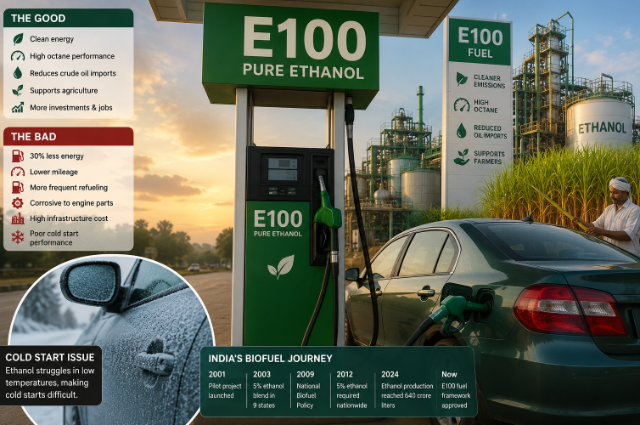
In 2001, India began a pilot project to blend ethanol with gasoline, aiming to boost agricultural sector production while reducing the environmental impact of most fuels. After successful trials, the government launched the Ethanol Blended Platform program in 2003, requiring a 5% ethanol blend in petrol across 9 states and 4 union territories.
In 2009, the National Biofuel Policy was enacted, setting an ambitious target of a 20% blend in all petrol by 2017. Oil Marketing Companies (OMCs) would be required to manage the blending process. In 2010, temporary procurement measures were implemented by the government to manage ethanol prices.
By 2012, the Cabinet Committee on Economic Affairs mandated a nationwide requirement for a 5% ethanol blend.
As a result, India's ethanol production surged from 38.2 crore litres in 2014 to 640 crore litres in 2024. By and large, the process has so far been successful. The recent switch to ethanol has, for a good turn, reduced India's dependence on crude oil imports, allowing it more of a sense of economic independence from the world.
And with oil prices fluctuating due to the perilous situation in the Middle East and other oil-producing countries, this is quite an important consideration.
But to consider something is not to consider only the advantages.
The challenges must also be viewed.
The Challenges
The idea is that ethanol fuel produces cleaner emissions and a high octane rating. This makes it resistant to engine knocking and ideal for delivering high performance in specially tuned engines. The decreased reliance on imported crude also allows India a sense of economic sovereignty.
The problem is when policies are enacted, enforced and required without much thought of the disadvantages of a certain product.
Ethanol contains about 30% less energy per litre. Users will generally experience 20-30% lower mileage and require much more frequent refuelling. This can be a hassle and a problem for those going through long trips throughout the country, finding themselves needing to stop by and refuel at a time they did not expect.
Pure ethanol is also highly corrosive.
It naturally absorbs water, and using it in standard petrol engines can rapidly degrade fuel lines, pumps, injectors and gaskets. The opportunity for automotive companies to invest in developing for this niche is a double-edged sword.
Because it is not compatible with existing cars (in the sense that standard petrol vehicles cannot run on E100), it requires dedicated or modified internal combustion engines and fuel systems resistant to corrosion. This can be a hassle and an added expense for many consumers.
The incentive may not be there for business owners either.
Automakers will have to replace zinc-coated fuel tanks with HDPE or stainless steel and standard engine valves with hardened cobalt alloys to prevent friction. And with a car that runs 30% less powerful than a petrol-based one, automakers will have to think smartly - invest in a new technology that is eco-friendly and allows economic sovereignty that people feel apathetic to procuring or invest in what is standard, more profitable and more common?
Widespread adoption faces heavy infrastructure hurdles too.
The move to E100 will require fuel stations to install specialised, leak-proof storage and dispensing systems. It is quite an investment for a fuel that runs 30% less powerful than its petrol counterpart, and the significant drop in vehicle mileage may turn customers off.
Ethanol, because of its latent heat of vaporisation and low vapour pressure, may also struggle to run on cold winter mornings. Because the fuel doesn't vaporise properly, it fails to form a combustible air-fuel mixture. Instead, the liquid ethanol simply coats the spark plugs (often referred to as "wetting" the plug) and cylinder walls, preventing combustion.
That is an important consideration, especially in much colder places. And to note, it may seem that India’s government has to consider things more carefully before implementing something this massive.
References:
- https://www.thehindubusinessline.com
- https://en.wikipedia.org
- https://www.sciencedirect.com
- https://www.ndtv.com