
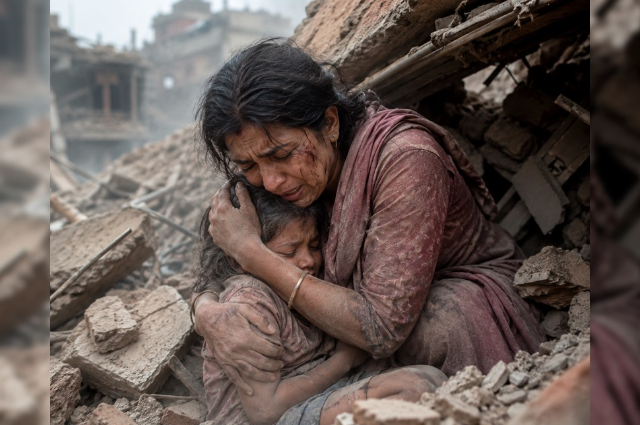
The Climate Crisis is not Gender-Neutral
Case Study 1: The 2004 Indian Ocean Tsunami
On December 26, 2004, a 9.1-magnitude earthquake off the coast of Sumatra caused several tsunami waves, affecting fourteen countries of the Indian Ocean. Indonesia, Sri Lanka, India, and Thailand had the most significant devastation. Coastal areas of these countries were destroyed.
However, the most deadly pattern was not where the waves hit but who died.
70% of those killed in the affected areas were women and girls. It was not a coincidence. Women in Aceh, Indonesia, were doing laundry or preparing food at home. Men were fishing at the sea. Women waited for their husbands, kids, parents, and neighbours to return. Men were more mobile and could afford to run away from the threat.
When the wave came, women stayed there to protect their families. When the wave receded, they drowned.
That is the first evidence. This is the first proof of the inequality. It proves that survival opportunities are unevenly distributed among people. And it is distributed in a very predictable way. **The most marginalised suffer the most.
Global Pattern of Gender-Based Climate Deaths
Case Study 2: Disaster Mortality Figures All Over the World
The tsunami was not an isolated phenomenon. It was a symptom of a larger pattern.
All over the world, women die during climate change-related events 14 times more frequently than men. 90% of the almost 140,000 people who perished in the 1991 cyclone in Bangladesh were female. In the 2003 heatwave in Europe, more women died than men. During the 2010 earthquake in Haiti, women died more frequently since they were at home with their children.
This pattern remains stable. Climate change does not discriminate. Human societies do it. The vulnerability is not biological. It is social.
80% of people forced to leave their homes because of the consequences of climate change are women and girls.
The reason is not biology. Women have fewer opportunities for self-protection. They are not informed on time. They cannot move away from the danger zone. They take responsibility for the kids and the old people. They are left out of decisions.
Economic Costs: Climate Change Forces Women into Poverty
Case Study 3: The Poverty Projection by 2050
By 2050, 158 million additional women and girls would be forced into poverty, sixteen million more than men and boys.
This is a projection, but it is based on the real lives of women. Women are more dependent on natural resources for their survival. They are affected by water shortages, crop failures, and deforestation.
When the climate changes, women lose their income, food, and future. And they are the last to be saved and the first to be forgotten.
India: The Country Experiencing the Worst Part of the Crisis
Case Study 4: The Problem of Indian Women Farmers
In India, the climate crisis is already there. Two-thirds of agricultural workers in India are women. They cultivate, weed, harvest, and process food for the country. However, they own only 11% of agricultural lands. They earn 22% less than men performing identical tasks. They do not have access to credit, insurance, or governmental assistance.
During the drought, women walk longer distances to find water. During the crop failures, women go hungry before anyone else. During the drought, women work more and eat less.
Who made the policies? Who makes decisions on adaptation to the climate crisis? Not the women cultivating the food. It is the men sitting in their air-conditioned offices who have never been in the paddy fields.
The Climate Crisis in 2024: Real-Time Case Study
Case Study 5: The Extremely Hot Summer of 2024
In 2024, India experienced one of the hottest summers ever recorded. Temperatures went sky-high. The taps ran dry. The hospitals were overloaded with heatstroke patients.
Almost 70% of women reported health issues because of the heat. Over 50% of women had disruption of their menstrual cycle and reproductive function. Almost two-thirds of women had irritability, anxiety, and sleep problems.
One of four women did not turn to the doctors. The reason? Frontline healthcare workers were not prepared to deal with the specific problems of women.
The summer was not only hot. It was a gendered crisis.
In households where indoor temperatures at nighttime exceeded 40°C, the rate of domestic violence rose by 72%*** in families where domestic violence was common. Financial stress. Overcrowdedness. Heat. What are the triggers? But the trigger is the social system that allows and silences violence.
Unpaid Care Work of Women
Case Study 6: The Time Spent by Women on Unpaid Activities
Women spend approximately 60% of their time on unpaid activities. These are collecting water, cooking, cleaning, and caring for children and the elderly.
If climate change occurs, this figure increases.
During the drought, women walk longer distances to get water. During the floods, women stay in danger zones because of their responsibilities. During the heatwaves, women working in agriculture and street vending suffer without cooling shelters, water, or breaks.
Climate change adds 90 minutes to the daily time of unpaid work of Indian women.
Ninety minutes of work performed but never paid, never counted, never appreciated, except by the women themselves.
The Root Cause: Patriarchy
Case Study 7: Research Proving the Role of Patriarchy in Environmental Destruction
But why does climate change have gendered impacts? That is the difficult question to answer.
It starts with who is burning fossil fuels. It starts with who is profiting from them. It starts with who refuses to stop.
In 2024, scientists publishing in the npj Biodiversity journal found that "patriarchal norms and structures, which promote male supremacy and inequality, are the root causes of environmental destruction."
"Patriarchal norms and structures, existing in conservation, should be questioned and dismantled to make conservation effective and just," the authors state.
This conclusion is made by numerous organisations, from the UN to the World Bank.
The patriarchal dominance culture provides a power hierarchy that prefers short-term profits and exploitation. It results in environmental destruction and social inequalities.
Evidence from Different Parts of the World
Case Study 8: Gender and Environment Survey in Cambodia
In Cambodia, men are more likely to use pesticides, resulting in soil degradation and increasing the amount of carbon emissions.
Women are more likely to use sustainable methods of managing forests. They are spending more time on ecological care labour using complex silviculture practices.
The same pattern is everywhere. The same mentality that causes environmental destruction leads to the subordination of women, the exploitation of nature, and the domination of profit-based ideology. This mentality prioritises domination over collaboration, short-term profit over sustainability.
Petro-Masculinity: Climate Change and Gender Violence
Case Study 9: The Concept of Petro-Masculinity
Political scientist Cara Daggett coined the term "petro-masculinity" to define the concept of the unity of fossil fuel politics and anti-feminist politics.
Petro-masculinity is a connection between men's identities and fossil fuels. It includes the 'breadwinner' function of men, the nostalgic attitude to the fossil fuel technologies like cars, trucks, and oil rigs.
Environmental protection is feminised and hence fragile. Climate change denial becomes an expression of masculine strength: no man is going to admit his vulnerability or the need for change.
The same dynamics are visible in India. There is a glorification of coal and oil. There is a denial of renewable energy sources as "impractical." There is discrimination against women who fight for environmental rights.
In India, environmental protection is considered a luxury of the rich, not a necessity for common people.
Resistance of Men: Gender and Climate Change
Case Study 10: Research on the Relations between Masculinity and Climate Change Attitude
Indeed, the data confirms the predictions of ecofeminist theories: men have a lower degree of environmentalism than women.
Once, it was attributed to the personalities of people. Now the research shows an ideological aspect of this difference. The acceptance of hegemonic masculinity, the aggressive form of masculinity, is linked to anti-environmentalism.
The men opposing the measures to fight climate change are the same who are opposing gender equality. They are fighting for the system they believe benefits them.
But This Is Not the Story of Bad Men
But it would be a wrong idea to think this is a story of bad men and good women.
Men are also limited by patriarchy. They are taught from childhood that vulnerability is a sign of weakness, that caring is something feminine, and that concern about the environment is not 'manly.'
The same patriarchy, which discriminates against women, also binds men. It forces men to live in a narrow circle of emotional repression and permanent proving of manhood.
It does not excuse anything. But it explains things. Patriarchy is a prison for all of us.
Agents of Change: Women Fighting for Them
Case Study 11: Women-Led Climate Adaptation in Odisha
Despite the oppression, women are fighting back.
In Odisha, women farmers are implementing climate-resistant agriculture. They develop drought-resistant crops and diversify their livelihoods. If the harvest is poor, it is women who find solutions. Studies show the direct contribution of women's empowerment in agriculture to improved nutrition.
All around India, women are organising movements for environmental justice. They are protesting against coal mines. They are protecting forests. They are asking for clean water.
They are organising on the grassroots level because the national-level policy fails them.
But they remain underrepresented in decision-making. Climate change policies not considering gender differences could exacerbate inequalities. Women at the forefront of climate change, especially Indigenous and rural women, should be a part of the decision-making process.
What Must Be Done
There are simple actions, but politically inconvenient.
First, acknowledge climate change as a gender issue. Collect the data disaggregated by gender and use it when making policies. The UN's Gender Equality and Climate Action Scorecard assesses how each country addresses the gender-based impact of climate change. India should follow this example.
Second, challenge the patriarchal norms in conservation and climate change policies. Who decides? Who knows? Who benefits? The representation alone is not enough. Participation in decision-making is needed.
Third, empower women. This concerns women in agriculture, renewable energy, and climate change adaptation. They should be represented in disaster-preparedness committees. Special funds should be created for education regarding sustainable agriculture practised by women.
Fourth, fight petro-masculinity. Social norms that teach boys to dominate and not to care about the environment should be changed. This starts in schools with curriculum reform.
Conclusion: The Same Battle
But it does not mean the battle against men. This is a fight against the system hurting everyone. Stereotypes produced by patriarchy: that a man should be tough, unfeeling, domineering; that a woman should be nurturing, passive, submissive, are the structural barriers to fighting climate change.
These stereotypes prevent men from adopting sustainable behaviour. They prevent women from leadership. They prevent all of us from seeing the crisis as it is.
Their dismantling is not an act of violence against masculinity. It is an invitation to a new kind of strength. To the strength which is protective instead of exploitative.
The climate crisis is a moral problem. It is the problem of values, of power, and of our choice.
Gender inequality and climate change are not two separate issues. They are the same problem.
As actor and activist Dia Mirza said, "Climate change and patriarchy are deeply connected. Both emerge from systems that value extraction over care, domination over balance, and short-term gain over long-term well-being."
The battle for climate justice is the battle for gender justice. One cannot be achieved without the other.
The people of India may keep moving down the road of extraction, exploitation, and inequality. Or they can choose a different one. The road where women and men work together, where nature is respected, and where the future is not sacrificed for the present.
It is time to make a choice.