
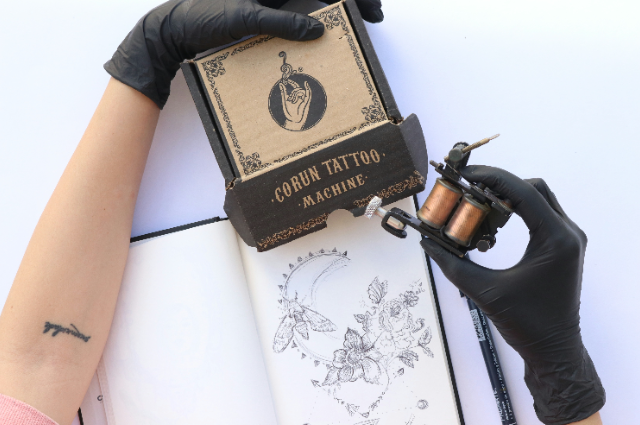
Some of the world's most famous inventions require decades of highly specialised laboratory research. Others happen simply because someone looks at a totally ordinary, everyday object and visualises a completely different way to use it. The modern electric tattoo machine is a classic example of this second path.
Back in 1891, an Irish-American tattoo artist named Samuel O’Reilly changed the trajectory of the art world forever. He did not build a new device from scratch. Instead, he took an abandoned, failed office tool designed by Thomas Edison and cleverly modified it into the world's very first electric tattoo machine.
The Gruelling Era of Manual Tattooing
To really appreciate why O’Reilly’s invention changed everything, you have to understand how difficult and exhausting tattooing was in the late 19th century. Before electricity entered the picture, professional artists in Western society had to rely entirely on manual, hand-poke methods. These old-school techniques used standard needles tied to basic wooden handles or pieces of bone.
Artists had to manually poke the skin at a slow rate of just two or three punctures every single second. Because the human hand naturally gets tired, maintaining a perfectly uniform depth over a long period was nearly impossible. As a result, line work was often shaky and uneven. The whole process was agonisingly slow. It demanded an immense amount of patience from the artist and a brutal level of pain tolerance from the client. A medium-sized tattoo that takes about an hour today would require several painful, multi-hour sessions back then. This massive physical barrier kept tattooing as a small, expensive subculture. It was mostly restricted to sailors, circus performers, and societal outlaws who had the grit to sit through the pain.
Thomas Edison’s Failed Office Tool
In 1876, Thomas Edison patented a brand-new device called the "electric pen." He certainly was not thinking about body art when he made it. He designed it to help busy corporate offices make quick copies of documents like contracts, insurance forms, and letters.
The electric pen featured a primitive, quite heavy electric motor mounted right on top of a handheld rod. This motor drove a tiny internal needle up and down at a very fast pace. When an office clerk wrote normally across a page with the pen, the rapidly moving needle punched roughly 50 tiny holes every second into a special sheet of waxed paper. This process turned the paper into a reusable stencil. The clerk would then place this hole-punched stencil over a blank sheet of paper and use an ink roller to force ink through the tiny holes, printing an exact duplicate.
Even though the engineering was incredibly clever, the electric pen was a massive commercial failure. The device was incredibly top-heavy. This design flaw made it clumsy and tiring to hold during a long workday. It was also highly expensive, loud, and required messy, leaky chemical batteries to run. Typewriters quickly advanced around the same time and completely wiped out Edison’s invention. This left thousands of these electric pens sitting forgotten in dark storage rooms and pawnshops across New York.
Samuel O’Reilly’s Flash of Inspiration
By 1890, Samuel O'Reilly was running a highly successful tattoo parlour in the busy Bowery district of New York City. The Bowery was the absolute epicentre of working-class entertainment at the time, packed with dime museums, crowded saloons, and sailors looking for permanent souvenirs from their travels. O'Reilly was constantly looking for a way to speed up his workflow so he could keep pace with the massive demand of the port city.
When O'Reilly ran across a discarded Edison electric pen, he had a massive flash of inspiration. He realised that a mechanical motor strong enough to pierce heavy stencil paper 50 times a second could easily pierce human skin to drop ink.
However, Edison's pen was not safe to use on human skin straight out of the box. O'Reilly had to use his practical knowledge of the trade to make three major engineering upgrades to turn the office tool into a safe, artistic device:
- The Ink Reservoir: Edison's pen required a separate ink roller after the holes were made. O'Reilly attached a small metal tube reservoir right above the needle to hold liquid ink, letting it flow down the needle continuously via capillary action.
- The Tube Guide: He added a hollow needle guide tube. This kept the artist's fingers safe from the moving parts and allowed the creator to control exactly how deep the needles went into the dermis layer of the skin.
- Multiple-Needle Assemblies: Edison’s pen used just a single sharp point. O'Reilly modified the main drive bar so it could hold clusters of multiple needles at the same time, allowing artists to transition easily from thin lines to heavy shading.
On December 8, 1891, O’Reilly received U.S. Patent No. 464,801 for his new invention.
A Permanent Revolution
The impact on the art world was immediate. The electric machine could puncture skin 50 times per second, completely blowing past the speed of traditional hand tattooing. Tattoos could suddenly be finished in a fraction of the time, with much cleaner lines and far less pain for the customer.
Over the years, a popular urban myth surfaced claiming that a furious Thomas Edison sued O'Reilly for intellectual property theft. Historical court and patent records show that this rumour is completely false. Edison showed zero interest in the tattoo industry, and O'Reilly’s patent was legally safe because his major modifications completely transformed the fundamental purpose and utility of the original technology.
Today, modern tattoo machines are lighter, quieter, and safer, but they still rely on the exact same mechanical principles that O’Reilly put together over 130 years ago. It goes to show that innovation is not always about inventing something out of thin air. Sometimes, it just takes one creative person to look at an old piece of office equipment and see an artistic breakthrough.
References:
- Thomas A. Edison, U.S. Patent No. 180,857, "Improvement in Autographic Printing," August 8, 1876. You can view the history via the Smithsonian Institution.
- Samuel F. O'Reilly, U.S. Patent No. 464,801, "Tattooing-Machine," December 8, 189.
. . .