
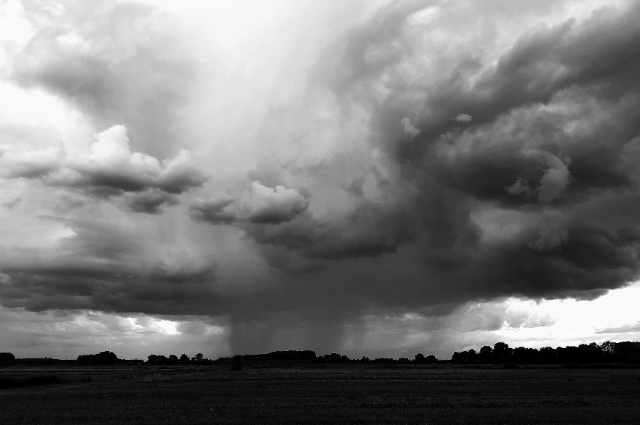
Imagine standing in an open field under a bruising, violet sky. The wind turns sharp, smelling of ozone and wet earth. A blinding crack of lightning tears through the dark, followed instantly by a chest-rattling boom of thunder. Most see a hazard; others see a spectacular show. But hidden within that flash of electricity is a life-giving miracle—one that has been quietly nourishing the planet for billions of years.
Long before humans cleared the first fields, before civilisations engineered irrigation, and before chemical factories began mass-producing fertiliser, the sky was already farming the earth.
Every single thunderstorm is actually a vast, ancient planetary engine designed to unlock the soil's true potential.
The Molecular Prison of Air
To understand the genius of a thunderstorm, you must understand the tragedy of the plant world.
Plants are desperate for nitrogen. It is the core building block of chlorophyll—the green engine that captures sunlight to fuel photosynthesis. It dictates the strength of a stalk, the spread of a leaf, and the yield of a crop. Without it, flora turns a sickly yellow, stunts, and dies.
Here lies nature's cruellest paradox: plants are drowning in nitrogen they cannot breathe.
Nearly 78 per cent of Earth’s atmosphere is pure nitrogen gas. However, these atmospheric nitrogen atoms are locked in a chemical death-grip. They are bound by a triple covalent bond—one of the strongest, most stubborn molecular bonds in the universe. For a blade of grass or a towering oak, this abundant nitrogen is entirely out of reach. It is an invisible feast behind an unbreakable glass wall.
Nature needed a hammer heavy enough to shatter that molecular glass. It found it in the lightning bolt.
The Earth’s Ancient Co-Conspirators
For millions of centuries, this high-voltage alchemy sustained the wild landscapes of the prehistoric world. The great p forests of the Carboniferous period and the endless grasslands of the Miocene didn't have human hands to tend them. They relied on a tag-team system of sky and dirt.
While lightning acted as the dramatic, sudden supplier of nitrogen, it shared the workload with a quieter hero: microscopic bacteria.
Deep within the soil, and nestled in the root nodules of ancient legumes like wild peas and clover, symbiotic microbes worked continuously. They used slow biochemical processes to quietly harvest atmospheric gas, complementing the lightning's violent bursts. Together, the bolt and the bacterium formed an elegant, self-sustaining partnership that kept the planet green for eons.
The Modern Threat: Out-Farming Nature
For millennia, human agriculture respected this balance. We used crop rotation, composted organic waste, and planted cover crops to mimic the soil's natural rhythm. But as the human population exploded in the 19th century, nature's slow-cooked menu could no longer keep pace with our hunger.
In the early 20th century, German scientists developed the Haber-Bosch process. This industrial breakthrough effectively cloned the power of a lightning bolt inside a factory, using immense pressure and fossil fuels to force atmospheric nitrogen into synthetic ammonia.
Today, synthetic fertilizers sustain nearly half of the global population. Without them, billions would starve. Yet, our industrial shortcut has broken the loop.
Unlike the clean, metered dosage of a thunderstorm, millions of tons of synthetic fertilizers overwhelm the earth. The excess washes out of our fields and into our waterways, triggering catastrophic algal blooms that choke the oxygen out of oceans and lakes, creating aquatic "dead zones." Furthermore, it evaporates into nitrous oxide—a greenhouse gas nearly 300 times more potent at trapping heat than carbon dioxide.
The Poetry of the Storm
Statistically, lightning is a minority contributor to the global nitrogen budget, yielding only a fraction of what microbes produce. But symbolically and ecologically, it remains irreplaceable.
It serves as a stark, electrifying reminder that our planet is a single, interconnected organism. A thunderstorm is not a chaotic meteorological malfunction; it is a calculated act of planetary recycling. It proves that in the grand design of the cosmos, even the most terrifying and destructive forces can carry the seeds of life.
The next time you retreat indoors to escape a rumbling sky, look out the window at the flashing horizon. You aren't just witnessing a storm. You are watching the atmosphere break its own chains, raining down its ancient, glowing inheritance to feed the world beneath your feet
References:
- The Nitrogen Cycle: An Interdisciplinary Approach, Academic Press.
- Enriching the Earth: Fritz Haber, Carl Bosch, and the Transformation of World Food Production by Vaclav Smil.
- Global Nitrogen Cycle and Environmental Impacts, Environmental Protection Agency (EPA) reports on fertiliser run-off, aquatic dead zones, and nitrous oxide emissions.
- The Rhizosphere and Nitrogen-Fixing Bacteria, Nature Education.